Thank you for visiting SNEWPapers!
Sign up free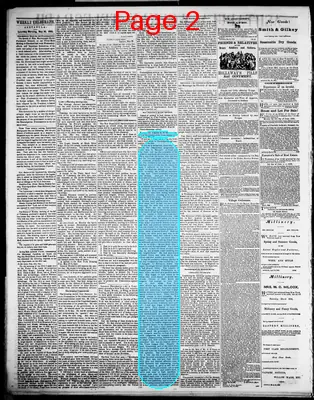
Ashtabula Weekly Telegraph
Ashtabula, Ashtabula County, Ohio
What is this article about?
Extract from Rev. Dr. Bellows' speech at Union League Club opening in New York on May 12, detailing Missouri border atrocities against Unionists, personal vendettas, and the need for loyal associations like the club for defense and solidarity amid Civil War threats.
Clipping

OCR Quality
Full Text
"If you see a head, hit it." was the Irishman's instruction to his inexperienced companion at the fair.
"If you see a butter-nut, shoot him." has become the compendious programme of Union men in Missouri! A friend just from there told me that a member of the legislature had lately described an interview with a man from the border, who told him that his own case might serve to illustrate the condition of society in his region. "I had five brothers-in-law, and every one of them had sworn to take my life, simply because I adhered to the Union. They sought to shoot me through my own windows, to waylay me, to kill me anywhere or anyhow. I have succeeded in slaying three of them. Shall not feel that my life is safe till I have killed the other two."
A boy of sixteen, concealed in a Union house, saw his own mother taken out and shot before her own door, in wantonness, by an infernal guerrilla crew. He went out the moment the assassins had fled to pick up her lifeless form; counted the wounds—there were nine—and having buried his mother, instantly, stripling as he was, enlisted in the Union army. He had already made sure of the slaughter of seven rebels by his own hand, and he swore he would never cease until he had two more rebel lives—one for each shot in his mother's body! These are the terrible passions which the malignity of the foe has aroused in the hearts of our brethren on the border! Do you wonder at them? Is it not absolutely essential to self-preservation that they should adopt the policy, nay let me rather say yield to the passion of extermination under such furious hatred as our enemy feels and practices towards them?—Can you wonder that they form solemn leagues and covenants of common defence, and swear oaths of mutual fidelity? Said one of them—an ultra peace man who, in the worst Kansas times, had refused to wear secret weapons: Do you know what it means"—and his face, said my friend whom he addressed, glared with a terrible earnestness as he spoke—“do you know what it means to swear by inspiration? For I have so sworn to have the blood of every rebel that on any pretense comes sneaking into my neighborhood." He had seen dozens of honest Union men taken out by these villains and shot without provocation.
It was the possibility of scenes like this in our own communities that started the Loyal Leagues. In Baltimore, where they began, the danger was not merely imminent, it had already fallen. The invasion of Pennsylvania aroused Philadelphia to a sense of her own peril as a possible border city. Men began to look round to see whom they could depend on should men, already traitors in their hearts and tongues, find courage to turn traitors in their deeds. New York three months ago, when this club had its inception, did not know, from party appearances and animosities, how soon it might become necessary here to compel every man openly to show his hand. There was blustering treason in every assembly. How soon a fearful trial of strength might arise between the unconditional loyalty of the city and its partisan treachery, none could tell. Loyal men began to feel round for their peers. They wanted to know who was who, and they determined to form an association in which men not afraid openly and unconditionally to commit themselves should enter into solemn covenant to stand by each other in any and every moment of danger to the country and the cause; to fly to council in the sudden exigencies possible in the dark future; to lay shoulder against shoulder and form a trusty phalanx when social or commercial whiffiers and cowards should assail the government or threaten our domestic security; to frown down with solid indignation the sympathy of a light-minded, pleasure-loving, fashion-led crowd of vulgar rich, with southern interests and principles! this was the original object of this Union League Club. Happily, the most threatening part of the cloud whose fury it was erected to draw off, has already dispersed under the wholesome wind of popular agitation. But how much remains for a club like this to accomplish in purifying the social atmosphere of this metropolis! Here men who love their country with pure and devoted affection—men of solid character and undeviating loyalty, without regard to party or sect, but only men tried, known and trusted—are to come together to confirm each other's faith, to nerve each other to fresh sacrifices, to counsel each other in times of doubt, and to uphold each other in hours of calamity, to meet every disaster with fresh reserves of hope and confidence, and to resolve, after every postponement and vexatious delay, on a new patience, and a longer persistence.
What sub-type of article is it?
What themes does it cover?
What keywords are associated?
What entities or persons were involved?
Where did it happen?
Story Details
Key Persons
Location
Missouri Border, New York, Baltimore, Philadelphia, Pennsylvania
Event Date
May 12
Story Details
Rev. Dr. Bellows recounts brutal guerrilla violence against Union men in Missouri, including a man's killing of three brothers-in-law who threatened him and a boy's revenge after his mother's shooting, justifying Union leagues for self-preservation and describing the formation of the Union League Club in New York for loyal mutual defense.