Thank you for visiting SNEWPapers!
Sign up free
Editorial
April 25, 1843
Indiana State Sentinel
Indianapolis, Marion County, Indiana
What is this article about?
Editorial rebuts Indiana Journal's Whig arguments supporting British high tariffs, exposes factual misrepresentations on duties, defends Democratic policy to reform tariffs and Corn Laws for better export markets for Indiana farmers' products.
Clipping
OCR Quality
98%
Excellent
Full Text
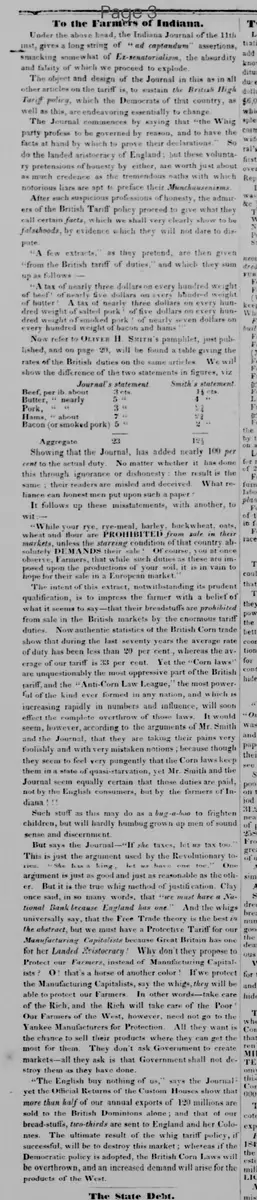
To the Farmers of Indiana.
Under the above head, the Indiana Journal of the 11th inst., gives a long string of 'ad captandum' assertions, smacking somewhat of Ex-senatorialism. The absurdity and falsity of which we proceed to explode.
The object and design of the Journal in thus as in all other articles on the tariff is, to sustain the British High Tariff policy, which the Democrats of that country, as well as this, are endeavoring essentially to change.
The Journal commences by saying that 'the Whig party profess to be governed by reason, and to have the facts at hand by which to prove their declarations.' So do the landed aristocracy of England, but these voluntary pretensions of honesty by either, are worth just about as much credence as the tremendous oaths with which notorious liars are apt to preface their Munchausenisms.
After such suspicious professions of honesty, the admirers of the British Tariff policy proceed to give what they call certain facts, which we shall very clearly show to be falsehoods, by evidence of which they will not dare to dispute.
'A few extracts,' as they pretend, are then given 'from the British tariff of duties,' and which they sum up as follows:
'A tax of nearly three dollars on every hundred weight of beef; of nearly five dollars on every hundred weight of butter; A tax of nearly three dollars on every hundred weight of salted pork; of five dollars on every hundred weight of smoked pork; of nearly seven dollars on every hundred weight of bacon and hams.'
Now refer to Oliver H. Smith's pamphlet, just published, and on page 20, will be found a table giving the rates of the British duties on the same articles. We will show the difference of the two statements in figures, viz:
Aggregate 23 121
Showing that the Journal has added nearly 100 per cent to the actual duty. No matter whether it has done this through ignorance or dishonesty: the result is the same; their readers are misled and deceived. What reliance can honest men put upon such a paper?
It follows up these misstatements, with another, to wit:
'While your rye, rye-meal, barley, buckwheat, oats, wheat and flour are PROHIBITED from sale in their markets, unless the starving condition of that country absolutely DEMANDS their sale.' Of course, you at once observe, Farmers, that while such duties as these are imposed upon the productions of your soil, it is in vain to hope for their sale in a European market.'
The intent of this extract, notwithstanding its prudent qualification, is to impress the farmer with a belief of what it seems to say—that their breadstuffs are prohibited from sale in the British markets by the enormous tariff duties. Now authentic statistics of the British Corn trade show that during the last seventy years the average rate of duty has been less than 20 per cent, whereas the average of our tariff is 33 per cent. Yet the 'Corn laws' are unquestionably the most oppressive part of the British tariff, and the 'Anti-Corn Law League,' the most powerful of the kind ever formed in any nation, and which is increasing rapidly in numbers and influence, will soon effect the complete overthrow of those laws. It would seem, however, according to the arguments of Mr. Smith and the Journal, that they are taking their pains very foolishly and with very mistaken notions; because though they seem to feel very pungently that the Corn laws keep them in a state of quasi-starvation, yet Mr. Smith and the Journal seem equally certain that those duties are paid, not by the English consumers, but by the farmers of Indiana!!!
Such stuff as this may do as a bug-a-boo to frighten children, but will hardly humbug grown up men of sound sense and discernment.
But says the Journal—'If she taxes, let us tax too.' This is just the argument used by the Revolutionary Tories. 'She has a king, let us have one too.' One argument is just as good and just as reasonable as the other. But it is the true whig method of justification. Clay once said, in so many words, that 'we must have a National Bank because England has one.' And the whigs universally say, that the Free Trade theory is the best in the abstract, but we must have a Protective Tariff for our Manufacturing Capitalists because Great Britain has one for her Landed Aristocracy! Why don't they propose to Protect our Farmers, instead of Manufacturing Capitalists? O' that's a horse of another color! If we protect the Manufacturing Capitalists, say the whigs, they will be able to protect our Farmers. In other words—take care of the Rich, and the Rich will take care of the Poor.
Our Farmers of the West, however, need not go to the Yankee Manufacturers for Protection. All they want is the chance to sell their products where they can get the most for them. They don't ask Government to create markets—all they ask is that Government shall not destroy them as they have done.
'The English buy nothing of us,' says the Journal; yet the Official Returns of the Custom Houses show that more than half of our annual exports of 120 millions are sold to the British Dominions alone: and that of our bread-stuffs, two-thirds are sent to England and her Colonies. The ultimate result of the whig tariff policy, if successful, will be to destroy this market; whereas if the Democratic policy is adopted, the British Corn Laws will be overthrown, and an increased demand will arise for the products of the West.
Under the above head, the Indiana Journal of the 11th inst., gives a long string of 'ad captandum' assertions, smacking somewhat of Ex-senatorialism. The absurdity and falsity of which we proceed to explode.
The object and design of the Journal in thus as in all other articles on the tariff is, to sustain the British High Tariff policy, which the Democrats of that country, as well as this, are endeavoring essentially to change.
The Journal commences by saying that 'the Whig party profess to be governed by reason, and to have the facts at hand by which to prove their declarations.' So do the landed aristocracy of England, but these voluntary pretensions of honesty by either, are worth just about as much credence as the tremendous oaths with which notorious liars are apt to preface their Munchausenisms.
After such suspicious professions of honesty, the admirers of the British Tariff policy proceed to give what they call certain facts, which we shall very clearly show to be falsehoods, by evidence of which they will not dare to dispute.
'A few extracts,' as they pretend, are then given 'from the British tariff of duties,' and which they sum up as follows:
'A tax of nearly three dollars on every hundred weight of beef; of nearly five dollars on every hundred weight of butter; A tax of nearly three dollars on every hundred weight of salted pork; of five dollars on every hundred weight of smoked pork; of nearly seven dollars on every hundred weight of bacon and hams.'
Now refer to Oliver H. Smith's pamphlet, just published, and on page 20, will be found a table giving the rates of the British duties on the same articles. We will show the difference of the two statements in figures, viz:
Aggregate 23 121
Showing that the Journal has added nearly 100 per cent to the actual duty. No matter whether it has done this through ignorance or dishonesty: the result is the same; their readers are misled and deceived. What reliance can honest men put upon such a paper?
It follows up these misstatements, with another, to wit:
'While your rye, rye-meal, barley, buckwheat, oats, wheat and flour are PROHIBITED from sale in their markets, unless the starving condition of that country absolutely DEMANDS their sale.' Of course, you at once observe, Farmers, that while such duties as these are imposed upon the productions of your soil, it is in vain to hope for their sale in a European market.'
The intent of this extract, notwithstanding its prudent qualification, is to impress the farmer with a belief of what it seems to say—that their breadstuffs are prohibited from sale in the British markets by the enormous tariff duties. Now authentic statistics of the British Corn trade show that during the last seventy years the average rate of duty has been less than 20 per cent, whereas the average of our tariff is 33 per cent. Yet the 'Corn laws' are unquestionably the most oppressive part of the British tariff, and the 'Anti-Corn Law League,' the most powerful of the kind ever formed in any nation, and which is increasing rapidly in numbers and influence, will soon effect the complete overthrow of those laws. It would seem, however, according to the arguments of Mr. Smith and the Journal, that they are taking their pains very foolishly and with very mistaken notions; because though they seem to feel very pungently that the Corn laws keep them in a state of quasi-starvation, yet Mr. Smith and the Journal seem equally certain that those duties are paid, not by the English consumers, but by the farmers of Indiana!!!
Such stuff as this may do as a bug-a-boo to frighten children, but will hardly humbug grown up men of sound sense and discernment.
But says the Journal—'If she taxes, let us tax too.' This is just the argument used by the Revolutionary Tories. 'She has a king, let us have one too.' One argument is just as good and just as reasonable as the other. But it is the true whig method of justification. Clay once said, in so many words, that 'we must have a National Bank because England has one.' And the whigs universally say, that the Free Trade theory is the best in the abstract, but we must have a Protective Tariff for our Manufacturing Capitalists because Great Britain has one for her Landed Aristocracy! Why don't they propose to Protect our Farmers, instead of Manufacturing Capitalists? O' that's a horse of another color! If we protect the Manufacturing Capitalists, say the whigs, they will be able to protect our Farmers. In other words—take care of the Rich, and the Rich will take care of the Poor.
Our Farmers of the West, however, need not go to the Yankee Manufacturers for Protection. All they want is the chance to sell their products where they can get the most for them. They don't ask Government to create markets—all they ask is that Government shall not destroy them as they have done.
'The English buy nothing of us,' says the Journal; yet the Official Returns of the Custom Houses show that more than half of our annual exports of 120 millions are sold to the British Dominions alone: and that of our bread-stuffs, two-thirds are sent to England and her Colonies. The ultimate result of the whig tariff policy, if successful, will be to destroy this market; whereas if the Democratic policy is adopted, the British Corn Laws will be overthrown, and an increased demand will arise for the products of the West.
What sub-type of article is it?
Economic Policy
Trade Or Commerce
Partisan Politics
What keywords are associated?
Tariff Policy
British Corn Laws
Protective Tariff
Whig Democrats
Farmers Markets
Free Trade
Export Duties
What entities or persons were involved?
Indiana Journal
Whig Party
Democrats
Oliver H. Smith
Henry Clay
Anti Corn Law League
British Landed Aristocracy
Editorial Details
Primary Topic
Rebuttal Of Whig Tariff Arguments Supporting British Policy
Stance / Tone
Anti Whig, Pro Democratic Free Trade
Key Figures
Indiana Journal
Whig Party
Democrats
Oliver H. Smith
Henry Clay
Anti Corn Law League
British Landed Aristocracy
Key Arguments
Journal Inflates British Duties On Beef, Butter, Pork By Nearly 100 Percent Compared To Smith's Pamphlet.
British Corn Duties Average Under 20 Percent Over 70 Years, Lower Than Us 33 Percent Tariff.
Anti Corn Law League Will Soon Repeal Oppressive Corn Laws.
Whig Policy Protects Manufacturers Like British Aristocracy, Not Farmers.
Us Exports Over Half To British Dominions, Two Thirds Breadstuffs To England And Colonies.
Democratic Policy Will Overthrow Corn Laws, Increasing Demand For Western Products.
Whigs Mimic British Systems, E.G., National Bank Because England Has One.
Farmers Need Open Markets, Not Government Destruction Via Tariffs.