Thank you for visiting SNEWPapers!
Sign up free
Atlanta Daily World
Atlanta, Fulton County, Georgia
What is this article about?
In 1955, U.S. sports fans expressed hostility towards losing coaches through effigy hangings. Columnist Marion E. Jackson argues success relies on talented players, not just coaching, citing anecdotes from coaches like O. Clemons, Jim Tatum, and Jake Gaither across various colleges.
Clipping
OCR Quality
Full Text
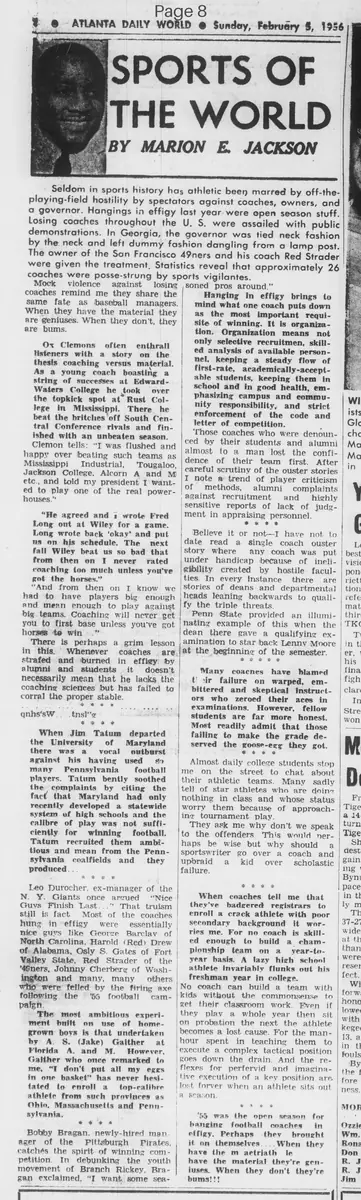
SPORTS OF THE WORLD
BY MARION E. JACKSON
Seldom in sports history has athletics been marred by off-the-playing-field hostility by spectators against coaches, owners, and a governor. Hangings in effigy last year were open season stuff. Losing coaches throughout the U. S. were assailed with public demonstrations. In Georgia, the governor was tied neck and neck and left dummy fashion dangling from a lamp post. The owner of the San Francisco 49ers and his coach Red Strader were given the treatment. Statistics reveal that approximately 26 coaches were post-strung by sports vigilantes.
Mock violence against losing coaches remind me they share the same fate as baseball managers. When they have the material they are geniuses. When they don't, they are bums.
O. Clemons often enthrall listeners with a story on the thesis coaching versus material. As a young coach boasting a string of successes at Edward Waters College he took over the head coach spot at Rust College in Mississippi. There he beat the britches off South Central Conference rivals and finished with an unbeaten season. Clemons tells: "I was flushed and happy over beating such teams as Mississippi Industrial, Tougaloo, Jackson College, Alcorn A and M etc., and told my president I wanted to play one of the real powerhouses."
"He agreed and I wrote Fred Long out at Wiley for a game. Long wrote back okay and put us on his schedule. The next fall Wiley beat us so bad that from then on I never rated coaching too much unless you've got the horses."
"And from then on I know we had to have players big enough and mean enough to play against big teams. Coaching will never get you to first base unless you've got horses to win."
There is perhaps a grim lesson in this. Whenever coaches are strafed and burned in effigy by alumni and students it doesn't necessarily mean that he lacks the coaching sciences but has failed to corral the proper stable.
When Jim Tatum departed the University of Maryland there was a vocal outburst against his having used so many Pennsylvania football players. Tatum gently soothed the complaints by citing the fact that Maryland had only recently developed a statewide system of high schools and the calibre of play was not sufficiently high for winning football. Tatum recruited them ambitious and mean from the Pennsylvania coalfields and they produced.
Leo Durocher, ex-manager of the N. Y. Giants once argued "Nice Guys Finish Last." That truism still is fact. Most of the coaches hung in effigy were essentially nice guys like George Barclay of North Carolina, Harold (Red) Drew of Alabama, Osly S. Gates of Fort Valley State, Red Strader of the 49ers, Johnny Cherberg of Washington and many, many others who were felled by the firing axe following the '55 football campaign.
The most ambitious experiment built on use of home-grown boys is that undertaken by A. S. (Jake) Gaither at Florida A. and M. However, Gaither who once remarked to me, "I don't put all my eggs in one basket" has never hesitated to enroll a top-calibre athlete from such provinces as Ohio, Massachusetts and Pennsylvania.
Bobby Bragan, newly-hired manager of the Pittsburgh Pirates, catches the spirit of winning competition. In debunking the youth movement of Branch Rickey, Bragan exclaimed, "I want some seasoned pros around."
Hanging in effigy brings to mind what one coach puts down as the most important requisite of winning. It is organization. Organization means not only selective recruitment, skilled analysis of available personnel, keeping a steady flow of first-rate, academically-acceptable students, keeping them in school and in good health, emphasizing campus and community responsibility, and strict enforcement of the code and letter of competition.
Those coaches who were denounced by their students and alumni almost to a man lost the confidence of their team first. After careful scrutiny of the ouster stories I note a trend of player criticism of methods, alumni complaints against recruitment and highly sensitive reports of lack of judgment in appraising personnel.
Believe it or not I have not to date read a single coach ouster story where any coach was put under handicap because of ineligibility created by hostile faculties. In every instance there are stories of deans and departmental heads leaning backwards to qualify the triple threats.
Penn State provided an illuminating example of this when the dean there gave a qualifying examination to star back Lenny Moore at the beginning of the semester.
Many coaches have blamed their failure on warped, embittered and skeptical instructors who zeroed their aces in examinations. However, fellow students are far more honest. Most readily admit that those failing to make the grade deserved the goose-egg they got.
Almost daily college students stop me on the street to chat about their athletic teams. Many sadly tell of star athletes who are doing nothing in class and whose status worry them because of approaching tournament play.
They ask me why don't we speak to the offenders. This would perhaps be wise but why should a sportswriter go over a coach and upbraid a kid over scholastic failure.
When coaches tell me that they've badgered registrars to enroll a crack athlete with poor secondary background it worries me. For no coach is skilled enough to build a championship team on a year-to-year basis. A lazy high school athlete invariably flunks out his freshman year in college.
No coach can build a team with kids without the commonsense to get their classroom work. Even if they play a whole year then sit on probation the next the athlete becomes a lost cause. For the man-hour spent in teaching them to execute a complex tactical position goes down the drain. And the reflexes for perfervid and imaginative execution of a key position are lost forever when an athlete sits out a season.
'55 was the open season for banging football coaches in effigy. Perhaps they brought it on themselves. When they have the material they're geniuses. When they don't they're bums!!!
What sub-type of article is it?
What themes does it cover?
What keywords are associated?
What entities or persons were involved?
Where did it happen?
Story Details
Key Persons
Location
United States (Various Colleges And Teams Including Georgia, Mississippi, Maryland, Florida A&M, Pennsylvania)
Event Date
1955 Football Season
Story Details
Columnist Marion E. Jackson reflects on 1955 fan hostility towards losing coaches, including effigy hangings of 26 coaches and a governor. Emphasizes that coaching success depends on player talent ('horses') rather than skill alone, illustrated by anecdotes: O. Clemons' unbeaten season at Rust College followed by defeat by powerhouse Wiley; Jim Tatum's recruitment from Pennsylvania for Maryland; Jake Gaither's balanced approach at Florida A&M. Critiques nice guys finishing last, stresses organization and recruitment over blaming faculty, and notes players' academic failures undermine teams.