Thank you for visiting SNEWPapers!
Sign up free
Story
September 26, 1857
Keowee Courier
Walhalla, Pickens, Oconee County, Pickens County, South Carolina
What is this article about?
Joseph Ridgeway, a former debtor from Baltimore in 1810, returns after 47 years to repay his old creditors double the amounts owed, despite legal discharge, showcasing remarkable honesty despite his ongoing poverty.
Clipping
OCR Quality
95%
Excellent
Full Text
A Queer Man—A letter in the Baltimore American gives the following account of a "rare bird:"
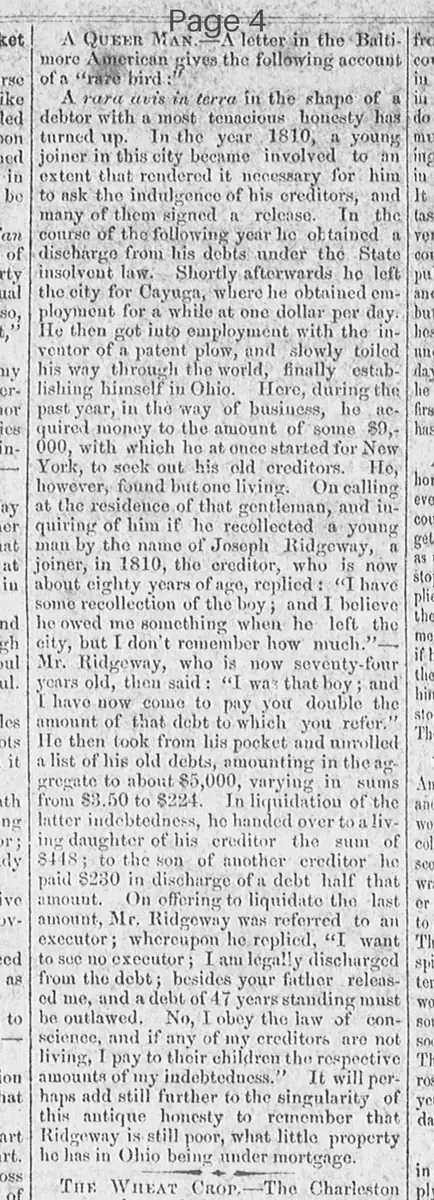
A rara avis in terra in the shape of a debtor with a most tenacious honesty has turned up. In the year 1810, a young joiner in this city became involved to an extent that rendered it necessary for him to ask the indulgence of his creditors, and many of them signed a release. In the course of the following year he obtained a discharge from his debts under the State insolvent law. Shortly afterwards he left the city for Cayuga, where he obtained employment for a while at one dollar per day. He then got into employment with the inventor of a patent plow, and slowly toiled his way through the world, finally establishing himself in Ohio. Here, during the past year, in the way of business, he acquired money to the amount of some $9,000, with which he at once started for New York, to seek out his old creditors. He, however, found but one living. On calling at the residence of that gentleman, and inquiring of him if he recollected a young man by the name of Joseph Ridgeway, a joiner, in 1810, the creditor, who is now about eighty years of age, replied: "I have some recollection of the boy; and I believe he owed me something when he left the city, but I don't remember how much." Mr. Ridgeway, who is now seventy-four years old, then said: "I was that boy; and I have now come to pay you double the amount of that debt to which you refer." He then took from his pocket and unrolled a list of his old debts, amounting in the aggregate to about $5,000, varying in sums from $3.50 to $224. In liquidation of the latter indebtedness, he handed over to a living daughter of his creditor the sum of $448; to the son of another creditor he paid $230 in discharge of a debt half that amount. On offering to liquidate the last amount, Mr. Ridgeway was referred to an executor; whereupon he replied, "I want to see no executor; I am legally discharged from the debt: besides your father released me, and a debt of 47 years standing must be outlawed. No, I obey the law of conscience, and if any of my creditors are not living, I pay to their children the respective amounts of my indebtedness." It will perhaps add still further to the singularity of this antique honesty to remember that Ridgeway is still poor, what little property he has in Ohio being under mortgage.
A rara avis in terra in the shape of a debtor with a most tenacious honesty has turned up. In the year 1810, a young joiner in this city became involved to an extent that rendered it necessary for him to ask the indulgence of his creditors, and many of them signed a release. In the course of the following year he obtained a discharge from his debts under the State insolvent law. Shortly afterwards he left the city for Cayuga, where he obtained employment for a while at one dollar per day. He then got into employment with the inventor of a patent plow, and slowly toiled his way through the world, finally establishing himself in Ohio. Here, during the past year, in the way of business, he acquired money to the amount of some $9,000, with which he at once started for New York, to seek out his old creditors. He, however, found but one living. On calling at the residence of that gentleman, and inquiring of him if he recollected a young man by the name of Joseph Ridgeway, a joiner, in 1810, the creditor, who is now about eighty years of age, replied: "I have some recollection of the boy; and I believe he owed me something when he left the city, but I don't remember how much." Mr. Ridgeway, who is now seventy-four years old, then said: "I was that boy; and I have now come to pay you double the amount of that debt to which you refer." He then took from his pocket and unrolled a list of his old debts, amounting in the aggregate to about $5,000, varying in sums from $3.50 to $224. In liquidation of the latter indebtedness, he handed over to a living daughter of his creditor the sum of $448; to the son of another creditor he paid $230 in discharge of a debt half that amount. On offering to liquidate the last amount, Mr. Ridgeway was referred to an executor; whereupon he replied, "I want to see no executor; I am legally discharged from the debt: besides your father released me, and a debt of 47 years standing must be outlawed. No, I obey the law of conscience, and if any of my creditors are not living, I pay to their children the respective amounts of my indebtedness." It will perhaps add still further to the singularity of this antique honesty to remember that Ridgeway is still poor, what little property he has in Ohio being under mortgage.
What sub-type of article is it?
Curiosity
Biography
Personal Triumph
What themes does it cover?
Moral Virtue
Fortune Reversal
Triumph
What keywords are associated?
Debt Repayment
Honesty
Insolvent Discharge
Moral Integrity
Creditor Release
What entities or persons were involved?
Joseph Ridgeway
Where did it happen?
Baltimore, Cayuga, Ohio, New York
Story Details
Key Persons
Joseph Ridgeway
Location
Baltimore, Cayuga, Ohio, New York
Event Date
1810
Story Details
After receiving a legal discharge from debts in 1811, Joseph Ridgeway works his way to financial means and returns 47 years later to repay his creditors double the original amounts out of conscience, even to their heirs, despite remaining poor.