Thank you for visiting SNEWPapers!
Sign up free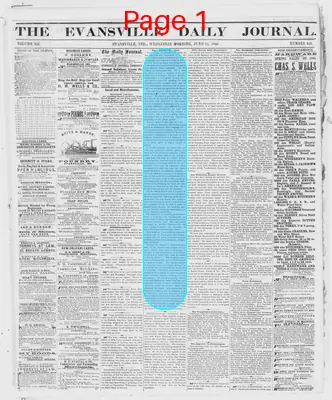
Editorial
June 13, 1860
The Evansville Daily Journal
Evansville, Vanderburgh County, Indiana
What is this article about?
The Journal editorial defends against attacks from the Enquirer's 'Guerilla Editor,' a former Whig who switched to Democracy, exposing his hypocrisy and refuting claims of begging for support while praising their own reciprocal patronage practices in this partisan newspaper feud.
Clipping

OCR Quality
95%
Excellent
Full Text
The Guerilla Unearthed,
By a couple of well-directed shots we tore away the dirt breastwork of the Enquirer, behind which its Guerilla Editor was entrenched, and exposed to view the deserter from the Whig camp, who had gone over to the Democracy, and turned his rusty matchlock upon his former comrades. Our disclosure has discomfited him. For a while he did not attempt a renewal of his hostility, but in Sunday's Enquirer he fires a random shot--a revengeful, wicked one--and begs for quarter by pleading his long friendship for the wronged party, and his very disinterested intentions now in deserting from and fighting against his old friends.
The new Enquirer editor takes occasion to speak of the "flabby puerilities" of the Journal. He probably got that idea from the story of the frog that was found in the coal mine, and submitted to the inspection of a learned arithmetician, who, by an intricate calculation, demonstrated that said frog had been imbedded in the solid coal since a period anterior to the creation of the earth! The frog is a flabby reptile; the surmise was a puerile one. Hence the derivation of the phrase quoted.
The new Enquirer man goes on to say: "A concern that daily and weekly hands round its mendacious hate, begging for a few pennies of public support, and bestows the most extravagant panegyrics upon every one that in compassion, or to avoid an annoyance, drops so much as a dime into the eleemosynary contribution, has no conception of a better spirit or higher motive in others."
If by such allusions he means that we ever ask gratuities, without giving full value in return, he simply intimates a falsehood. If he means that we are willing to "help those who help us"--notice favorably our patrons, and thus help to build up the business of the place while we are incidentally sustaining an expensive Daily newspaper in a small city--we can understand the drift of his malicious innuendo. The only difference between us in the latter case is, that while Mr. Guerilla would, if he were in our place, swallow like a swine the patronage given the office by a liberal public without acknowledging the favor, we take pleasure in reciprocating the kind offices of our friends on any and all occasions.
Yet we confess that in such a sentence as the one quoted, we can find very little sense. What he means by "handing round mendacious hate" he only knows who wrote it. How one would go to work to hand around the intangible article, or what it could be handed round for, only the Guerilla editor, the classical writer, and astute politician of the Enquirer can explain.
The complaint of assailing private character is decidedly cool, coming from the writer who so shamefully stigmatizes Judge DeBruler without cause. We have made no assault on private character--we are only trying to protect the character of others from base and cowardly attacks. Such terms as "treasonable doctrines and political sins of Republican abolitionists," indicate that the writer is obliged to resort to blackguardism in his barrenness of legitimate argument.
Finally, the Enquirer's Supernumerary asks, "if the Journal has a horror of concealed editors, why don't it bring out to the light of day the assailants in its editorial columns of Judge Law from the shades of the city Banks?" This delightful specimen of demagoguery and vindictiveness is a "flash in the pan." The regular attaches of this paper have no occasion to resort to city banks for accommodations in the line of editorials. The banks, we presume, have enough to do to attend to their own legitimate business, without wishing to edit newspapers. No article emanating from a bank and directed at Judge Law has been published in these columns--editorially or otherwise--since the present editor took control of the paper. It is reserved for the Democratic organ to get its editorials from an individual who was formerly a Whig, and opposed to Democracy from education, more recently editor of an American newspaper, and latterly a professed Douglas Democrat, while pretending a strong preference for John Bell for the Presidency. Truly, the Enquirer is "hard up" for editorials.
By a couple of well-directed shots we tore away the dirt breastwork of the Enquirer, behind which its Guerilla Editor was entrenched, and exposed to view the deserter from the Whig camp, who had gone over to the Democracy, and turned his rusty matchlock upon his former comrades. Our disclosure has discomfited him. For a while he did not attempt a renewal of his hostility, but in Sunday's Enquirer he fires a random shot--a revengeful, wicked one--and begs for quarter by pleading his long friendship for the wronged party, and his very disinterested intentions now in deserting from and fighting against his old friends.
The new Enquirer editor takes occasion to speak of the "flabby puerilities" of the Journal. He probably got that idea from the story of the frog that was found in the coal mine, and submitted to the inspection of a learned arithmetician, who, by an intricate calculation, demonstrated that said frog had been imbedded in the solid coal since a period anterior to the creation of the earth! The frog is a flabby reptile; the surmise was a puerile one. Hence the derivation of the phrase quoted.
The new Enquirer man goes on to say: "A concern that daily and weekly hands round its mendacious hate, begging for a few pennies of public support, and bestows the most extravagant panegyrics upon every one that in compassion, or to avoid an annoyance, drops so much as a dime into the eleemosynary contribution, has no conception of a better spirit or higher motive in others."
If by such allusions he means that we ever ask gratuities, without giving full value in return, he simply intimates a falsehood. If he means that we are willing to "help those who help us"--notice favorably our patrons, and thus help to build up the business of the place while we are incidentally sustaining an expensive Daily newspaper in a small city--we can understand the drift of his malicious innuendo. The only difference between us in the latter case is, that while Mr. Guerilla would, if he were in our place, swallow like a swine the patronage given the office by a liberal public without acknowledging the favor, we take pleasure in reciprocating the kind offices of our friends on any and all occasions.
Yet we confess that in such a sentence as the one quoted, we can find very little sense. What he means by "handing round mendacious hate" he only knows who wrote it. How one would go to work to hand around the intangible article, or what it could be handed round for, only the Guerilla editor, the classical writer, and astute politician of the Enquirer can explain.
The complaint of assailing private character is decidedly cool, coming from the writer who so shamefully stigmatizes Judge DeBruler without cause. We have made no assault on private character--we are only trying to protect the character of others from base and cowardly attacks. Such terms as "treasonable doctrines and political sins of Republican abolitionists," indicate that the writer is obliged to resort to blackguardism in his barrenness of legitimate argument.
Finally, the Enquirer's Supernumerary asks, "if the Journal has a horror of concealed editors, why don't it bring out to the light of day the assailants in its editorial columns of Judge Law from the shades of the city Banks?" This delightful specimen of demagoguery and vindictiveness is a "flash in the pan." The regular attaches of this paper have no occasion to resort to city banks for accommodations in the line of editorials. The banks, we presume, have enough to do to attend to their own legitimate business, without wishing to edit newspapers. No article emanating from a bank and directed at Judge Law has been published in these columns--editorially or otherwise--since the present editor took control of the paper. It is reserved for the Democratic organ to get its editorials from an individual who was formerly a Whig, and opposed to Democracy from education, more recently editor of an American newspaper, and latterly a professed Douglas Democrat, while pretending a strong preference for John Bell for the Presidency. Truly, the Enquirer is "hard up" for editorials.
What sub-type of article is it?
Partisan Politics
Satire
What keywords are associated?
Newspaper Rivalry
Political Defection
Whig Democracy
Editorial Feud
Partisan Attacks
Judge Debruler
Judge Law
What entities or persons were involved?
Guerilla Editor
Enquirer
Journal
Judge Debruler
Judge Law
John Bell
Douglas Democrat
Editorial Details
Primary Topic
Response To Enquirer's Attacks And Exposure Of Its Editor
Stance / Tone
Defensive Counter Attack With Satirical Elements
Key Figures
Guerilla Editor
Enquirer
Journal
Judge Debruler
Judge Law
John Bell
Douglas Democrat
Key Arguments
Disclosure Of Enquirer's Editor As A Whig Deserter Discomfits Him
Journal Does Not Beg For Unreciprocated Support But Aids Patrons
Enquirer's Attacks On Private Character Are Hypocritical
No Bank Sourced Editorials Against Judge Law In Journal
Enquirer Relies On Inconsistent Former Whig For Editorials