Thank you for visiting SNEWPapers!
Sign up free
Richmond Enquirer
Richmond, Richmond County, Virginia
What is this article about?
Correspondence from Washington City on Feb 20, 1846, reports joyful reception by Democrats of news from England via Cambria steamer indicating Corn Law repeal, promising better markets for US agriculture if tariffs adjusted. Criticizes Whigs for opposing changes to protect 1842 Tariff, dismissing their claims of British guile.
Clipping
OCR Quality
Full Text
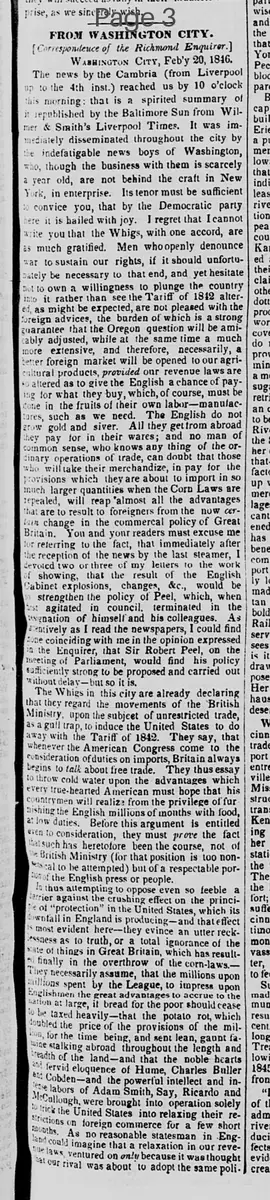
[Correspondence of the Richmond Enquirer.]
WASHINGTON CITY, Feb'y 20, 1846.
The news by the Cambria (from Liverpool up to the 4th inst.) reached us by 10 o'clock this morning: that is a spirited summary of it republished by the Baltimore Sun from Wilmer & Smith's Liverpool Times. It was immediately disseminated throughout the city by the indefatigable news boys of Washington, who, though the business with them is scarcely a year old, are not behind the craft in New York, in enterprise. Its tenor must be sufficient to convince you, that by the Democratic party here it is hailed with joy. I regret that I cannot write you that the Whigs, with one accord, are as much gratified. Men who openly denounce war to sustain our rights, if it should unfortunately be necessary to that end, and yet hesitate not to own a willingness to plunge the country into it rather than see the Tariff of 1842 altered, as might be expected, are not pleased with the foreign advices, the burden of which is a strong guarantee that the Oregon question will be amicably adjusted, while at the same time a much more extensive, and therefore, necessarily, a better foreign market will be opened to our agricultural products, provided our revenue laws are altered as to give the English a chance of paying for what they buy, which, of course, must be in the fruits of their own labor—manufactures, such as we need. The English do not grow gold and silver. All they get from abroad they pay for in their wares; and no man of common sense, who knows any thing of the ordinary operations of trade, can doubt that those who will take their merchandize, in pay for the provisions which they are about to import in so much larger quantities when the Corn Laws are repealed, will reap almost all the advantages that are to result to foreigners from the now certain change in the commercial policy of Great Britain. You and your readers must excuse me for referring to the fact, that immediately after the reception of the news by the last steamer, I devoted two or three of my letters to the work of showing, that the result of the English Cabinet explosions, changes, &c., would be to strengthen the policy of Peel, which, when last agitated in council, terminated in the resignation of himself and his colleagues. Attentively as I read the newspapers, I could find none coinciding with me in the opinion expressed in the Enquirer, that Sir Robert Peel, on the meeting of Parliament, would find his policy sufficiently strong to be proposed and carried out without delay -but so it is.
The Whigs in this city are already declaring that they regard the movements of the British Ministry, upon the subject of unrestricted trade as a guile trap, to induce the United States to do away with the Tariff of 1842. They say, that whenever the American Congress come to the consideration of duties on imports, Britain always begins to talk about free trade. They thus essay to throw cold water upon the advantages which every true-hearted American must hope that his countrymen will realize from the privilege of furnishing the English millions of mouths with food at low duties. Before this argument is entitled even to consideration, they must prove the fact that such has heretofore been the course, not of British Ministry (for that position is too nonsensical to be attempted) but of a respectable portion of the English press or people.
In thus attempting to oppose even so feeble a barrier against the crushing effect on the principles of "protection" in the United States, which its downfall in England is producing—and that effect is most evident here—they evince an utter recklessness as to truth, or a total ignorance of the state of things in Great Britain, which has resulted finally in the overthrow of the corn-laws.— They necessarily assume, that the millions upon millions spent by the League, to impress upon Englishmen the great advantages to accrue to the nation at large, if bread for the poor should cease to be taxed heavily—that the potato rot, which doubled the price of the provisions of the million, for the time being, and sent lean, gaunt famine stalking abroad throughout the length and breadth of the land—and that the noble hearts and fervid eloquence of Hume, Charles Villiers and Cobden, labors of Adam Smith, Say, Ricardo and McCulloch—in short, no reasonable statesman in England could imagine that relaxation in our revenue laws was ventured on because our rival was about to adopt the same policy.
What sub-type of article is it?
What themes does it cover?
What keywords are associated?
What entities or persons were involved?
Letter to Editor Details
Recipient
Richmond Enquirer
Main Argument
the news of the impending repeal of britain's corn laws promises expanded markets for us agricultural products, provided us revenue laws are adjusted to allow reciprocal trade; this is hailed by democrats but opposed by whigs who prioritize protecting the 1842 tariff over potential benefits.
Notable Details