Thank you for visiting SNEWPapers!
Sign up free
Editorial
February 1, 1851
Alexandria Gazette
Alexandria, Alexandria County, District Of Columbia
What is this article about?
Editorial endorses Robert C. Winthrop as the Whig candidate for Senate, praising his balanced stance on slavery, opposition to ultra abolitionists and secessionists, and defense of constitutional rights like habeas corpus. Criticizes Jeremiah Morton as pro-slavery and calls for rebuke to extremists.
Clipping
OCR Quality
95%
Excellent
Full Text
Excited
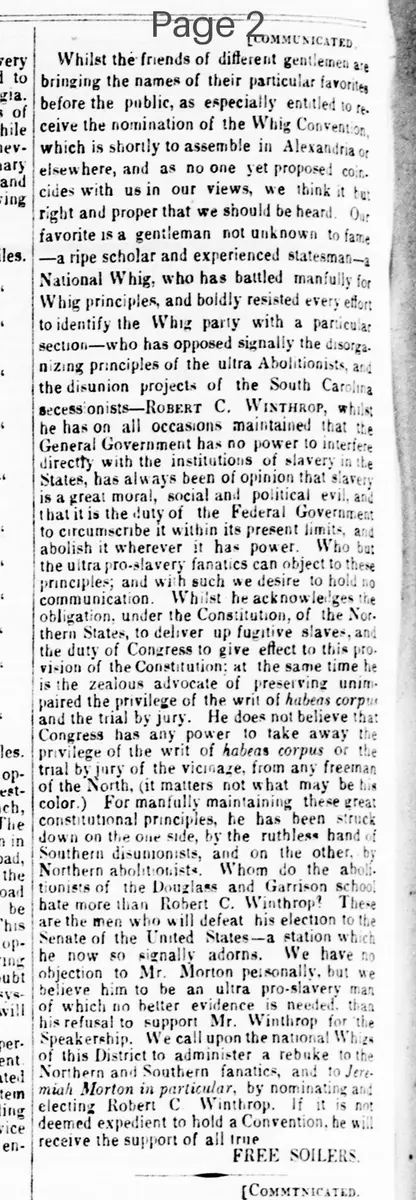
Whilst the friends of different gentlemen are bringing the names of their particular favorites before the public, as especially entitled to receive the nomination of the Whig Convention, which is shortly to assemble in Alexandria or elsewhere, and as no one yet proposed coincides with us in our views, we think it but right and proper that we should be heard.
Our favorite is a gentleman not unknown to fame—a ripe scholar and experienced statesman—a National Whig, who has battled manfully for Whig principles, and boldly resisted every effort to identify the Whig party with a particular section—who has opposed signally the disorganizing principles of the ultra Abolitionists, and the disunion projects of the South Carolina Secessionists—ROBERT C. WINTHROP, whilst he has on all occasions maintained that the General Government has no power to interfere directly with the institutions of slavery in the States, has always been of opinion that slavery is a great moral, social and political evil, and that it is the duty of the Federal Government to circumscribe it within its present limits, and abolish it wherever it has power. Who but the ultra pro-slavery fanatics can object to these principles; and with such we desire to hold no communication. Whilst he acknowledges the obligation, under the Constitution, of the Northern States, to deliver up fugitive slaves, and the duty of Congress to give effect to this provision of the Constitution: at the same time he is the zealous advocate of preserving unimpaired the privilege of the writ of habeas corpus and the trial by jury. He does not believe that Congress has any power to take away the privilege of the writ of habeas corpus or the trial by jury of the vicinage, from any freeman of the North, (it matters not what may be his color.) For manfully maintaining these great constitutional principles, he has been struck down on the one side, by the ruthless hand of Southern disunionists, and on the other, by Northern abolitionists. Whom do the abolitionists of the Douglass and Garrison school hate more than Robert C. Winthrop? These are the men who will defeat his election to the Senate of the United States—a station which he now so signally adorns. We have no objection to Mr. Morton personally, but we believe him to be an ultra pro-slavery man of which no better evidence is needed, than his refusal to support Mr. Winthrop for the Speakership. We call upon the national Whigs of this District to administer a rebuke to the Northern and Southern fanatics, and to Jeremiah Morton in particular, by nominating and electing Robert C. Winthrop. If it is not deemed expedient to hold a Convention, he will receive the support of all true
FREE SOILERS.
Whilst the friends of different gentlemen are bringing the names of their particular favorites before the public, as especially entitled to receive the nomination of the Whig Convention, which is shortly to assemble in Alexandria or elsewhere, and as no one yet proposed coincides with us in our views, we think it but right and proper that we should be heard.
Our favorite is a gentleman not unknown to fame—a ripe scholar and experienced statesman—a National Whig, who has battled manfully for Whig principles, and boldly resisted every effort to identify the Whig party with a particular section—who has opposed signally the disorganizing principles of the ultra Abolitionists, and the disunion projects of the South Carolina Secessionists—ROBERT C. WINTHROP, whilst he has on all occasions maintained that the General Government has no power to interfere directly with the institutions of slavery in the States, has always been of opinion that slavery is a great moral, social and political evil, and that it is the duty of the Federal Government to circumscribe it within its present limits, and abolish it wherever it has power. Who but the ultra pro-slavery fanatics can object to these principles; and with such we desire to hold no communication. Whilst he acknowledges the obligation, under the Constitution, of the Northern States, to deliver up fugitive slaves, and the duty of Congress to give effect to this provision of the Constitution: at the same time he is the zealous advocate of preserving unimpaired the privilege of the writ of habeas corpus and the trial by jury. He does not believe that Congress has any power to take away the privilege of the writ of habeas corpus or the trial by jury of the vicinage, from any freeman of the North, (it matters not what may be his color.) For manfully maintaining these great constitutional principles, he has been struck down on the one side, by the ruthless hand of Southern disunionists, and on the other, by Northern abolitionists. Whom do the abolitionists of the Douglass and Garrison school hate more than Robert C. Winthrop? These are the men who will defeat his election to the Senate of the United States—a station which he now so signally adorns. We have no objection to Mr. Morton personally, but we believe him to be an ultra pro-slavery man of which no better evidence is needed, than his refusal to support Mr. Winthrop for the Speakership. We call upon the national Whigs of this District to administer a rebuke to the Northern and Southern fanatics, and to Jeremiah Morton in particular, by nominating and electing Robert C. Winthrop. If it is not deemed expedient to hold a Convention, he will receive the support of all true
FREE SOILERS.
What sub-type of article is it?
Partisan Politics
Slavery Abolition
Constitutional
What keywords are associated?
Whig Party
Robert C Winthrop
Slavery
Abolitionists
Secessionists
Constitutional Principles
Habeas Corpus
Fugitive Slaves
Senate Nomination
What entities or persons were involved?
Robert C. Winthrop
Jeremiah Morton
Whig Convention
Ultra Abolitionists
South Carolina Secessionists
Douglass
Garrison
Editorial Details
Primary Topic
Endorsement Of Robert C. Winthrop For Senate Nomination
Stance / Tone
Strong Advocacy For Winthrop Against Abolitionists And Secessionists
Key Figures
Robert C. Winthrop
Jeremiah Morton
Whig Convention
Ultra Abolitionists
South Carolina Secessionists
Douglass
Garrison
Key Arguments
Winthrop Is A National Whig Who Resists Sectional Identification Of The Party
Opposes Disorganizing Principles Of Ultra Abolitionists And Disunion Projects Of Secessionists
Views Slavery As A Moral, Social, And Political Evil To Be Circumscribed And Abolished Where Possible
Supports Constitutional Duty To Return Fugitive Slaves But Defends Habeas Corpus And Jury Trials For All Freemen
Criticizes Morton As Ultra Pro Slavery For Refusing To Support Winthrop For Speakership
Calls For Whigs To Nominate Winthrop To Rebuke Northern And Southern Fanatics