Thank you for visiting SNEWPapers!
Sign up free
The Freeman's Journal, Or, New Hampshire Gazette
Portsmouth, Rockingham County, New Hampshire
What is this article about?
In the British House of Commons on May 22, 1776, General Conway delivered a critical speech against the administration's handling of the American war, moving for an address to the King to reveal instructions to Lords Howe for peace negotiations. He urged reconciliation to avoid ruin and highlighted foreign threats.
Clipping
OCR Quality
Full Text
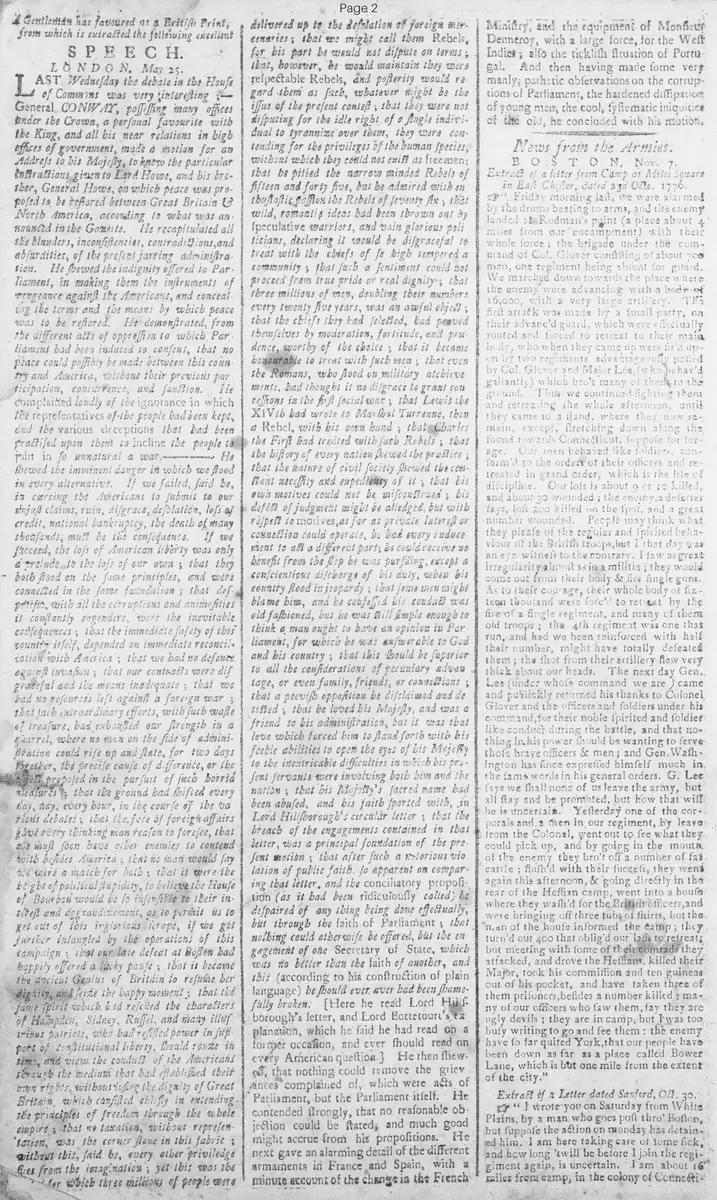
SPEECH.
LONDON. May 25.
Last Wednesday the debate in the House of Commons was very interesting; in
General Conway, possessing many offices under the Crown, a personal favourite with
the King, and all his near relations in high
offices of government, made a motion for an
Address to his Majesty, to know the particular
Instructions given to Lord Howe, and his brother,
General Howe, on which peace was proposed to be restored between Great Britain and
North America, according to what was announced in the Gazette. He recapitulated all
the Blunders, inconsistencies, contradictions, and
absurdities, of the present jarring administration.
He showed the indignity offered to Parliament,
in making them the instruments of
vengeance against the Americans, and concealing the terms and the means by which peace
was to be restored. He demonstrated, from
the different acts of oppression to which Parliament had been induced to consent, that no
peace could possibly be made between this country and America, without their previous participation, concurrence, and sanction. He
complained loudly of the ignorance in which
the representatives of the people had been kept,
and the various deceptions that had been
practised upon them to incline the people to
join in so unnatural a war. Against them. He
showed the imminent danger in which we stood
in every alternative. If we failed, said he,
in carrying the Americans to submit to our
unjust claims, ruin, disgrace, desolation, loss of
credit, national bankruptcy, the death of many
thousands, must be the consequence. If we
succeed, the loss of American liberty was only
a prelude to the loss of our own: that there
both stood on the same principles, and were
connected in the same foundation; that despotism, with all the corruptions and animosities
it constantly engenders, were the inevitable
consequences; that the immediate safety of this
country itself, depended on immediate reconciliation with America: that we had no defence
against invasion; that our contracts were disgraceful and the means inadequate; that we
had no resources left against a foreign war;
that faith extraordinary efforts, with such waste
of treasure, had exhausted our strength in a
quarrel, where no man on the side of administration could rise up and state, for two days
together, the precise cause of difference, or the
objects proposed in the pursuit of such horrid
measures: that the ground had shifted every
day, nay, every hour, in the course of the various debates: that the face of foreign affairs
gave every thinking man reason to foresee, that
we must soon have other enemies to contend
with besides America: that no man would say
we were a match for both: that it were the
height of political stupidity, to believe the House
of Bourbon would be so insensible to their interest and aggrandizement, as to permit us to
get out of this inglorious scrape, if we got
further entangled by the operations of this
campaign; that our late defeat at Boston had
happily offered a lucky pause; that it became
the ancient Genius of Britain to resume her
dignity, and seize the happy moment: that the
same spirit which had rescued the characters
of Hampden, Sidney, Russell, and many illustrious patriots, who had resisted power in support of constitutional liberty, should rouse in
time, and view the conduct of the Americans
through the medium that had established their
own rights, without losing the dignity of Great
Britain, which consisted chiefly in extending
the principles of freedom through the whole
empire; that no taxation, without representation, was the corner stone in this fabric:
without this, said he, every other privilege
arises from the imagination: yet this was the
cause for which three millions of people were
delivered up to the desolation of foreign mercenaries: that we might call them Rebels.
For his part he would not dispute on terms:
that, however, he would maintain they were
respectable Rebels, and posterity would regard them as such, whatever might be the
issue of the present contest; that they were not
disputing for the idle right of one individual
to tyrannize over them, they were contending for the privileges of the human species
without which they could not exist as freemen;
that he pitied the narrow minded Rebels of
fifteen and forty five, but he admired with enthusiasm passion the Rebels of seventy six: that
wild, romantic ideas had been shown only by
speculative warriors, and vain glorious politicians, declaring it would be disgraceful to
treat with the chiefs of so high tempered a
community: that such a sentiment could not
proceed from true pride or real dignity: that
three millions of men, doubling their numbers
every twenty five years, was an awful object:
that the chiefs they had elected, had proved
themselves by moderation, fortitude, and prudence, worthy of the choice: that it became
honourable to treat with such men; that even
the Romans, who stood on military achievements, had thought it no disgrace to grant concessions in the first Punic war: that Lewis the
XIVth had wrote to Marshal Turenne, then
a Rebel, with his own hand: that Charles
the First had treated with such Rebels: that
the history of every nation showed the practice;
that the nature of civil society showed the constant necessity and expediency of it: that his
own motives could not be misconstrued; his
defect of judgment might be alleged, but with
respect to motives, as far as private interest or
connection could operate, he had every inducement to act a different part; he could receive no
benefit from the step he was pursuing, except a
conscientious discharge of his duty, when his
country stood in jeopardy: that some men might
blame him, and he confessed his conduct was
old fashioned, but he was still simple enough to
think a man ought to have an opinion in Parliament, for which he was answerable to God
and his country: that this should be superior
to all the considerations of pecuniary advantage, or even family, friends, or connections:
that a peevish opposition he disclaimed and detested: that he loved his Majesty, and was a
friend to his administration, but it was that
love which forced him to stand forth with his
feeble abilities to open the eyes of his Majesty
to the inextricable difficulties in which his present servants were involving both him and the
nation: that his Majesty's sacred name had
been abused, and his faith sported with, in
Lord Hillsborough's circular letter: that the
breach of the engagements contained in that
letter, was a principal foundation of the present motion: that after such a glorious violation of public faith, so apparent on comparing that letter, and the conciliatory proposition (as it had been ridiculously called) he
despair of any thing being done effectually.
but through the faith of Parliament: that
nothing could otherwise be offered, but the engagement of one Secretary of State, which
was no better than the faith of another, and
this (according to his construction of plain
language) he should ever aver had been shame-
fully broken. [Here he read Lord Hills-
borough's letter, and Lord Botetourt's explanation, which he said he had read on a
former occasion, and ever should read on
every American question.] He then showed,
that nothing could remove the grievances complained of, which were acts of
Parliament, but the Parliament itself. He
contended strongly, that no reasonable objection could be stated; and much good
might accrue from his propositions. He
next gave an alarming detail of the different
armaments in France and Spain, with a
minute account of the change in the French
Ministry, and the equipment of Monsieur
Dennevoy, with a large force, for the West
Indies: also the ticklish situation of Portugal. And then having made some very
manly, pathetic observations on the corruptions of Parliament, the hardened dissipation
of young men, the cool, phlegmatic iniquities
of the old, he concluded with his motion.
What sub-type of article is it?
What keywords are associated?
What entities or persons were involved?
Where did it happen?
Foreign News Details
Primary Location
London
Event Date
Last Wednesday Before May 25, 1776
Key Persons
Outcome
motion for address to the king to reveal peace instructions; no specific outcome reported; warnings of potential ruin, bankruptcy, loss of liberties, and foreign threats if war continues.
Event Details
General Conway moved for an Address to the King inquiring about instructions to Lord Howe and General Howe for restoring peace with North America, as announced in the Gazette. He criticized the administration's blunders, deceptions, and oppressive acts, arguing that Parliament must participate in any peace. He warned of dangers in failure or success of the war, urged immediate reconciliation to preserve liberties and defend against invasion, highlighted shifting war justifications and foreign threats from France, Spain, and House of Bourbon, praised American rebels, and read Lord Hillsborough's letter to underscore broken faith. He detailed foreign armaments and concluded with his motion after observations on parliamentary corruption.