Thank you for visiting SNEWPapers!
Sign up free
Story
August 2, 1852
The Republic
Washington, District Of Columbia
What is this article about?
Editorial analyzing conflicting newspaper reports of General Pierce's January speech at New Boston on slavery and the Fugitive Slave Law, concluding that anti-slavery sentiments attributed to him are likely accurate based on evidence from various sources.
Clipping
OCR Quality
96%
Excellent
Full Text
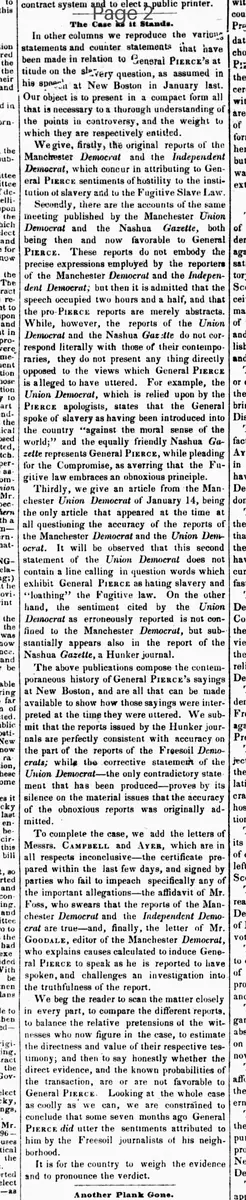
The Case as it Stands.
In other columns we reproduce the various statements and counter statements that have been made in relation to General Pierce's attitude on the slavery question, as assumed in his speech at New Boston in January last.
Our object is to present in a compact form all that is necessary to a thorough understanding of the points in controversy, and the weight to which they are respectively entitled.
We give, firstly, the original reports of the Manchester Democrat and the Independent Democrat, which concur in attributing to General Pierce sentiments of hostility to the institution of slavery and to the Fugitive Slave Law.
Secondly, there are the accounts of the same meeting published by the Manchester Union Democrat and the Nashua Gazette, both being then and now favorable to General Pierce. These reports do not embody the precise expressions employed by the reporters of the Manchester Democrat and the Independent Democrat; but then it is admitted that the speech occupied two hours and a half, and that the pro-Pierce reports are merely abstracts.
While, however, the reports of the Union Democrat and the Nashua Gazette do not correspond literally with those of their contemporaries, they do not present any thing directly opposed to the views which General Pierce is alleged to have uttered. For example, the Union Democrat, which is relied upon by the Pierce apologists, states that the General spoke of slavery as having been introduced into the country "against the moral sense of the world;" and the equally friendly Nashua Gazette represents General Pierce, while pleading for the Compromise, as averring that the Fugitive law embraces an obnoxious principle.
Thirdly, we give an article from the Manchester Union Democrat of January 14, being the only article that appeared at the time at all questioning the accuracy of the reports of the Manchester Democrat and the Independent Democrat. It will be observed that this second statement of the Union Democrat does not contain a line calling in question words which exhibit General Pierce as hating slavery and "loathing" the Fugitive law. On the other hand, the sentiment cited by the Union Democrat as erroneously reported is not confined to the Manchester Democrat, but substantially appears also in the report of the Nashua Gazette, a Hunker journal.
The above publications compose the contemporaneous history of General Pierce's sayings at New Boston, and are all that can be made available to show how those sayings were interpreted at the time they were uttered. We submit that the reports issued by the Hunker journals are perfectly consistent with accuracy on the part of the reports of the Freesoil Democrats; while the corrective statement of the Union Democrat—the only contradictory statement that has been produced—proves by its silence on the material issues that the accuracy of the obnoxious reports was originally admitted.
To complete the case, we add the letters of Messrs. CAMPBELL and AYER, which are in all respects inconclusive—the certificate prepared within the last few days, and signed by parties who fail to impeach specifically any of the important allegations—the affidavit of Mr. Foss, who swears that the reports of the Manchester Democrat and the Independent Democrat are true—and, finally, the letter of Mr. GOODALE, editor of the Manchester Democrat, who explains causes calculated to induce General Pierce to speak as he is reported to have spoken, and challenges an investigation into the truthfulness of the report.
We beg the reader to scan the matter closely in every part, to compare the different reports, to balance the relative pretensions of the witnesses who now figure in the case, to estimate the directness and value of their respective testimony; and then to say honestly whether the direct evidence, and the known probabilities of the transaction, are or are not favorable to General Pierce. Looking at the whole case as coolly as we can, we are constrained to conclude that some seven months ago General PIERCE did utter the sentiments attributed to him by the Freesoil journalists of his neighborhood.
It is for the country to weigh the evidence and to pronounce the verdict.
In other columns we reproduce the various statements and counter statements that have been made in relation to General Pierce's attitude on the slavery question, as assumed in his speech at New Boston in January last.
Our object is to present in a compact form all that is necessary to a thorough understanding of the points in controversy, and the weight to which they are respectively entitled.
We give, firstly, the original reports of the Manchester Democrat and the Independent Democrat, which concur in attributing to General Pierce sentiments of hostility to the institution of slavery and to the Fugitive Slave Law.
Secondly, there are the accounts of the same meeting published by the Manchester Union Democrat and the Nashua Gazette, both being then and now favorable to General Pierce. These reports do not embody the precise expressions employed by the reporters of the Manchester Democrat and the Independent Democrat; but then it is admitted that the speech occupied two hours and a half, and that the pro-Pierce reports are merely abstracts.
While, however, the reports of the Union Democrat and the Nashua Gazette do not correspond literally with those of their contemporaries, they do not present any thing directly opposed to the views which General Pierce is alleged to have uttered. For example, the Union Democrat, which is relied upon by the Pierce apologists, states that the General spoke of slavery as having been introduced into the country "against the moral sense of the world;" and the equally friendly Nashua Gazette represents General Pierce, while pleading for the Compromise, as averring that the Fugitive law embraces an obnoxious principle.
Thirdly, we give an article from the Manchester Union Democrat of January 14, being the only article that appeared at the time at all questioning the accuracy of the reports of the Manchester Democrat and the Independent Democrat. It will be observed that this second statement of the Union Democrat does not contain a line calling in question words which exhibit General Pierce as hating slavery and "loathing" the Fugitive law. On the other hand, the sentiment cited by the Union Democrat as erroneously reported is not confined to the Manchester Democrat, but substantially appears also in the report of the Nashua Gazette, a Hunker journal.
The above publications compose the contemporaneous history of General Pierce's sayings at New Boston, and are all that can be made available to show how those sayings were interpreted at the time they were uttered. We submit that the reports issued by the Hunker journals are perfectly consistent with accuracy on the part of the reports of the Freesoil Democrats; while the corrective statement of the Union Democrat—the only contradictory statement that has been produced—proves by its silence on the material issues that the accuracy of the obnoxious reports was originally admitted.
To complete the case, we add the letters of Messrs. CAMPBELL and AYER, which are in all respects inconclusive—the certificate prepared within the last few days, and signed by parties who fail to impeach specifically any of the important allegations—the affidavit of Mr. Foss, who swears that the reports of the Manchester Democrat and the Independent Democrat are true—and, finally, the letter of Mr. GOODALE, editor of the Manchester Democrat, who explains causes calculated to induce General Pierce to speak as he is reported to have spoken, and challenges an investigation into the truthfulness of the report.
We beg the reader to scan the matter closely in every part, to compare the different reports, to balance the relative pretensions of the witnesses who now figure in the case, to estimate the directness and value of their respective testimony; and then to say honestly whether the direct evidence, and the known probabilities of the transaction, are or are not favorable to General Pierce. Looking at the whole case as coolly as we can, we are constrained to conclude that some seven months ago General PIERCE did utter the sentiments attributed to him by the Freesoil journalists of his neighborhood.
It is for the country to weigh the evidence and to pronounce the verdict.
What sub-type of article is it?
Historical Event
Mystery
What themes does it cover?
Justice
Deception
What keywords are associated?
Slavery Controversy
Fugitive Slave Law
Pierce Speech
New Boston
Newspaper Reports
Political Debate
What entities or persons were involved?
General Pierce
Messrs. Campbell
Messrs. Ayer
Mr. Foss
Mr. Goodale
Where did it happen?
New Boston
Story Details
Key Persons
General Pierce
Messrs. Campbell
Messrs. Ayer
Mr. Foss
Mr. Goodale
Location
New Boston
Event Date
January Last
Story Details
Analysis of conflicting newspaper reports on General Pierce's speech at New Boston, attributing anti-slavery sentiments to him, supported by evidence from various sources and concluding the reports are accurate.