Thank you for visiting SNEWPapers!
Sign up free
Springfield Weekly Republican
Springfield, Hampden County, Massachusetts
What is this article about?
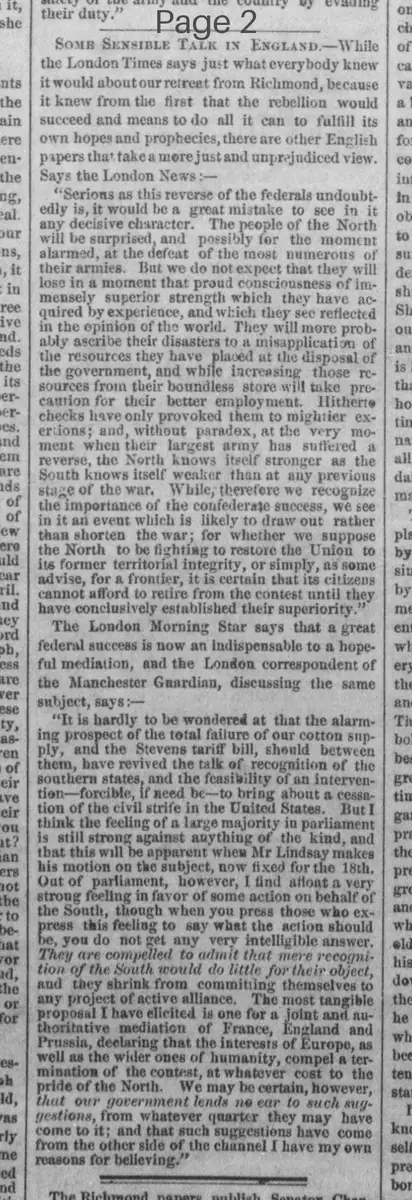
British newspapers, including the London News and Morning Star, view the Union's retreat from Richmond as a setback that will strengthen Northern resolve rather than end the war, while discussions of Southern recognition and mediation persist despite parliamentary opposition.
Clipping
OCR Quality
Full Text
"Serious as this reverse of the federals undoubtedly is, it would be a great mistake to see in it any decisive character. The people of the North will be surprised, and possibly for the moment alarmed, at the defeat of the most numerous of their armies. But we do not expect that they will lose in a moment that proud consciousness of immensely superior strength which they have acquired by experience, and which they see reflected in the opinion of the world. They will more probably ascribe their disasters to a misapplication of the resources they have placed at the disposal of the government, and while increasing those resources from their boundless store will take precaution for their better employment. Hitherto checks have only provoked them to mightier exertions; and, without paradox, at the very moment when their largest army has suffered a reverse, the North knows itself stronger as the South knows itself weaker than at any previous stage of the war. While, therefore we recognize the importance of the confederate success, we see in it an event which is likely to draw out rather than shorten the war; for whether we suppose the North to be fighting to restore the Union to its former territorial integrity, or simply, as some advise, for a frontier, it is certain that its citizens cannot afford to retire from the contest until they have conclusively established their superiority."
The London Morning Star says that a great federal success is now an indispensable to a hopeful mediation, and the London correspondent of the Manchester Guardian, discussing the same subject, says:
"It is hardly to be wondered at that the alarming prospect of the total failure of our cotton supply, and the Stevens tariff bill, should between them, have revived the talk of recognition of the southern states, and the feasibility of an intervention—forcible, if need be—to bring about a cessation of the civil strife in the United States. But I think the feeling of a large majority in parliament is still strong against anything of the kind, and that this will be apparent when Mr. Lindsay makes his motion on the subject, now fixed for the 18th. Out of parliament, however, I find afloat a very strong feeling in favor of some action on behalf of the South, though when you press those who express this feeling to say what the action should be, you do not get any very intelligible answer. They are compelled to admit that mere recognition of the South would do little for their object, and they shrink from committing themselves to any project of active alliance. The most tangible proposal I have elicited is one for a joint and authoritative mediation of France, England and Prussia, declaring that the interests of Europe, as well as the wider ones of humanity, compel a termination of the contest, at whatever cost to the pride of the North. We may be certain, however, that our government lends no ear to such suggestions, from whatever quarter they may have come to it; and that such suggestions have come from the other side of the channel I have my own reasons for believing."
What sub-type of article is it?
What keywords are associated?
What entities or persons were involved?
Where did it happen?
Foreign News Details
Primary Location
England
Key Persons
Outcome
confederate success likely to draw out rather than shorten the war
Event Details
London Times criticizes Union retreat from Richmond; London News sees it as non-decisive, expecting North to strengthen; London Morning Star deems federal success essential for mediation; Manchester Guardian correspondent reports revived talk of Southern recognition and intervention due to cotton supply fears and Stevens tariff, but parliamentary majority opposes, with Mr. Lindsay's motion set for the 18th; proposes joint mediation by France, England, and Prussia, though government unreceptive.