Thank you for visiting SNEWPapers!
Sign up free
Editorial
April 25, 1814
Kentucky Gazette
Lexington, Fayette County, Kentucky
What is this article about?
Editorial criticizes President Madison and Congress for repealing the embargo and non-importation laws, arguing it benefits British commerce, harms American manufactures and farmers, and exposes national weakness during conflict with Britain.
Merged-components note: The 'Justification' section directly continues the editorial on the President, Congress, and repeal of embargo laws.
Clipping
OCR Quality
88%
Good
Full Text
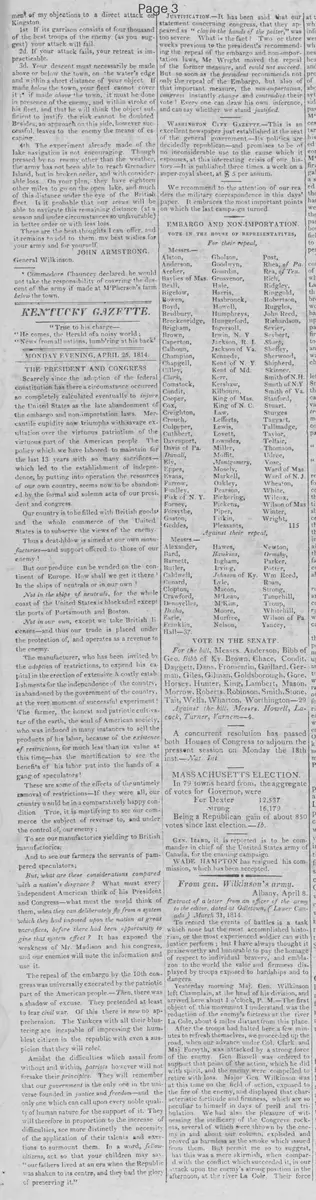
THE PRESIDENT AND CONGRESS
Scarcely since the adoption of the federal constitution has there a circumstance occurred so completely calculated eventually to injure the United States as the late abandonment of the embargo and non-importation laws. Mercantile cupidity now triumphs with savage exultation over the virtuous patriotism of the virtuous part of the American people. The policy which we have labored to maintain for the last 13 years with so many sacrifices—which led to the establishment of independence, by putting into operation the resources of our own country, seems now to be abandoned by the formal and solemn acts of our president and congress.
Our country is to be filled with British goods and the whole commerce of the United States is to subserve the views of the enemy. Thus a death-blow is aimed at our own manufactories—and support offered to those of our enemy!
But our produce can be vended on the continent of Europe. How shall we get it there? In the ships of neutrals or in our own? Not in the ships of neutrals, for the whole coast of the United States is blockaded except the ports of Portsmouth and Boston. Not in our own, except we take British licenses—and thus our trade is placed under the protection of, and operates as a revenue to the enemy.
The manufacturer, who has been invited by the adoption of restrictions, to expend his capital in the erection of extensive & costly establishments for the independence of the country, is abandoned by the government of the country, at the very moment of successful experiment!
The farmer, the honest and patriotic cultivator of the earth, the soul of American society, who was induced in many instances to sell the products of his labor, because of the existence of restrictions, for much less than its value at this time—has the mortification to see the benefits of his labor put into the hands of a gang of speculators!
These are some of the effects of the untimely removal of restrictions—If they were all, our country would be in a comparatively happy condition. True, it is mortifying to see our commerce the subject of revenue to, and under the control of, our enemy; To see our manufactories yielding to British manufactories: And to see our farmers the servants of pampered speculators; But, what are these considerations compared with a nation's disgrace? What must every independent American think of his President and Congress—what must the world think of them, when they can deliberately fly from a system which they had imposed upon the nation at great sacrifices, before there had been opportunity to give that system effect? It has exposed the weakness of Mr. Madison and his congress, and our enemies will note the information and use it.
The repeal of the embargo by the 10th congress was universally execrated by the patriotic part of the American people.—Then, there was a shadow of excuse. They pretended at least to fear civil war. Of this there is now no apprehension. The Yankees with all their blustering are incapable of impressing the humblest citizen in the republic with even a suspicion that they will rebel.
Amidst the difficulties which assail from without and within, patriots however will not forsake their principles. They will remember that our government is the only one in the universe founded in justice and freedom—and the only one which can call upon every noble quality of human nature for the support of it. They will therefore in proportion to the increase of difficulties, see more distinctly the necessity of the application of their talents and exertions to surmount them. In a word, fellow citizens, act so that your children may say, "our fathers lived at an era when the Republic was shaken to its centre, and they had the glory of preserving it."
Justification.—It has been said that our statement concerning congress, that they appeared as "clay in the hands of the potter," was too severe. What is the fact? Two or three weeks previous to the president's recommending the repeal of the embargo and non-importation laws, Mr Wright moved the repeal of the former measure, and could not succeed. But so soon as the president recommends not only the repeal of the Embargo, but also of that important measure, the non-importation, congress instantly change and contradict their vote! Every one can draw his own inference, and can say whether we stand justified.
Scarcely since the adoption of the federal constitution has there a circumstance occurred so completely calculated eventually to injure the United States as the late abandonment of the embargo and non-importation laws. Mercantile cupidity now triumphs with savage exultation over the virtuous patriotism of the virtuous part of the American people. The policy which we have labored to maintain for the last 13 years with so many sacrifices—which led to the establishment of independence, by putting into operation the resources of our own country, seems now to be abandoned by the formal and solemn acts of our president and congress.
Our country is to be filled with British goods and the whole commerce of the United States is to subserve the views of the enemy. Thus a death-blow is aimed at our own manufactories—and support offered to those of our enemy!
But our produce can be vended on the continent of Europe. How shall we get it there? In the ships of neutrals or in our own? Not in the ships of neutrals, for the whole coast of the United States is blockaded except the ports of Portsmouth and Boston. Not in our own, except we take British licenses—and thus our trade is placed under the protection of, and operates as a revenue to the enemy.
The manufacturer, who has been invited by the adoption of restrictions, to expend his capital in the erection of extensive & costly establishments for the independence of the country, is abandoned by the government of the country, at the very moment of successful experiment!
The farmer, the honest and patriotic cultivator of the earth, the soul of American society, who was induced in many instances to sell the products of his labor, because of the existence of restrictions, for much less than its value at this time—has the mortification to see the benefits of his labor put into the hands of a gang of speculators!
These are some of the effects of the untimely removal of restrictions—If they were all, our country would be in a comparatively happy condition. True, it is mortifying to see our commerce the subject of revenue to, and under the control of, our enemy; To see our manufactories yielding to British manufactories: And to see our farmers the servants of pampered speculators; But, what are these considerations compared with a nation's disgrace? What must every independent American think of his President and Congress—what must the world think of them, when they can deliberately fly from a system which they had imposed upon the nation at great sacrifices, before there had been opportunity to give that system effect? It has exposed the weakness of Mr. Madison and his congress, and our enemies will note the information and use it.
The repeal of the embargo by the 10th congress was universally execrated by the patriotic part of the American people.—Then, there was a shadow of excuse. They pretended at least to fear civil war. Of this there is now no apprehension. The Yankees with all their blustering are incapable of impressing the humblest citizen in the republic with even a suspicion that they will rebel.
Amidst the difficulties which assail from without and within, patriots however will not forsake their principles. They will remember that our government is the only one in the universe founded in justice and freedom—and the only one which can call upon every noble quality of human nature for the support of it. They will therefore in proportion to the increase of difficulties, see more distinctly the necessity of the application of their talents and exertions to surmount them. In a word, fellow citizens, act so that your children may say, "our fathers lived at an era when the Republic was shaken to its centre, and they had the glory of preserving it."
Justification.—It has been said that our statement concerning congress, that they appeared as "clay in the hands of the potter," was too severe. What is the fact? Two or three weeks previous to the president's recommending the repeal of the embargo and non-importation laws, Mr Wright moved the repeal of the former measure, and could not succeed. But so soon as the president recommends not only the repeal of the Embargo, but also of that important measure, the non-importation, congress instantly change and contradict their vote! Every one can draw his own inference, and can say whether we stand justified.
What sub-type of article is it?
Economic Policy
Foreign Affairs
Partisan Politics
What keywords are associated?
Embargo Repeal
Non Importation Laws
British Goods
American Manufactures
Farmers
Madison
Congress
War Of 1812
What entities or persons were involved?
President Madison
Congress
Mr Wright
Yankees
Editorial Details
Primary Topic
Criticism Of Repealing Embargo And Non Importation Laws
Stance / Tone
Strongly Critical Of President Madison And Congress
Key Figures
President Madison
Congress
Mr Wright
Yankees
Key Arguments
Abandonment Of Embargo And Non Importation Laws Benefits British Commerce And Harms American Interests
Trade Under British Licenses Supports The Enemy
Manufacturers And Farmers Suffer From Removal Of Restrictions
Repeal Exposes Weakness To Enemies
Congress Flip Flops After Presidential Recommendation
Patriots Must Uphold Principles Despite Difficulties