Thank you for visiting SNEWPapers!
Sign up free
Story
April 9, 1772
The Massachusetts Spy
Boston, Suffolk County, Massachusetts
What is this article about?
Mr. Sawbridge delivers a speech in court censuring the Lord Mayor for refusing to summon a Common-Hall, accusing him of falsehoods, hypocrisy, and evading his duty to the citizens of London by claiming a disputed right is in litigation when it is not.
Clipping
OCR Quality
95%
Excellent
Full Text
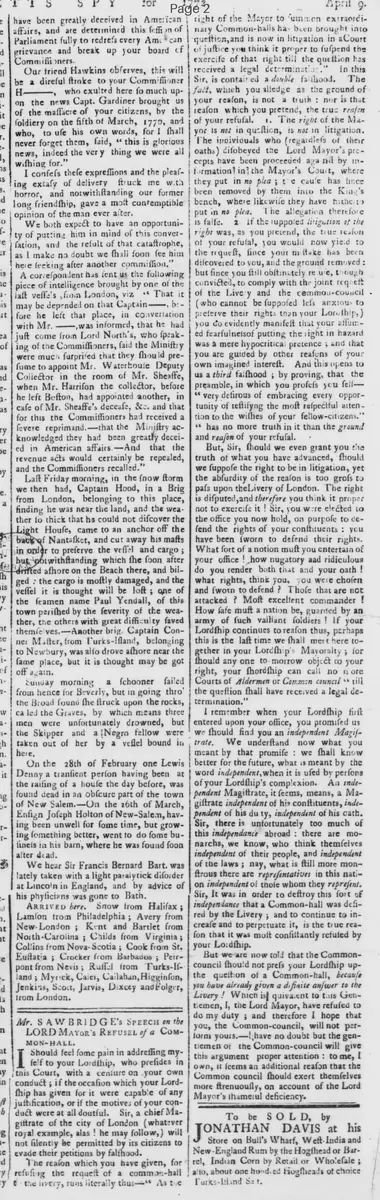
Mr. SAWBRIDGE's SPEECH on the LORD Mayors Refusal of a COM-MON-HALL.
Should feel some pain in addressing myself to your Lordship, who presides in this Court, with a censure on your Own conduct; if the occasion which your Lordship has given for it were capable of any justification, or if the motives of your conduct were at all doubtful. Sir, a chief Magistrate of the city of London (whatever royal example, alas! he may follow,) will not silently be permitted by its citizens to evade their petitions by falsehood.
The reason which you have given, for refusing the request of a common-hall at the present, runs literally thus- "As the right of the Mayor to summon extraordinary Common-halls has been brought into question, and is now in litigation in a Court of justice you think it proper to suspend the exercise of that right till the question has received a legal determination." In this Sir, is contained a double falsehood. The fact, which you allege as the ground of your reason, is not a truth: nor is that reason which you pretend, the true reason of your refusal. 1. The right of the Mayor is not in question, is not in litigation. The individuals who (regardless of their oaths) disobeyed the Lord Mayor's precepts have been proceeded against by information in the Mayor's Court, where they put in no plea; the cause has since been removed by them into the King's bench, where likewise they have not yet put in a plea. The allegation therefore is false. 2. if the supposed litigation of the right was, as you pretend, the true reason of your refusal, you would now yield to the request, since your mistake has been discovered to you, and the ground removed: but since you still obstinately refuse, though convicted, to comply with the joint request of the Livery and the common-council (who cannot be supposed less anxious to preserve their rights than your Lordship.) you do evidently manifest that your assumed fearfulness of putting the right in hazard was a mere hypocritical pretence; and that you are guided by other reasons of your own imagined interest. And this opens to us a third falsehood; by proving, that the preamble, in which you profess yourself- "very desirous of embracing every opportunity of testifying the most respectful attention to the wishes of your fellow-citizens." has no more truth in it than the ground and reason of your refusal.
But, Sir, should we even grant you the truth of what you have advanced, should we suppose the right to be in litigation, yet the absurdity of the reason is too gross to pass upon the Livery of London. The right is disputed, and therefore you think it proper not to exercise it! Sir, you were elected to the office you now hold, on purpose to defend the rights of your constituents: you have been sworn to defend their rights. What sort of a notion must you entertain of your office! how nugatory and ridiculous do you render both that and your oath! what rights, think you, you were chosen and sworn to defend? Those that are not attacked? Most excellent commander! How safe must a nation be, guarded by an army of such valiant soldiers! If your Lordship continues to reason thus, perhaps this is the last time we shall meet here together in your Lordship's Mayoralty; for should any one tomorrow object to your right, your Lordship can call no more Courts of Aldermen or Common council till the question shall have received a legal determination.
I remember when your Lordship first entered upon your office, you promised us we should find you an independent Magistrate. We understand now what you meant by that promise: we shall know better for the future, what is meant by the word independent, when it is used by persons of your Lordship's complexion. An independent Magistrate, it seems, means, a Magistrate independent of his constituents, independent of his duty, independent of his oath.
Sir, there is unfortunately too much of this independance abroad: there are monarchs, we know, who think themselves independent of their people, and independent of the laws; nay, what is still more monstrous there are representatives in this nation independent of those whom they represent.
Sir, It was in order to destroy this sort of independance that a Common-hall was desired by the Livery; and to continue to increase and to perpetuate it, is the true reason that it was most consistently refused by your Lordship.
But we are now told that the Common-council should not press your Lordship upon the question of a Common-hall, because you have already given a definitive answer to the Livery! Which is equivalent to this Gentlemen, I, the Lord Mayor, have refused to do my duty; and therefore I hope that you, the Common-council, will not perform yours.- I have no doubt but the gentlemen of the Common-council will give this argument proper attention: to me, I own, it seems an additional reason that the Common council should exert themselves more strenuously, on account of the Lord Mayor's shameful deficiency.
Should feel some pain in addressing myself to your Lordship, who presides in this Court, with a censure on your Own conduct; if the occasion which your Lordship has given for it were capable of any justification, or if the motives of your conduct were at all doubtful. Sir, a chief Magistrate of the city of London (whatever royal example, alas! he may follow,) will not silently be permitted by its citizens to evade their petitions by falsehood.
The reason which you have given, for refusing the request of a common-hall at the present, runs literally thus- "As the right of the Mayor to summon extraordinary Common-halls has been brought into question, and is now in litigation in a Court of justice you think it proper to suspend the exercise of that right till the question has received a legal determination." In this Sir, is contained a double falsehood. The fact, which you allege as the ground of your reason, is not a truth: nor is that reason which you pretend, the true reason of your refusal. 1. The right of the Mayor is not in question, is not in litigation. The individuals who (regardless of their oaths) disobeyed the Lord Mayor's precepts have been proceeded against by information in the Mayor's Court, where they put in no plea; the cause has since been removed by them into the King's bench, where likewise they have not yet put in a plea. The allegation therefore is false. 2. if the supposed litigation of the right was, as you pretend, the true reason of your refusal, you would now yield to the request, since your mistake has been discovered to you, and the ground removed: but since you still obstinately refuse, though convicted, to comply with the joint request of the Livery and the common-council (who cannot be supposed less anxious to preserve their rights than your Lordship.) you do evidently manifest that your assumed fearfulness of putting the right in hazard was a mere hypocritical pretence; and that you are guided by other reasons of your own imagined interest. And this opens to us a third falsehood; by proving, that the preamble, in which you profess yourself- "very desirous of embracing every opportunity of testifying the most respectful attention to the wishes of your fellow-citizens." has no more truth in it than the ground and reason of your refusal.
But, Sir, should we even grant you the truth of what you have advanced, should we suppose the right to be in litigation, yet the absurdity of the reason is too gross to pass upon the Livery of London. The right is disputed, and therefore you think it proper not to exercise it! Sir, you were elected to the office you now hold, on purpose to defend the rights of your constituents: you have been sworn to defend their rights. What sort of a notion must you entertain of your office! how nugatory and ridiculous do you render both that and your oath! what rights, think you, you were chosen and sworn to defend? Those that are not attacked? Most excellent commander! How safe must a nation be, guarded by an army of such valiant soldiers! If your Lordship continues to reason thus, perhaps this is the last time we shall meet here together in your Lordship's Mayoralty; for should any one tomorrow object to your right, your Lordship can call no more Courts of Aldermen or Common council till the question shall have received a legal determination.
I remember when your Lordship first entered upon your office, you promised us we should find you an independent Magistrate. We understand now what you meant by that promise: we shall know better for the future, what is meant by the word independent, when it is used by persons of your Lordship's complexion. An independent Magistrate, it seems, means, a Magistrate independent of his constituents, independent of his duty, independent of his oath.
Sir, there is unfortunately too much of this independance abroad: there are monarchs, we know, who think themselves independent of their people, and independent of the laws; nay, what is still more monstrous there are representatives in this nation independent of those whom they represent.
Sir, It was in order to destroy this sort of independance that a Common-hall was desired by the Livery; and to continue to increase and to perpetuate it, is the true reason that it was most consistently refused by your Lordship.
But we are now told that the Common-council should not press your Lordship upon the question of a Common-hall, because you have already given a definitive answer to the Livery! Which is equivalent to this Gentlemen, I, the Lord Mayor, have refused to do my duty; and therefore I hope that you, the Common-council, will not perform yours.- I have no doubt but the gentlemen of the Common-council will give this argument proper attention: to me, I own, it seems an additional reason that the Common council should exert themselves more strenuously, on account of the Lord Mayor's shameful deficiency.
What sub-type of article is it?
Historical Event
What themes does it cover?
Justice
Deception
Moral Virtue
What keywords are associated?
Lord Mayor Refusal
Common Hall
Political Speech
Livery London
Mayoral Conduct
Falsehood Accusation
Citizens Rights
What entities or persons were involved?
Mr. Sawbridge
Lord Mayor
Where did it happen?
City Of London
Story Details
Key Persons
Mr. Sawbridge
Lord Mayor
Location
City Of London
Story Details
Mr. Sawbridge accuses the Lord Mayor of falsehoods in refusing to summon a Common-Hall, claiming the right is not in litigation and that the refusal is hypocritical to avoid addressing citizens' concerns about independence and duty.