Thank you for visiting SNEWPapers!
Sign up free
Letter to Editor
November 5, 1736
The Virginia Gazette
Richmond, Williamsburg, Richmond County, Virginia
What is this article about?
A letter to the Monitor describes the courtship of Miss Fainwould by three suitors—a parson, doctor, and lawyer—detailing their interactions and her rejections. It includes poems from a suitor and reflects on love as an infectious distemper similar to smallpox, advocating prudence.
Clipping
OCR Quality
95%
Excellent
Full Text
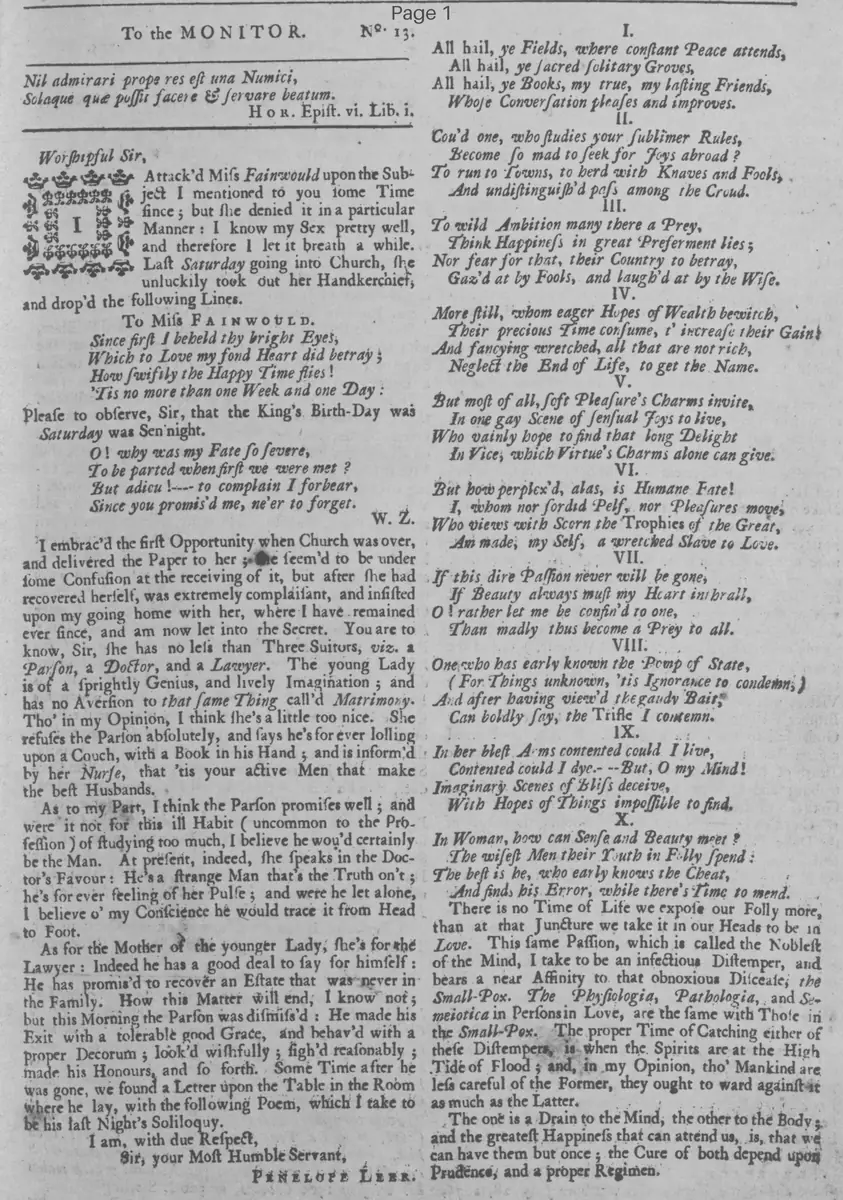
To the MONITOR.
No. 13.
Nil admirari prope res est una Numici,
Solaque quae possunt facere et seruare beatum.
Hor. Epist. vi. Lib. i.
Worshipful Sir,
Attacked Miss Fainwould upon the Subject I mentioned to you some Time since; but he denied it in a particular
I
Manner: I know my Sex pretty well,
and therefore I let it breathe a while.
Last Saturday going into Church, She
unluckily took out her Handkerchief;
and dropp'd the following Lines.
To Miss FAINWOULD.
Since first I beheld thy bright Eyes,
Which to Love my fond Heart did betray
How swiftly the Happy Time flies!
'Tis no more than one Week and one Day:
Please to observe, Sir, that the King's Birth-Day
was
Saturday was Sen'night.
O! why was my Fate so severe,
To be parted when first we were met?
But adieu!---- to complain I forbear,
Since you promis'd me, ne'er to forget.
W. Z.
I embrac'd the first Opportunity when Church was over,
and delivered the Paper to her; she seem'd to be under
some Confusion at the receiving of it, but after She had
recovered herself, was extremely complaisant, and insisted
upon my going home with her, where I have remained
ever since, and am now let into the Secret. You are to
know, Sir, She has no less than Three Suitors, viz. a
Parson, a Doctor, and a Lawyer. The young Lady
is of a sprightly Genius, and lively Imagination; and
has no Aversion to that same Thing call'd Matrimony.
Tho' in my Opinion, I think she's a little too nice. She
refuses the Parson absolutely, and says he's for ever lolling
upon a Couch, with a Book in his Hand; and is inform'd
by her Nurse, that 'tis your Active Men that make
the best Husbands.
As to my Part, I think the Parson promises well; and
were it not for this ill Habit (uncommon to the Pro-
fession) of studying too much, I believe he wou'd certainly
be the Man. At present, indeed, he speaks in the Doc-
tor's Favour: He's a strange Man that's the Truth on't:
he's for ever feeling of her Pulse; and were he let alone,
I believe o' my Conscience he would trace it from Head
to Foot.
As for the Mother of the younger Lady; She's for the
Lawyer: Indeed he has a good deal to say for himself:
He has promis'd to recover an Estate that was never in
the Family. How this Matter will end; I know not;
but this Morning the Parson was dismiss'd: He made his
Exit with a tolerable good Grace, and behav'd with a
proper Decorum; look'd wishfully; sigh'd reasonably;
made his Honours, and so forth. Some Time after he
was gone, we found a Letter upon the Table in the Room
where he lay, with the following Poem, which I take to
be his last Night's Soliloquy.
I am, with due Respect,
Sir, your Most Humble Servant.
I.
All hail, ye Fields, where constant Peace attends,
All hail, ye sacred Solitary Groves,
All hail, ye Books, my true, my lasting Friends,
Whose Conversation pleases and improves.
II.
Cou'd one, who studies your Sublimer Rules,
Become so mad to seek for Joys abroad?
To run to Towns, to herd with Knaves and Fools
And undistinguish'd pass among the Croud.
III.
To wild Ambition many there a Prey,
Think Happiness in great Preferment lies;
Nor fear for that, their Country to betray,
Gaz'd at by Fools, and laugh'd at by the Wise.
IV.
More still, whom eager Hopes of Wealth bewitch,
Their precious Time consume, t' increase their Gain
And fancying wretched, all that are not rich,
Neglect the End of Life, to get the Name.
V.
But most of all, Soft Pleasure's Charms invite,
In one gay Scene of Sensual Joys to live,
Who vainly hope to find that long Delight
In Vice; which Virtue's Charms alone can give.
VI.
But how perplex'd, alas, is Humane Fate!
I, whom nor sordid Pelf. nor Pleasures move
Who views with Scorn the Trophies of the Great,
Am made, my Self, a wretched Slave to Love.
VII.
If this dire Passion never will be gone,
If Beauty always must my Heart inthrall,
O! rather let me be confin'd to one,
Than madly thus become a Prey to all.
VIII.
One who has early known the Pomp of State,
(For Things unknown, 'tis Ignorance to condemn;)
And after having view'd the gaudy Bair,
Can boldly say, the Trifle I contemn.
IX.
In her blest Arms contented could I live,
Contented could I dye.----But, O my Mind!
Imaginary Scenes of Bliss deceive,
With Hopes of Things impossible to find.
X.
In Woman, how can Sense and Beauty meet?
The wisest Men their Youth in Folly spend:
The best is he, who early knows the Cheat,
And finds his Error, while there's Time to mend.
There is no Time of Life we expose our Folly more,
than at that Juncture we take it in our Heads to be In
Love. This same Passion, which is called the Noblest
of the Mind, I take to be an infectious Distemper, and
bears a near Affinity to that obnoxious Disease; the
Small-Pox. The Physiologia, Pathologia, and Se-
meiotica in Persons in Love, are the same with Those in
the Small-Pox. The proper Time of Catching either of
these Distempers, is when the Spirits are at the High
Tide of Flood; and, in my Opinion, tho' Mankind are
less careful of the Former, they ought to ward against it
as much as the Latter.
The one is a Drain to the Mind, the other to the Body;.
and the greatest Happiness that can attend us, is, that we
can have them but once; the Cure of both depend upon
Prudence, and a proper Regimen.
No. 13.
Nil admirari prope res est una Numici,
Solaque quae possunt facere et seruare beatum.
Hor. Epist. vi. Lib. i.
Worshipful Sir,
Attacked Miss Fainwould upon the Subject I mentioned to you some Time since; but he denied it in a particular
I
Manner: I know my Sex pretty well,
and therefore I let it breathe a while.
Last Saturday going into Church, She
unluckily took out her Handkerchief;
and dropp'd the following Lines.
To Miss FAINWOULD.
Since first I beheld thy bright Eyes,
Which to Love my fond Heart did betray
How swiftly the Happy Time flies!
'Tis no more than one Week and one Day:
Please to observe, Sir, that the King's Birth-Day
was
Saturday was Sen'night.
O! why was my Fate so severe,
To be parted when first we were met?
But adieu!---- to complain I forbear,
Since you promis'd me, ne'er to forget.
W. Z.
I embrac'd the first Opportunity when Church was over,
and delivered the Paper to her; she seem'd to be under
some Confusion at the receiving of it, but after She had
recovered herself, was extremely complaisant, and insisted
upon my going home with her, where I have remained
ever since, and am now let into the Secret. You are to
know, Sir, She has no less than Three Suitors, viz. a
Parson, a Doctor, and a Lawyer. The young Lady
is of a sprightly Genius, and lively Imagination; and
has no Aversion to that same Thing call'd Matrimony.
Tho' in my Opinion, I think she's a little too nice. She
refuses the Parson absolutely, and says he's for ever lolling
upon a Couch, with a Book in his Hand; and is inform'd
by her Nurse, that 'tis your Active Men that make
the best Husbands.
As to my Part, I think the Parson promises well; and
were it not for this ill Habit (uncommon to the Pro-
fession) of studying too much, I believe he wou'd certainly
be the Man. At present, indeed, he speaks in the Doc-
tor's Favour: He's a strange Man that's the Truth on't:
he's for ever feeling of her Pulse; and were he let alone,
I believe o' my Conscience he would trace it from Head
to Foot.
As for the Mother of the younger Lady; She's for the
Lawyer: Indeed he has a good deal to say for himself:
He has promis'd to recover an Estate that was never in
the Family. How this Matter will end; I know not;
but this Morning the Parson was dismiss'd: He made his
Exit with a tolerable good Grace, and behav'd with a
proper Decorum; look'd wishfully; sigh'd reasonably;
made his Honours, and so forth. Some Time after he
was gone, we found a Letter upon the Table in the Room
where he lay, with the following Poem, which I take to
be his last Night's Soliloquy.
I am, with due Respect,
Sir, your Most Humble Servant.
I.
All hail, ye Fields, where constant Peace attends,
All hail, ye sacred Solitary Groves,
All hail, ye Books, my true, my lasting Friends,
Whose Conversation pleases and improves.
II.
Cou'd one, who studies your Sublimer Rules,
Become so mad to seek for Joys abroad?
To run to Towns, to herd with Knaves and Fools
And undistinguish'd pass among the Croud.
III.
To wild Ambition many there a Prey,
Think Happiness in great Preferment lies;
Nor fear for that, their Country to betray,
Gaz'd at by Fools, and laugh'd at by the Wise.
IV.
More still, whom eager Hopes of Wealth bewitch,
Their precious Time consume, t' increase their Gain
And fancying wretched, all that are not rich,
Neglect the End of Life, to get the Name.
V.
But most of all, Soft Pleasure's Charms invite,
In one gay Scene of Sensual Joys to live,
Who vainly hope to find that long Delight
In Vice; which Virtue's Charms alone can give.
VI.
But how perplex'd, alas, is Humane Fate!
I, whom nor sordid Pelf. nor Pleasures move
Who views with Scorn the Trophies of the Great,
Am made, my Self, a wretched Slave to Love.
VII.
If this dire Passion never will be gone,
If Beauty always must my Heart inthrall,
O! rather let me be confin'd to one,
Than madly thus become a Prey to all.
VIII.
One who has early known the Pomp of State,
(For Things unknown, 'tis Ignorance to condemn;)
And after having view'd the gaudy Bair,
Can boldly say, the Trifle I contemn.
IX.
In her blest Arms contented could I live,
Contented could I dye.----But, O my Mind!
Imaginary Scenes of Bliss deceive,
With Hopes of Things impossible to find.
X.
In Woman, how can Sense and Beauty meet?
The wisest Men their Youth in Folly spend:
The best is he, who early knows the Cheat,
And finds his Error, while there's Time to mend.
There is no Time of Life we expose our Folly more,
than at that Juncture we take it in our Heads to be In
Love. This same Passion, which is called the Noblest
of the Mind, I take to be an infectious Distemper, and
bears a near Affinity to that obnoxious Disease; the
Small-Pox. The Physiologia, Pathologia, and Se-
meiotica in Persons in Love, are the same with Those in
the Small-Pox. The proper Time of Catching either of
these Distempers, is when the Spirits are at the High
Tide of Flood; and, in my Opinion, tho' Mankind are
less careful of the Former, they ought to ward against it
as much as the Latter.
The one is a Drain to the Mind, the other to the Body;.
and the greatest Happiness that can attend us, is, that we
can have them but once; the Cure of both depend upon
Prudence, and a proper Regimen.
What sub-type of article is it?
Satirical
Comedic
Reflective
What themes does it cover?
Social Issues
Morality
What keywords are associated?
Courtship
Suitors
Matrimony
Love Distemper
Smallpox Analogy
Parson Rejection
Miss Fainwould
What entities or persons were involved?
To The Monitor
Letter to Editor Details
Recipient
To The Monitor
Main Argument
love is an infectious distemper akin to smallpox that drains the mind and should be guarded against with prudence, illustrated through the courtship of miss fainwould by three suitors.
Notable Details
Includes Poem Dropped By Miss Fainwould Signed W. Z.
Parson Dismissed After Rejection, Leaves Poem Soliloquy.
Compares Love To Smallpox In Physiology And Cure.
Horace Epigraph On Not Admiring To Achieve Happiness.