Thank you for visiting SNEWPapers!
Sign up free
Weekly National Intelligencer
Washington, District Of Columbia
What is this article about?
On March 8, 1854, in the U.S. House, Mr. Bayly of Virginia defends his votes on ceding swamp lands and soldier bounties, arguing Congress's power over public lands is limited by constitutional trust. He opposes a Minnesota railroad bill as a pretext for internal improvements, not true military use.
Clipping
OCR Quality
Full Text
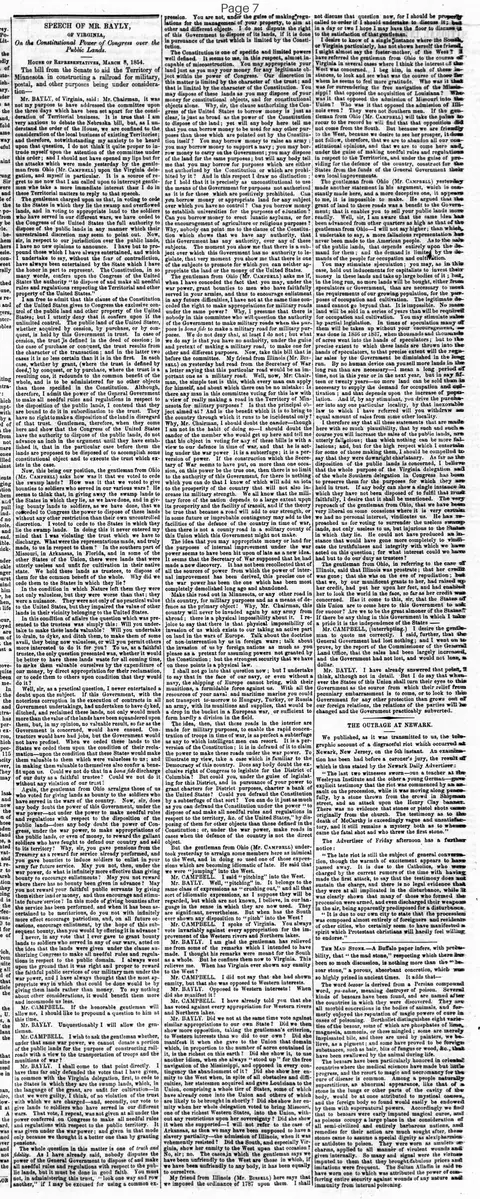
On the Constitutional Power of Congress over the Public Lands.
House of Representatives, March 8, 1854.
The bill from the Senate to aid the Territory of Minnesota in constructing a railroad for military, postal, and other purposes being under consideration—
Mr. BAYLY, of Virginia, said: Mr. Chairman, it was not my purpose to have addressed the committee upon the three days which have been set apart for the consideration of Territorial business. It is true that I am very anxious to debate the Nebraska bill, but, as I understand the order of the House, we are confined to the consideration of the local business of existing Territories; and therefore, notwithstanding my anxiety to be heard upon that question, I do not think it quite proper to intrude myself upon the attention of the committee under this order; and I should not have opened my lips but for the attacks which were made yesterday by the gentleman from Ohio (Mr. Campbell) upon the Virginia delegation, and myself in particular. It is a source of regret to me now that I am called upon to interrupt gentlemen who take a more immediate interest than I do in these Territorial matters to reply to that speech.
The gentleman charged upon us that, in voting to cede to the States in which they lie the swamp and overflowed lands, and in voting to appropriate land to the soldiers who have served in our different wars, we have ceded to the Congress of the United States the full authority to dispose of the public lands in any manner which their unrestrained discretion may seem to point out. Now, sir, in respect to our jurisdiction over the public lands, I have no new opinions to announce. I have but to propound those which I have always entertained, and which I undertake to say, without the fear of contradiction, have always been entertained by the State which I have the honor in part to represent. The Constitution, in so many words, confers upon the Congress of the United States the authority "to dispose of and make all needful rules and regulations respecting the Territorial and other property of the United States."
I am free to admit that this clause of the Constitution of the United States gives to Congress the exclusive control of the public land and other property of the United States; but I utterly deny that it confers upon it the unlimited control. The public land of the United States, whether acquired by cession, by purchase, or by conquest, is held by this Government in trust. In case of cession, the trust is defined in the deed of cession; in the case of purchase or conquest, the trust results from the character of the transaction; and in the latter two cases it is no less certain than it is in the first. In each case, whether by grant, (where the trust is defined by deed,) by conquest, or by purchase, where the trust is a resulting one, it redounds to the common benefit of the whole, and is to be administered for no other objects than those specified in the Constitution. Although, therefore, I admit the power of the General Government to make all needful rules and regulations in respect to the disposition of the public lands, I contend that they are bound to do it in subordination to the trust. They have no right to make a disposition of the land in disregard of that trust. Gentlemen, therefore, when they come here and show that the Congress of the United States have the authority to dispose of the public lands, do not advance an inch in the argument until they have established it, that in the particular case before them the lands are proposed to be disposed of to accomplish some constitutional object and to execute the trust which exists in the case.
Now, this being our position, the gentleman from Ohio (Mr. Campbell) asks how was it that we voted to cede the swamp lands? How was it that we voted to give bounties to soldiers who served in our various wars? He seems to think that, in giving away the swamp lands to the States in which they lie, as we have done, and in giving bounty lands to soldiers, as we have done, that we ceded to Congress the power to dispose of these lands without any other restriction than their own uncontrolled discretion. I voted to cede to the States in which they lie the swamp lands. In doing this it never entered my mind that I was violating the trust which we have to discharge. What were the representations made, and truly made, to us in respect to them? In the southern part of Missouri, in Arkansas, in Florida, and in some of the other States of the Union, there were lands that were utterly useless and unfit for cultivation in their native state. We hold these lands as trustees, to dispose of them for the common benefit of the whole. Why did we cede them to the States in which they lie?
In the condition in which Nature left them they were not only valueless, but they were worse than that; they were a nuisance. They were not only of no practical value to the United States, but they impaired the value of other lands in their vicinity belonging to the United States.
In this condition of affairs the question which was presented to the trustees was simply this: Will you undertake to make these lands valuable? Will you undertake to drain, to dyke, and ditch them, to make them of some avail, they being now valueless, or will you permit others more interested to do it for you? To us, as a faithful trustee, the only question presented was, whether it would be better to have these lands waste for all coming time, to make them valuable ourselves by the expenditure of our money, by direct appropriation for their reclamation, or to cede them to others upon condition that they would do it?
Well, sir, as a practical question, I never entertained a doubt upon the subject. If this Government, with the notorious corruption in the execution of contracts in all Government undertakings, had undertaken to have dyked, ditched, and reclaimed these lands, not only would much more than the value of the lands have been squandered upon them, but, in my opinion, no valuable result, so far as the Government is concerned, would have ensued. Contractors would have had jobs, but the Government would not have profited. When we ceded these lands to the States we ceded them upon the condition of their reclamation—upon the condition that these States would make them valuable to them which were valueless to us; and in making them valuable to themselves also confer a benefit upon us. Could we not do that in a bona fide discharge of our duty as a faithful trustee? Could we not do it without any violation of our trust?
Again, the gentleman from Ohio arraigns those of us who voted for giving lands as bounty to the soldiers who have served in the wars of the country. Now, sir, does anybody doubt the power of this Government, under the war power—not under the power to make needful rules and regulations with respect to the disposition of the public lands—does anybody doubt the power of Congress, under the war power, to make appropriations of the public lands, or even of money, to reward the gallant soldiers who have fought to defend our country and add to its territory? Why, sir, you gave pensions from the Treasury as a reward for service already performed, and you gave bounties to induce soldiers to enlist in your army for future service. May you not, then, under the war power, do what is infinitely more effective than giving bounty to encourage enlistments? May you not reward where there has no bounty been given in advance? May you not reward your faithful public servants by giving them either land or money, and thus encourage and stimulate future service? In this mode of giving bounties after the service has been performed, and when it has been ascertained to be meritorious, do you not with infinitely more effect encourage patriotism, and, on all future occasions, encourage enlistment, by the hope of this subsequent bounty, than you would by offering it in advance?
I never, in any vote that I ever gave to grant bounty lands to soldiers who served in any of our wars, acted on the idea that the lands were given under the clause authorizing Congress to make all needful rules and regulations in respect to the public domain. I always went upon the ground that it was right and proper to reward the faithful public services of our military men under the war power, and I have always thought that the most appropriate way in which that could be done would be by giving them lands rather than money. To say nothing about other considerations, it would benefit them more and incommode us less.
Mr. CAMPBELL. If the honorable gentleman will allow me, I should like to propound a question to him at this time.
Mr. BAYLY. Unquestionably I will allow the gentleman.
Mr. CAMPBELL. I wish to ask the gentleman whether under that same war power, we cannot donate a portion of the public lands for the purpose of constructing railroads with a view to the transportation of troops and the munitions of war?
Mr. BAYLY. I shall come to that point directly. I have thus far only defended the votes that I have given, in common with the Virginia delegation, first, to cede to the States in which they are the swamp lands, which, in the language of the grant, are unfit for cultivation—in that we were guilty, I think, of no violation of the trust with which we are charged—and, secondly, our vote to give lands to soldiers who have served in our different wars. That vote, I repeat, was not given at all under the power conferred on Congress to make all needful rules and regulations with respect to the public territory. It was given under the war power; and given in that mode only because we thought it a better one than by granting pensions.
The whole question in this matter is one of truth and fidelity. As I have already said, nobody disputes the power of the General Government to dispose of and make all needful rules and regulations with respect to the public lands, but it must be done in good faith. You must not, in administering this trust, "look one way and row another," if I may be excused for using a common expression. You are not, under the guise of making regulations for the management of your property, to aim at other and different objects. I do not dispute the right of this Government to dispose of its lands, if it is done in pursuance of the trust which is limited by the Constitution.
The Constitution is one of specific and limited powers well defined. It seems to me, in this respect, almost incapable of misconstruction. You may appropriate your land just as you may your money for any legitimate object within the power of Congress. Our discretion in this matter is limited by the character of the trust; and that is limited by the character of the Constitution. You may dispose of these lands as you may dispose of your money for constitutional objects, and for constitutional objects alone. Why, sir, the clause authorizing the Congress of the United States to borrow money is just as clear, is just as broad as the power of the Constitution to dispose of the land; yet will anybody here tell me that you can borrow money to be used for any other purposes than those which are pointed out by the Constitution itself? You may borrow money to raise an army; you may borrow money to support a navy; you may borrow money to carry on the Government; you may dispose of the land for the same purposes; but will anybody tell me that you may borrow for purposes which are either not authorized by the Constitution or which are prohibited by it? And in this respect I draw no distinction; for I hold that it is precisely as unconstitutional to use the means of the Government for purposes not authorized as it is for those which are positively prohibited. Can you borrow money or appropriate land for any subject over which you have no control? Can you borrow money to establish universities for the purposes of education? Can you borrow money to erect lunatic asylums, or for the encouragement of agriculture or religious purposes? Why, nobody can point me to the clause of the Constitution which shows that we have any authority, that this Government has any authority, over any of these subjects.
The moment you show me that there is a subject over which this Government has no authority to legislate, that very moment you show me that there is one of the subjects to promote for which you can neither appropriate the land or the money of the United States.
The gentleman from Ohio (Mr. Campbell) asks me if when I have conceded the fact that you may, under the war power, grant bounties to men who have faithfully served in your armies, and thus to encourage enlistment in any future difficulties, I have not at the same time conceded the right to make appropriations for military roads under the same power? Why, I presume that there is nobody in this committee who will question the authority of the Government to make military roads when the purpose is bona fide to make a military road for military purposes. We do not deny that, at least I do not; but what we do say is that you have no authority, under the guise and pretext of making a military road, to make one for other and different purposes. Now, take this bill that is before the committee. My friend from Illinois (Mr. Bissell) on yesterday had read from the Secretary of War a letter saying that this particular road would be an important one as a military road. Well, now, Mr. Chairman, the simple test is this, which every man can apply for himself, and about which there can be no mistake: Is there any man in this committee voting for this law with a view of really making a road in the Territory of Minnesota for military purposes? Is that the principal object aimed at? And is the benefit which it is to bring to the country through which it runs to be incidental only?
Why, Mr. Chairman, I should doubt the candor—though I am not in the habit of doing so—I should doubt the candor of the member who would get up here and tell me that his object in voting for any of these bills is with a view to our defence in time of war, and that he is acting under the war power. It is a subterfuge; it is a perversion of power. If the construction which the Secretary of War seems to have put, on more than one occasion, on this power be the true one, then there is no limit to the authority of this Government, for there is nothing which you can do that I know of which will add an iota to the prosperity of the country that will not also increase its military strength. We all know that the military force of the nation depends to a large extent upon its prosperity and the facility of transit, and if the theory be true that because a road will add to our strength, or in some future or improbable contingency may add to the facilities of the defence of the country in time of war, then there is not a county road in a solitary county of this Union which this Government might not make.
The idea that you may appropriate money or land for the purposes of internal improvement under the war power seems to have been hit upon of late as a new idea. It seems that the Secretary of War supposed that he had made a new discovery. It has not been recollected that of all the sources of power from which the power of internal improvement has been derived, this precise one of the war power has been the one which has been most completely demolished long ago and abandoned.
Make this road out in Minnesota, or any other road in this country, for military purposes and as a means of defence as the primary object! "Why, Mr. Chairman, this country will never be invaded again by any army from abroad; there is a physical impossibility about it. I rejoice to say that there is that physical impossibility of invasion of us which exists to our taking an active part on land in the wars of Europe. Talk about the doctrine of non-intervention by us in foreign wars; talk about the invasion of us by foreign nations as much as you please as a pretext for assuming powers not granted by the Constitution; but the strongest security that we have on these points is a physical law.
I shall not go into that question now; but I undertake to say that in the face of our navy, or even without a navy, the shipping of Europe cannot bring, with their munitions, a formidable force against us. With all the resources of your naval and maritime marine you could not transport to-morrow to Hungary, Turkey, or Russia an army, with its munitions and supplies, that would be a drop in the bucket in a European war, or sufficient to form hardly a division in the field.
The idea, then, that these roads in the interior are made for military purposes, to enable the rapid concentration of troops in time of war, is as perfect a subterfuge as any to which intelligent men can resort. It is a perversion of the Constitution: it is in defraud of it to claim the power to make these roads under the war power. To illustrate my view, take a case which is familiar to the Democracy of this country. Does anybody doubt the exclusive right of Congress to legislate for the District of Columbia? But could you, under the guise of legislating for this District, and in pursuance of your power to grant charters for District purposes, charter a bank of the United States? Could you defraud the Constitution by a subterfuge of that sort? You can do it just as much as you can defraud the Constitution under the power "to dispose of and make all needful rules and regulations in respect to the territory, &c. of the United States," by disposing of them for other objects than those defined in the Constitution; or, under the war power, make roads in cases when the defence of the country is not the direct object.
But the gentleman from Ohio (Mr. Campbell) undertook yesterday to arraign some members here as inimical to the West, and in doing so used one of those expressions which are becoming idiomatic of late. He said that we were "jumping" into the West.
Mr. CAMPBELL. I said "pitching" into the West.
Mr. BAYLY. Well, "pitching" in. It belongs to the same class of expressions as "crushing out," and all that sort of idiomatic expressions, as I suppose they will be regarded, but which are not known, I believe, in our language in the sense in which they are now used. They are significant, nevertheless. But when has the South ever shown any disposition to "pitch" into the West?
Mr. CAMPBELL. I spoke of Virginia. You always vote invariably against every appropriation for the improvement of the Western rivers and Northern lakes.
Mr. BAYLY. I am glad the gentleman has relieved me from some of the remarks which I intended to have made. I thought his remarks were meant for the South as a whole. But he confines them now to Virginia. This relieves me. When has Virginia ever shown any enmity to the West?
Mr. CAMPBELL. I did not say that she had shown enmity, but that she was opposed to Western interests.
Mr. BAYLY. Opposed to Western interests! When did she manifest it?
Mr. CAMPBELL. I have already told you that she has voted against every appropriation for Western rivers and Northern lakes.
Mr. BAYLY. Did we not at the same time vote against similar appropriations to our own State? Did we then show more opposition, taking the gentleman's criterion, to Western interests than we did to our own? Did she manifest it when she gave to the Union that domain which, in proportion to the number of acres contained in it, is the richest on this earth? Did she show it, to use another idiom, when she always "stood up" for the free navigation of the Mississippi, and opposed in every contingency the abandonment of it? Did she show her enmity to the West when, in spite of all obstacles and difficulties, her statesmen acquired and gave Louisiana to the Union, comprising a whole tier of States, some of which have already come into the Union and others of which are likely to be brought in shortly? Did she show her enmity when her whole delegation voted to bring Missouri, one of the richest Western States, into the Union, without any restrictions upon her sovereignty? Did she show it when she supported—I will not refer to the case of Arkansas, as then we may have been supposed to have a slavery partiality—the admission of Illinois, when it was vehemently resisted? Did the South, and especially Virginia, show her enmity to the West upon that occasion?
No, sir: no. The cases in which the gentleman says we have been unfriendly to the West are those in which, if we have been unfriendly to anybody, it has been equally to ourselves.
My friend from Illinois (Mr. Bissell) here says that we imposed the ordinance of 1787 upon them. I shall not discuss that question now, for I should be properly called to order if I should undertake to discuss it; but in a day or two I hope I may have the floor to discuss it to the satisfaction of that gentleman.
I desire to know of a single instance where the South, or Virginia particularly, has not shown herself the friend—I might almost say the foster-mother, of the West! I have referred the gentleman from Ohio to the course of Virginia in several cases where I think the interest of the West was concerned. I beg him, in each of these instances, to look and see what was the course of those men whom he seems to feel more gratitude. Who was it that was for surrendering the free navigation of the Mississippi? that opposed the acquisition of Louisiana? Who was it that opposed the admission of Missouri into the Union? Who was it that opposed the admission of Illinois even? They were not Southern men. If the gentleman from Ohio (Mr. Campbell) will take the pains to recur to the record he will find that that opposition did not come from the South. But because we are friendly to the West, because we desire to see her prosper, it does not follow, therefore, that we are to abandon all our constitutional opinions, and that we are to come here and, under the guise of making needful rules and regulations in respect to the Territories, and under the guise of providing for the defence of the country, construct for those States from the funds of the General Government their own local improvements.
The gentleman from Ohio (Mr. Campbell) yesterday made another statement in his argument, which is constantly made here, and a more deceptive one, it appears to me, it is impossible to make. He argued that the grant of land to these roads was a benefit to the Government; that it enables you to sell your public lands more readily. Well, sir, I am aware that the same idea has been advanced from other quarters as high as that of the gentleman from Ohio—I will not say higher; than which I undertake to say, a more fallacious representation has never been made to the American people. As to the sale of the public lands, that depends entirely upon the demand for them; and the demand is limited by the demands of the people for occupation and cultivation.
You may stimulate speculation; you may, as in this case, hold out inducements for capitalists to invest their money in these lands and take up large bodies of it; but, in the long run, no more lands will be bought, either from speculators or Government, than are necessary to answer the requirements of our growing population, for the purposes of occupation and cultivation. The legitimate demand cannot go beyond that. It is impossible. No more land will be sold in a series of years than will be required for occupation and cultivation. You may stimulate sales by partial legislation. In times of speculation many of them will be taken up without your encouragement, as was done in 1836 or 1837, when thousands and thousands of acres went into the hands of speculators; but to the precise extent to which these lands are thrown into the hands of speculators, to that precise extent will the regular sales by the Government be diminished in the long run. By no human device can you sell more lands in the long run than are necessary—I mean a long period of time, not in this year or in the next year, but in say fifteen or twenty years—no more land can be sold than is necessary to supply the demand for occupation and cultivation; and that depends upon the increase of population. And if, by any stimulant, you drive the purchaser into any one particular locality, by that inexorable law to which I have referred will you withdraw an equal amount of sales from some other locality.
I therefore say that all these statements that are made here with so much plausibility, that by such and such course you will increase the sales of the public lands, are utterly fallacious; than which nothing can be more fallacious; and, but for the high respect which I entertain for some of those making them, I should be compelled to say that they were downright charlatanry. As far as the disposition of the public lands is concerned, I believe that the whole purpose of the Virginia delegation and of the whole Southern delegation in Congress has been to preserve them for the purposes for which they are held in trust. If anybody can show a single instance in which they have not been disposed of to fulfil that trust faithfully, I desire that it shall be mentioned. The very reproach of the gentleman from Ohio, that we have been very liberal on some occasions where it is very certain we had no personal interest, vindicates us. He has reproached us for voting to surrender the useless swamp lands, not only useless to us, but injurious to the States in which they lie. He could not have produced an instance that would have gone more completely to vindicate the truthfulness and integrity with which we have acted on this question; for what interest could we have had but to do our duty as trustees?
The gentleman from Ohio, in referring to the case of Illinois, said that Illinois was prostrate; that her credit was gone; that she was on the eve of repudiation; but that we, by our munificent grants to her, had raised up her credit, had put her upon her feet, and had enabled her to look the world in the face, so far as her credit was concerned. Has it come to this, sir, that the States of this Union are to come here to this Government to ask for succor? Are we to be the great almoner of the States? If there be any thing in this Government in which I take a pride it is the independence of the States—
Mr. CAMPBELL, (interrupting.) I desire the gentleman to quote me correctly. I said, further, that the General Government had lost nothing; and I went on to prove, by the report of the Commissioner of the General Land Office, that the sales had been largely increased, and the Government had not lost, and would not lose, a dollar.
Mr. BAYLY. I have already answered that point, I think, although not in detail. But I do say that whenever the States of this Union shall turn their eyes to this Government as the source from which their relief from pecuniary embarrassment is to come, or to look to this Government for any other protection than grows out of our foreign relations, the relations of the parties will be changed and the Government practically subverted.
What sub-type of article is it?
What themes does it cover?
What keywords are associated?
What entities or persons were involved?
Where did it happen?
Story Details
Key Persons
Location
House Of Representatives
Event Date
March 8, 1854
Story Details
Mr. Bayly defends Virginia's votes on swamp lands and soldier bounties as fulfilling constitutional trust over public lands. He opposes Minnesota railroad bill as unconstitutional pretext for internal improvements under war power guise, emphasizing limited congressional authority and historical Southern support for the West.