Thank you for visiting SNEWPapers!
Sign up free
Editorial
April 9, 1869
The Charleston Daily News
Charleston, Charleston County, South Carolina
What is this article about?
An editorial discusses James Anthony Froude's inaugural address as Rector of the University of St. Andrews, advocating for practical education that prepares students for modern life, independence, and honest labor, critiquing outdated classical learning and emphasizing sciences and integrity.
Clipping
OCR Quality
95%
Excellent
Full Text
FROUDE ON EDUCATION.
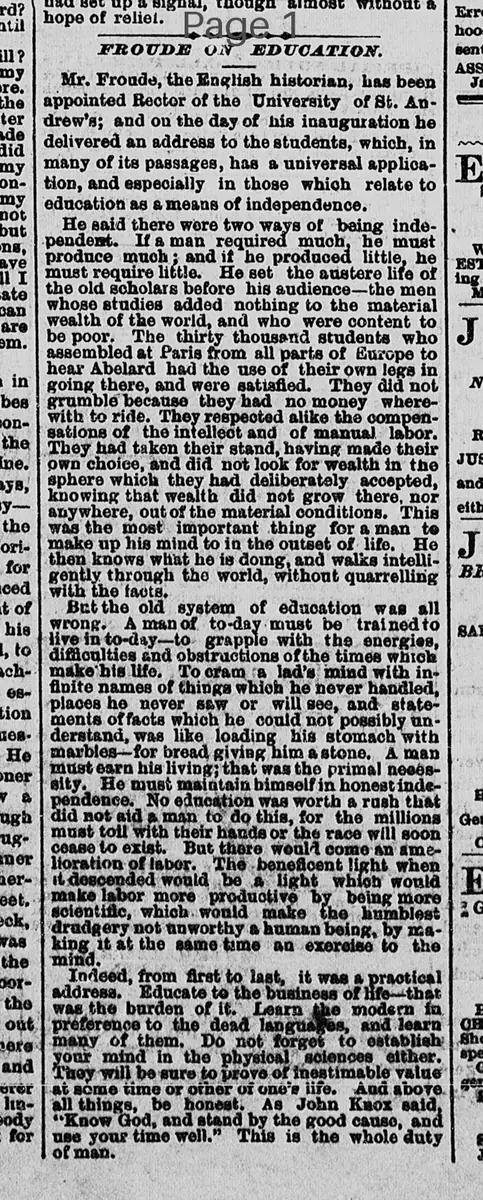
Mr. Froude, the English historian, has been appointed Rector of the University of St. Andrew's; and on the day of his inauguration he delivered an address to the students, which, in many of its passages, has a universal application, and especially in those which relate to education as a means of independence.
He said there were two ways of being independent. If a man required much, he must produce much; and if he produced little, he must require little. He set the austere life of the old scholars before his audience-the men whose studies added nothing to the material wealth of the world, and who were content to be poor. The thirty thousand students who assembled at Paris from all parts of Europe to hear Abelard had the use of their own legs in going there, and were satisfied. They did not grumble because they had no money wherewith to ride. They respected alike the compensations of the intellect and of manual labor. They had taken their stand, having made their own choice, and did not look for wealth in the sphere which they had deliberately accepted, knowing that wealth did not grow there, nor anywhere, out of the material conditions. This was the most important thing for a man to make up his mind to in the outset of life. He then knows what he is doing, and walks intelligently through the world, without quarrelling with the facts.
But the old system of education was all wrong. A man of to-day must be trained to live in to-day-to grapple with the energies, difficulties and obstructions of the times which make his life. To cram a lad's mind with infinite names of things which he never handled, places he never saw or will see, and statements of facts which he could not possibly understand, was like loading his stomach with marbles-for bread; giving him a stone. A man must earn his living; that was the primal necessity. He must maintain himself in honest independence. No education was worth a rush that did not aid a man to do this, for the millions must toil with their hands or the race will soon cease to exist. But there would come an amelioration of labor. The beneficent light when it descended would be a light which would make labor more productive by being more scientific, which would make the humblest drudgery not unworthy a human being, by making it at the same time an exercise to the mind.
Indeed from first to last, it was a practical address. Educate to the business of life; that was the burden of it. Learn the modern in preference to the dead languages, and learn many of them. Do not forget to establish your mind in the physical sciences either. They will be sure to prove of inestimable value at some time or other of one's life. And above all things, be honest. As John Knox said, "Know God, and stand by the good cause, and use your time well." This is the whole duty of man.
Mr. Froude, the English historian, has been appointed Rector of the University of St. Andrew's; and on the day of his inauguration he delivered an address to the students, which, in many of its passages, has a universal application, and especially in those which relate to education as a means of independence.
He said there were two ways of being independent. If a man required much, he must produce much; and if he produced little, he must require little. He set the austere life of the old scholars before his audience-the men whose studies added nothing to the material wealth of the world, and who were content to be poor. The thirty thousand students who assembled at Paris from all parts of Europe to hear Abelard had the use of their own legs in going there, and were satisfied. They did not grumble because they had no money wherewith to ride. They respected alike the compensations of the intellect and of manual labor. They had taken their stand, having made their own choice, and did not look for wealth in the sphere which they had deliberately accepted, knowing that wealth did not grow there, nor anywhere, out of the material conditions. This was the most important thing for a man to make up his mind to in the outset of life. He then knows what he is doing, and walks intelligently through the world, without quarrelling with the facts.
But the old system of education was all wrong. A man of to-day must be trained to live in to-day-to grapple with the energies, difficulties and obstructions of the times which make his life. To cram a lad's mind with infinite names of things which he never handled, places he never saw or will see, and statements of facts which he could not possibly understand, was like loading his stomach with marbles-for bread; giving him a stone. A man must earn his living; that was the primal necessity. He must maintain himself in honest independence. No education was worth a rush that did not aid a man to do this, for the millions must toil with their hands or the race will soon cease to exist. But there would come an amelioration of labor. The beneficent light when it descended would be a light which would make labor more productive by being more scientific, which would make the humblest drudgery not unworthy a human being, by making it at the same time an exercise to the mind.
Indeed from first to last, it was a practical address. Educate to the business of life; that was the burden of it. Learn the modern in preference to the dead languages, and learn many of them. Do not forget to establish your mind in the physical sciences either. They will be sure to prove of inestimable value at some time or other of one's life. And above all things, be honest. As John Knox said, "Know God, and stand by the good cause, and use your time well." This is the whole duty of man.
What sub-type of article is it?
Education
Social Reform
What keywords are associated?
Education Reform
Practical Learning
Independence
Modern Sciences
Honest Labor
Scientific Progress
What entities or persons were involved?
Mr. Froude
University Of St. Andrew's
Abelard
John Knox
Editorial Details
Primary Topic
Froude's Advocacy For Practical Modern Education
Stance / Tone
Supportive Of Practical, Scientific Education For Independence And Honest Living
Key Figures
Mr. Froude
University Of St. Andrew's
Abelard
John Knox
Key Arguments
Two Ways Of Independence: Produce Much If Require Much, Or Require Little If Produce Little
Old Scholars Content With Poverty And Intellectual Pursuits
Old Education System Wrong; Must Train For Modern Life's Challenges
Crammed Knowledge Useless Like 'Marbles For Bread'
Education Must Aid Earning A Living And Honest Independence
Future Labor Amelioration Through Scientific Methods
Prioritize Modern Languages And Physical Sciences Over Dead Languages
Above All, Be Honest And Use Time Well