Thank you for visiting SNEWPapers!
Sign up free
Story
October 3, 1894
The Star
Reynoldsville, Jefferson County, Pennsylvania
What is this article about?
The Bank of England profits significantly from lost or destroyed bank notes, with over £1.3 million in outstanding notes from 1792-1832. Details on stopping lost notes, recovery procedures including guarantees for destroyed ones, and anecdotes of intentional spoilage by laborers for bravado.
Clipping
OCR Quality
98%
Excellent
Full Text
Lost and Spoiled Money.
The Bank of England Makes a Big Profit on Her Notes.
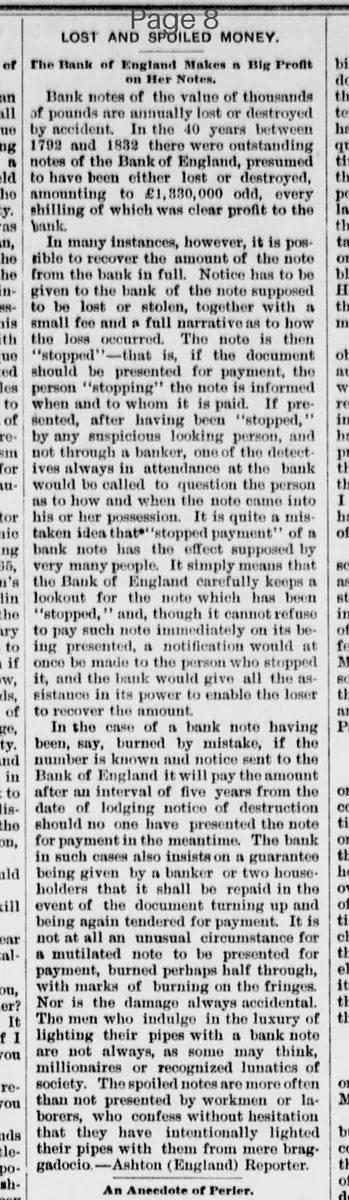
Bank notes of the value of thousands of pounds are annually lost or destroyed by accident. In the 40 years between 1792 and 1832 there were outstanding notes of the Bank of England, presumed to have been either lost or destroyed, amounting to £1,330,000 odd, every shilling of which was clear profit to the bank.
In many instances, however, it is possible to recover the amount of the note from the bank in full. Notice has to be given to the bank of the note supposed to be lost or stolen, together with a small fee and a full narrative as to how the loss occurred. The note is then "stopped" - that is, if the document should be presented for payment, the person "stopping" the note is informed when and to whom it is paid. If presented, after having been "stopped," by any suspicious looking person, and not through a banker, one of the detectives always in attendance at the bank would be called to question the person as to how and when the note came into his or her possession. It is quite a mistaken idea that "stopped payment" of a bank note has the effect supposed by very many people. It simply means that the Bank of England carefully keeps a lookout for the note which has been "stopped," and, though it cannot refuse to pay such note immediately on its being presented, a notification would at once be made to the person who stopped it, and the bank would give all the assistance in its power to enable the loser to recover the amount.
In the case of a bank note having been, say, burned by mistake, if the number is known and notice sent to the Bank of England it will pay the amount after an interval of five years from the date of lodging notice of destruction should no one have presented the note for payment in the meantime. The bank in such cases also insists on a guarantee being given by a banker or two house holders that it shall be repaid in the event of the document turning up and being again tendered for payment. It is not at all an unusual circumstance for a mutilated note to be presented for payment, burned perhaps half through, with marks of burning on the fringes. Nor is the damage always accidental. The men who indulge in the luxury of lighting their pipes with a bank note are not always, as some may think, millionaires or recognized lunatics of society. The spoiled notes are more often than not presented by workmen or laborers, who confess without hesitation that they have intentionally lighted their pipes with them from mere braggadocio. - Ashton (England) Reporter.
The Bank of England Makes a Big Profit on Her Notes.
Bank notes of the value of thousands of pounds are annually lost or destroyed by accident. In the 40 years between 1792 and 1832 there were outstanding notes of the Bank of England, presumed to have been either lost or destroyed, amounting to £1,330,000 odd, every shilling of which was clear profit to the bank.
In many instances, however, it is possible to recover the amount of the note from the bank in full. Notice has to be given to the bank of the note supposed to be lost or stolen, together with a small fee and a full narrative as to how the loss occurred. The note is then "stopped" - that is, if the document should be presented for payment, the person "stopping" the note is informed when and to whom it is paid. If presented, after having been "stopped," by any suspicious looking person, and not through a banker, one of the detectives always in attendance at the bank would be called to question the person as to how and when the note came into his or her possession. It is quite a mistaken idea that "stopped payment" of a bank note has the effect supposed by very many people. It simply means that the Bank of England carefully keeps a lookout for the note which has been "stopped," and, though it cannot refuse to pay such note immediately on its being presented, a notification would at once be made to the person who stopped it, and the bank would give all the assistance in its power to enable the loser to recover the amount.
In the case of a bank note having been, say, burned by mistake, if the number is known and notice sent to the Bank of England it will pay the amount after an interval of five years from the date of lodging notice of destruction should no one have presented the note for payment in the meantime. The bank in such cases also insists on a guarantee being given by a banker or two house holders that it shall be repaid in the event of the document turning up and being again tendered for payment. It is not at all an unusual circumstance for a mutilated note to be presented for payment, burned perhaps half through, with marks of burning on the fringes. Nor is the damage always accidental. The men who indulge in the luxury of lighting their pipes with a bank note are not always, as some may think, millionaires or recognized lunatics of society. The spoiled notes are more often than not presented by workmen or laborers, who confess without hesitation that they have intentionally lighted their pipes with them from mere braggadocio. - Ashton (England) Reporter.
What sub-type of article is it?
Curiosity
Historical Event
What themes does it cover?
Misfortune
Fortune Reversal
What keywords are associated?
Lost Bank Notes
Bank Profit
Note Recovery
Stopped Notes
Spoiled Money
Burned Notes
What entities or persons were involved?
Bank Of England
Where did it happen?
England
Story Details
Key Persons
Bank Of England
Location
England
Event Date
1792 1832
Story Details
Bank of England profits from lost or destroyed notes totaling £1,330,000 over 40 years; explains stopping lost notes, recovery after five years for destroyed ones with guarantees, and common intentional spoilage by laborers.