Thank you for visiting SNEWPapers!
Sign up free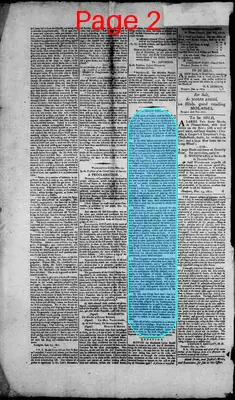
Editorial
January 9, 1802
Rhode Island Republican
Newport, Newport County, Rhode Island
What is this article about?
Editorial from Boston Chronicle defends President Jefferson's use of a written message to Congress instead of a speech, arguing it better suits the Constitution, avoids undue influence, saves time and money, and criticizes past Federalist-era practices as wasteful and manipulative.
Clipping
OCR Quality
98%
Excellent
Full Text
From the Boston Chronicle.
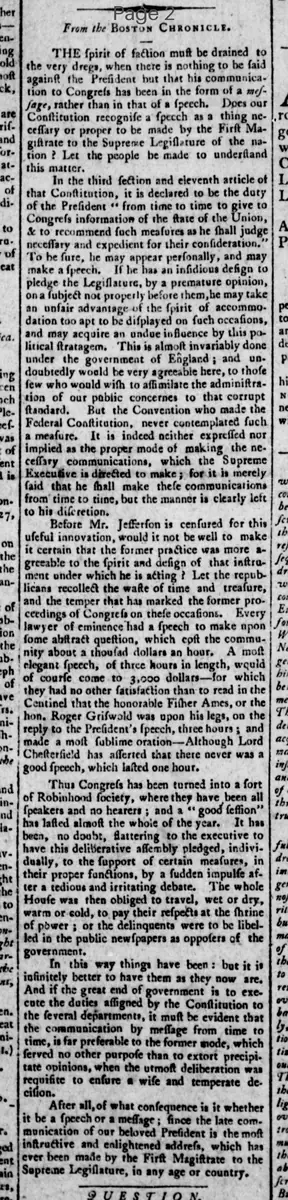
THE spirit of faction must be drained to the very dregs, when there is nothing to be said against the President but that his communication to Congress has been in the form of a message, rather than in that of a speech. Does our Constitution recognise a speech as a thing necessary or proper to be made by the First Magistrate to the Supreme Legislature of the nation? Let the people be made to understand this matter.
In the third section and eleventh article of that Constitution, it is declared to be the duty of the President "from time to time to give to Congress information of the state of the Union, & to recommend such measures as he shall judge necessary and expedient for their consideration."
To be sure, he may appear personally, and may make a speech. If he has an insidious design to pledge the Legislature, by a premature opinion, on a subject not properly before them, he may take an unfair advantage of the spirit of accommodation too apt to be displayed on such occasions, and may acquire an undue influence by this political stratagem. This is almost invariably done under the government of England; and undoubtedly would be very agreeable here, to those few who would wish to assimilate the administration of our public concerns to that corrupt standard. But the Convention who made the Federal Constitution, never contemplated such a measure. It is indeed neither expressed nor implied as the proper mode of making the necessary communications, which the Supreme Executive is directed to make; for it is merely said that he shall make these communications from time to time, but the manner is clearly left to his discretion.
Before Mr. Jefferson is censured for this useful innovation, would it not be well to make it certain that the former practice was more agreeable to the spirit and design of that instrument under which he is acting? Let the republicans recollect the waste of time and treasure, and the temper that has marked the former proceedings of Congress on these occasions. Every lawyer of eminence had a speech to make upon some abstract question, which cost the community about a thousand dollars an hour. A most elegant speech, of three hours in length, would of course come to 3,000 dollars—for which they had no other satisfaction than to read in the Centinel that the honorable Fisher Ames, or the hon. Roger Griswold was upon his legs, on the reply to the President's speech, three hours; and made a most sublime oration—Although Lord Chesterfield has asserted that there never was a good speech, which lasted one hour.
Thus Congress has been turned into a sort of Robinhood society, where they have been all speakers and no hearers: and a "good session" has lasted almost the whole of the year. It has been, no doubt, flattering to the executive to have this deliberative assembly pledged, individually, to the support of certain measures, in their proper functions, by a sudden impulse after a tedious and irritating debate. The whole House was then obliged to travel, wet or dry, warm or cold, to pay their respects at the shrine of power: or the delinquents were to be libelled in the public newspapers as opposers of the government.
In this way things have been: but it is infinitely better to have them as they now are. And if the great end of government is to execute the duties assigned by the Constitution to the several departments, it must be evident that the communication by message from time to time, is far preferable to the former mode, which served no other purpose than to extort precipitate opinions, when the utmost deliberation was requisite to ensure a wise and temperate decision.
After all, of what consequence is it whether it be a speech or a message; since the late communication of our beloved President is the most instructive and enlightened address, which has ever been made by the First Magistrate to the Supreme Legislature, in any age or country.
THE spirit of faction must be drained to the very dregs, when there is nothing to be said against the President but that his communication to Congress has been in the form of a message, rather than in that of a speech. Does our Constitution recognise a speech as a thing necessary or proper to be made by the First Magistrate to the Supreme Legislature of the nation? Let the people be made to understand this matter.
In the third section and eleventh article of that Constitution, it is declared to be the duty of the President "from time to time to give to Congress information of the state of the Union, & to recommend such measures as he shall judge necessary and expedient for their consideration."
To be sure, he may appear personally, and may make a speech. If he has an insidious design to pledge the Legislature, by a premature opinion, on a subject not properly before them, he may take an unfair advantage of the spirit of accommodation too apt to be displayed on such occasions, and may acquire an undue influence by this political stratagem. This is almost invariably done under the government of England; and undoubtedly would be very agreeable here, to those few who would wish to assimilate the administration of our public concerns to that corrupt standard. But the Convention who made the Federal Constitution, never contemplated such a measure. It is indeed neither expressed nor implied as the proper mode of making the necessary communications, which the Supreme Executive is directed to make; for it is merely said that he shall make these communications from time to time, but the manner is clearly left to his discretion.
Before Mr. Jefferson is censured for this useful innovation, would it not be well to make it certain that the former practice was more agreeable to the spirit and design of that instrument under which he is acting? Let the republicans recollect the waste of time and treasure, and the temper that has marked the former proceedings of Congress on these occasions. Every lawyer of eminence had a speech to make upon some abstract question, which cost the community about a thousand dollars an hour. A most elegant speech, of three hours in length, would of course come to 3,000 dollars—for which they had no other satisfaction than to read in the Centinel that the honorable Fisher Ames, or the hon. Roger Griswold was upon his legs, on the reply to the President's speech, three hours; and made a most sublime oration—Although Lord Chesterfield has asserted that there never was a good speech, which lasted one hour.
Thus Congress has been turned into a sort of Robinhood society, where they have been all speakers and no hearers: and a "good session" has lasted almost the whole of the year. It has been, no doubt, flattering to the executive to have this deliberative assembly pledged, individually, to the support of certain measures, in their proper functions, by a sudden impulse after a tedious and irritating debate. The whole House was then obliged to travel, wet or dry, warm or cold, to pay their respects at the shrine of power: or the delinquents were to be libelled in the public newspapers as opposers of the government.
In this way things have been: but it is infinitely better to have them as they now are. And if the great end of government is to execute the duties assigned by the Constitution to the several departments, it must be evident that the communication by message from time to time, is far preferable to the former mode, which served no other purpose than to extort precipitate opinions, when the utmost deliberation was requisite to ensure a wise and temperate decision.
After all, of what consequence is it whether it be a speech or a message; since the late communication of our beloved President is the most instructive and enlightened address, which has ever been made by the First Magistrate to the Supreme Legislature, in any age or country.
What sub-type of article is it?
Constitutional
Partisan Politics
What keywords are associated?
Presidential Message
Constitutional Procedure
Jefferson Defense
Congress Speech
Federalist Criticism
State Of The Union
What entities or persons were involved?
President Jefferson
Congress
Fisher Ames
Roger Griswold
Constitution
Federal Convention
Editorial Details
Primary Topic
Defense Of Jefferson's Message To Congress Over Speech
Stance / Tone
Supportive Of Jefferson's Constitutional Innovation And Critical Of Federalist Practices
Key Figures
President Jefferson
Congress
Fisher Ames
Roger Griswold
Constitution
Federal Convention
Key Arguments
Constitution Leaves Manner Of Presidential Communication To Discretion
Speeches Allow Undue Influence Similar To English Practices
Former Speeches Wasted Time And Money On Irrelevant Debates
Messages Promote Deliberation And Wise Decisions
Jefferson's Message Is The Most Instructive Ever