Thank you for visiting SNEWPapers!
Sign up free
United Automobile Worker
Detroit, Wayne County, Michigan
What is this article about?
Historical account of the Carriage, Wagon and Automobile Workers Union's disputes with AFL and series of strikes in auto industry from 1914-1917, including Hendee, Locomobile, American Car and Foundry, pattern makers, and others in Detroit and nationwide, demanding 8-hour day, recognition, and better pay amid mechanization and war influences.
Merged-components note: Merged parts of the 'High Points in Development of Automobile Labor' series (third installment) continued across pages 6 and 8
Clippings
1 of 2
OCR Quality
Full Text
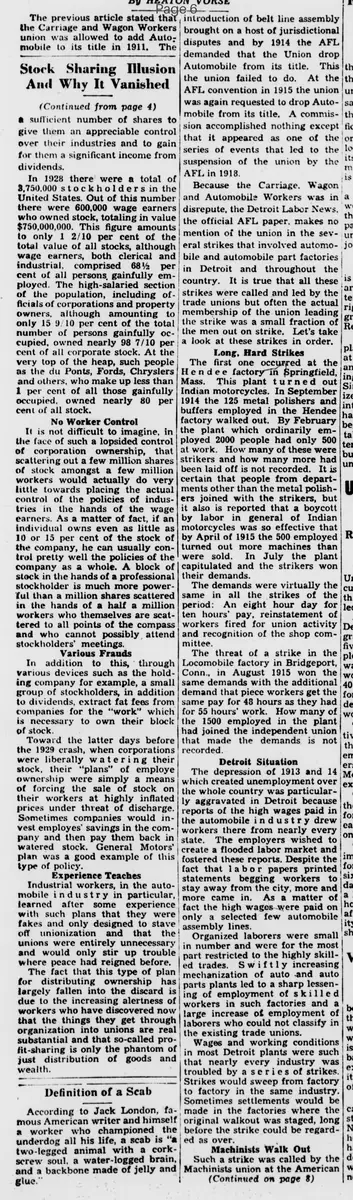
Because the Carriage, Wagon and Automobile Workers was in disrepute, the Detroit Labor News, the official AFL paper, makes no mention of the union in the several strikes that involved automobile and automobile part factories in Detroit and throughout the country. It is true that all these strikes were called and led by the trade unions but often the actual membership of the union leading the strike was a small fraction of the men out on strike. Let's take a look at these strikes in order.
Long, Hard Strikes
The first one occurred at the Hendee factory in Springfield, Mass. This plant turned out Indian motorcycles. In September 1914 the 125 metal polishers and buffers employed in the Hendee factory walked out. By February the plant which ordinarily employed 2000 people had only 500 at work. How many of these were strikers and how many more had been laid off is not recorded. It is certain that people from departments other than the metal polishers joined with the strikers, but it also is reported that a boycott by labor in general of Indian motorcycles was so effective that by April of 1915 the 500 employed turned out more machines than were sold. In July the plant capitulated and the strikers won their demands.
The demands were virtually the same in all the strikes of the period: An eight hour day for ten hours' pay, reinstatement of workers fired for union activity and recognition of the shop committee.
The threat of a strike in the Locomobile factory in Bridgeport, Conn., in August 1915 won the same demands with the additional demand that piece workers get the same pay for 48 hours as they had for 55 hours' work. How many of the 1500 employed in the plant had joined the independent union that made the demands is not recorded.
Detroit Situation
The depression of 1913 and 14 which created unemployment over the whole country was particularly aggravated in Detroit because reports of the high wages paid in the automobile industry drew workers there from nearly every state. The employers wished to create a flooded labor market and fostered these reports. Despite the fact that labor papers printed statements begging workers to stay away from the city, more and more came in. As a matter of fact the high wages were paid on only a selected few automobile assembly lines.
Organized laborers were small in number and were for the most part restricted to the highly skilled trades. Swiftly increasing mechanization of auto and auto parts plants led to a sharp lessening of employment of skilled workers in such factories and a large increase of employment of laborers who could not classify in the existing trade unions.
Wages and working conditions in most Detroit plants were such that nearly every industry was troubled by a series of strikes. Strikes would sweep from factory to factory in the same industry. Sometimes settlements would be made in the factories where the original walkout was staged, long before the strike could be regarded as over.
Machinists Walk Out
Such a strike was called by the Machinists union at the American
Auto Labor History
Car and Foundry plant Oct. 26, 1915. The 60 machinists and 700 other workers walked out from both shifts. They complained of long hours and non-recognition of the shop committee.
By Nov. 19, Seiwick Bros. and the Mailometer factories joined the machinists' strike and similar strike threats in several automobile and parts plants led to their voluntary acceptance of an 8-hour day.
It should be pointed out that the European war had lifted the depression from the industrialists of Detroit. Factories that turned out metal auto parts were well suited to make shrapnel for the western front. Such plants were the above mentioned Seiwick Bros. and the American Car and Foundry company. On the other hand, the overflooded labor market led those who did have jobs to hang to them in spite of long hours and low pay.
8-Hour Day, 10-Hours Pay
By Dec. 17, the strike in the American Car and Foundry was settled. The strikers won a raise in pay from 37½ cents to 45 and 55 cents an hour and no union discrimination. Two weeks later Seiwick Bros. settled for an eight-hour day with ten hours' pay. The Mailometer factory was still out and was joined by 2,000 strikers from the Kelsey factory by May 5 of the next year.
The pattern makers were fairly well paid in the larger factories of Detroit. The wage was a minimum of 55 cents an hour for a 44-hour week. Ford paid a minimum of $5 up to $7 a day for this class of work and Studebaker paid $4.50 for an eight-hour day. These plants had to meet the competition of several smaller factories where the labor standards were markedly lower. A certain Mr. Whirl, nebulously attached to a manufacturers' association, organized a Pattern Makers league of 195 members in these small plants.
On Feb. 4 these 195 and 22 other workers walked out of the Eastern Pattern & Construction company, the National Pattern shop, the Michigan Pattern company and seven other Detroit Pattern factories.
Police Brutality
At an unspecified time thereafter the Pattern Makers' league discovered the true nature of their organizer with the result that they joined the AFL affiliated Brotherhood of Patternmakers and proceeded to put up a real fight, winning out in spite of police brutality, injunctions and the arrest of five of them for contempt of court. This was a long drawn out battle. It wasn't until the middle of January 1917 that the last pattern-maker went back to work in this city, with all his demands won, while many had gone to other places to find work.
The winter and spring of 1916 saw strikes of every nature in Detroit. These strikes were cutting into the rich profits of the bosses and they with the able help of the police and the courts were using every means to break the strikes in particular and union organization in general. For instance at the striking Mailometer factories, the Detroit Labor News reported Feb. 4, 1916, that there were 30 police on hand to guard the 15 pickets.
Strike Breakers
A spokesman for the Machinists union is quoted, "Detroit is the only place in the country, so far as I know, where they put police at shops where strikes are on before there is any trouble." The same paper printed a story March 17 telling how the pattern manufacturers were attempting to get out-of-city patternmakers to come to Detroit. Another subterfuge was that the Packard and Cadillac factories would advertise for patternmakers and when workers applied they would be sent to struck plants. At the plants the police would tell the workers that there was no strike and would virtually rush them into the plants before pickets could tell them otherwise.
Courts all over the country were issuing anti-labor injunctions faster than a multigraph can spin out carbon copies.
Every issue of the Detroit Labor News of the period carried bitter editorials deploring the actions of the courts. On May 26 the injunction against the striking patternmakers was printed in full. It was, to coin a phrase, a sweeping injunction regulating just about everything in the strikers' life.
Ford Imports Police
In a previous issue, that of May 12, the paper carried the picture of a squad of police armed with rifles on the way to a tiny strike in the Ford chemical plant in Dearborn. These policemen were sent out of the city while a crime wave, undoubtedly due to the large number of unemployed, was causing the daily papers to editorialize the necessity for a larger police force in the city.
In spite of the opposition, strikes continued to grow in number and size. By May 12 one factory, the Michigan Motor Specialties, signed a union agreement with the Machinists involving 125 employees. The agreement was for the usual 8 for 10. But the same week saw two other factories, the Hayes Manufacturing company and the Detroit Gear and Machine company, join the list of plants struck by the Machinists and 425 men walked out.
Wages Raised
On June 1 the Willys Overland Automobile company in Toledo cut hours from 50 to 48 and raised the wages in some departments from 4 to 10 per cent. As automobile companies are notoriously non-altruistic it may be assumed that these favors were granted to avert a strike.
Another story in the Detroit Labor News of May 12 reports that the Murchey Machine company offered to settle its strike with the Machinists by a raise in wages but the men held out for their hour demands.
Next week's issue of the same paper reported that the strikers at the Hayes factory had increased to 700 in number and that the police outnumbered the pickets at struck plants two and three to one.
This, unfortunately, is the last story the paper carried about the Machinist strike. A huge strike in the Detroit cigar industry and the Patternmakers strike crowded it out of the four-page labor paper.
1917 and the War
That the Patternmakers won their strike in January has been recorded. The automobile industry was quiet during the winter of 1917. Not until May 6 of that year were there any labor difficulties reported.
At some time previous to that date the die sinkers in the Dodge Motor company asked for a wage increase. This demand was greeted by the firing of the ring leaders.
When protest was made against this action the company dished out 17 additional lay-offs. This caused the Brotherhood of Drop Forge Trades to call a strike in the plant.
The outcome of this strike is not recorded but it is interesting to note that this was the only strike called in an automobile factory proper during this period.
By this time the United States had entered the European war and it was termed unpatriotic to strike. Further, Congress was enacting a food control bill which in addition controlled virtually all production and particularly that involving war material.
The automobile industry had already entered the munitions field. The machinery of the War Labor board saw to it that there were no strikes in the auto industry during the war.
What sub-type of article is it?
What themes does it cover?
What keywords are associated?
What entities or persons were involved?
Where did it happen?
Story Details
Key Persons
Location
Detroit
Event Date
1914 1917
Story Details
The Carriage, Wagon and Automobile Workers Union faced AFL demands to drop 'Automobile' from its title, leading to suspension in 1918. Amid mechanization and depression, strikes erupted in auto factories for 8-hour days, recognition, and pay raises, including Hendee (1914-1915 win), Locomobile (1915 threat success), American Car and Foundry (1915-1916 settlement), pattern makers (1916-1917 win despite opposition), and others, suppressed by police, courts, and war in 1917.