Thank you for visiting SNEWPapers!
Sign up free
Morning Republican
Little Rock, Pulaski County, Arkansas
What is this article about?
The first day's proceedings of the Republican Congressional Convention for Arkansas's First District in Augusta on August 18, 1868, involved organizing the body, appointing officers and a credentials committee amid disputes over delegate representation from contested counties, heated debates on procedure, and adjournment after controversy over a resolution.
Merged-components note: Parts of the same report on the congressional convention proceedings.
Clipping
OCR Quality
Full Text
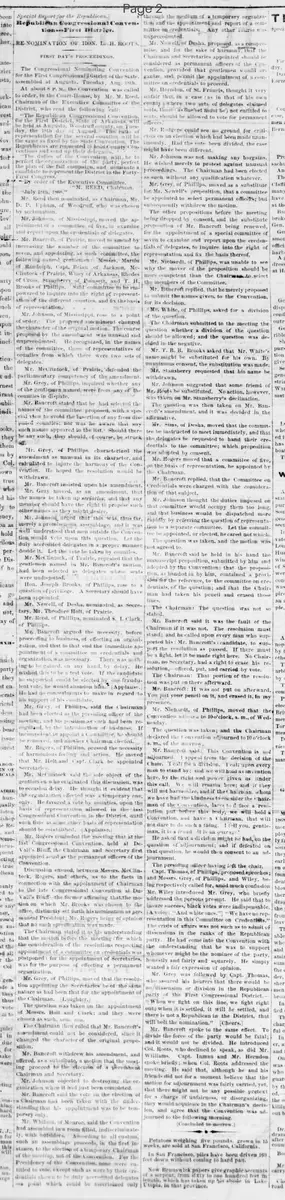
Republican Congressional Convention—First District.
RE-NOMINATION OF HON. L. H. ROOTS.
FIRST DAY'S PROCEEDINGS.
The Congressional Nominating Convention for the First Congressional District of the State, assembled at Augusta, Tuesday, Aug. 18th.
At about 8 P. M., the Convention was called to order, in the Court-House, by Mr. M. Reed, Chairman of the Executive Committee of the District, who read the following call:
"The Republican Congressional Convention, for the First District, State of Arkansas, will be held at Augusta, Woodruff county, on Tuesday, the 18th day of August. The ratio of representation for the several counties will be the same as fixed by the State Convention. The Republicans are requested to hold County Conventions and send up their delegates.
The duties of the Convention will be to perfect the organization of the party, perfect the plan of the fall campaign, and nominate a candidate to represent the District in the Forty-First Congress.
By order of the Executive Committee.
M. REED, Chairman.
July 18th, 1868."
Mr. Reed then nominated, as Chairman, Mr. D. P. Upham, of Woodruff, who was chosen by acclamation.
Mr. Johnson, of Mississippi, moved the appointment of a committee of five, to examine and report upon the credentials of delegates.
Mr. Bancroft, of Prairie, moved to amend by increasing the number of the committee to seven, and appointing, as such committee, the following-named gentlemen: Messrs. Martin of Randolph, Capt. Brian of Jackson, McClintock of Prairie, Wiley of Arkansas, Rhodes of Cross, Stansberry of Poinsett, and T. H. Brooks of Phillips. Said committee to be empowered to inquire into the right of representation of the different counties, and fix the basis of representation.
Mr. Johnson, of Mississippi, rose to a point of order. The proposed amendment changed the character of the original motion. The course proposed by the amendment was unusual and unprecedented. He recognized, in the names of the committee, those of representatives of counties from which there were two sets of delegates.
Mr. McClintock, of Prairie, defended the parliamentary competency of the amendment.
Mr. Grey, of Phillips, inquired whether any of the gentlemen named were from any of the counties in dispute.
Mr. Bancroft stated that he had selected the names of the committee proposed, with a special view to avoid the insertion of any from disputed counties; nor was he aware that any such names appeared in the list. Should there be any such, they should, of course, be struck off.
Mr. Grey, of Phillips, characterized the amendment as unusual in its character, and calculated to injure the harmony of the Convention. He hoped the resolution would be withdrawn.
Mr. Bancroft insisted upon his amendment.
Mr. Gray moved, as an amendment, that the names be taken up seriatim, and that any member should have the right to propose such other names as they might desire.
Mr. Johnson urged that this was, thus far, merely a promiscuous assemblage, and it was well understood that men outside the Convention would vote upon this question. Let the duly accredited delegates in a proper manner decide it. Let the vote be taken by counties.
Mr. McClintock, of Prairie, repeated that the gentlemen named in Mr. Bancroft's motion, had been selected as delegates whose seats were undisputed.
Hon. Joseph Brooks, of Phillips, rose to a question of privilege. A Secretary should have been appointed.
Mr. Newell, of Desha, nominated, as Secretary, Mr. Theodore Holt, of Prairie.
Mr. Reed, of Phillips, nominated S. L. Clark, of Phillips.
Mr. Bancroft argued the necessity, before proceeding to business, of effecting an organization, and that to that end the immediate appointment of a committee on credentials and organization was necessary. There was nothing to be gained, on any hand, by delay. He wished this to be a test vote. If the candidate he supported could be elected by one fraudulent vote, he would abandon him. [Applause.]
He had no contingencies to make in regard to his support of his candidate.
Mr. Grey, of Phillips, said the Chairman had been elected as the presiding officer of the meeting, and his position as such had been recognized, by the introduction of business. If incompetent to appoint a Committee, he should be removed, and another Chairman elected.
Mr. Rogers, of Phillips, pressed the necessity of harmonious feeling and action. He moved that Mr. Holt and Capt. Clark be appointed secretaries.
Mr. McClintock said the sole object of the gentlemen who originated this discussion, was to occasion delay. He thought it evident that the organization effected was a temporary one only. He favored a vote by counties, upon the basis of representation allowed in the last Congressional Convention in the District, until such time as some other basis of representation should be established. [Applause.]
Mr. Rogers reminded the meeting that at the last Congressional Convention, held at DeVall's Bluff, the Chairman and Secretary first appointed acted as the permanent officers of the Convention.
Discussion ensued, between Messrs. McClintock, Rogers, and others, as to the facts in connection with the appointment of Chairman to the late Congressional Convention at DeVall's Bluff—the former affirming that the motion on which Mr. Brooks was chosen to the office, distinctly set forth his nomination as permanent President; Mr. Rogers being of opinion that no such specification was made.
The Chairman stated it as his understanding that the motion before the meeting (for which the consideration of the resolutions respecting appointment of a committee on credentials was postponed) for the appointment of Secretaries, was for the purpose of effecting a permanent organization.
Mr. Grey, of Phillips, moved that the resolution appointing the Secretaries be of the same nature as had been that for the appointment of the Chairman. [Laughter.]
The question was taken on the appointment of Messrs. Holt and Clark; and they were chosen as such, nem. con.
The Chairman then ruled that Mr. Bancroft's amendment could not be considered, since it changed the character of the original proposition.
Mr. Bancroft withdrew his amendment, and offered, as a substitute, a motion that the meeting proceed to the election of a permanent Chairman and secretary.
Mr. Johnson objected to destroying the organization when it had just been completed.
Mr. Bancroft said the vote on the election of Chairman had been taken with the distinct understanding that his appointment was to be temporary only.
Mr. Whitacre, of Monroe said the Convention had assembled in a room filled, indiscriminately, with outsiders. According to all custom, such an assemblage proceeds, in the first instance, to the election of a temporary Chairman of the meeting, not of the Convention. For the Presidency of the Convention, none were entitled to vote, except such as were by their credentials shown to be duly accredited delegates—a point which could be ascertained only through the medium of a temporary organization and the appointment and report of a committee on credentials. Any other course was unprecedented.
Mr. Newell, of Desha, proposed, as a compromise, and for the sake of harmony, that the Chairman and secretaries appointed should be considered as permanent officers of the Convention, provided that gentlemen would organize, and permit the appointment of a committee on credentials to proceed.
Mr. Herndon, of St. Francis, thought it very unfair that, in a case (as in that of his own county) where two sets of delegates claimed seats, those of one set must be (not entitled to seats) allowed to vote for permanent officers.
Mr. Rodgers could see no ground for criticism on an election which had been made unanimously. Had the vote been divided, the case might have been different.
Mr. Johnson was not making any bargains. He wished merely to protest against unusual proceedings. The Chairman had been elected as such without any qualification whatever.
Mr. Grey, of Phillips, moved as a substitute for Mr. Newell's proposition, that a committee be appointed to select permanent officers; but subsequently withdrew the motion.
The other propositions before the meeting being dropped by consent, and the substitute proposition of Mr. Bancroft being renewed, for the appointment of a special committee of seven to examine and report upon the credentials of delegates, to inquire into the right of representation and fix the basis thereof.
Mr. Niehardt, of Phillips, was unable to see why the mover of the proposition should be more competent than the Chairman to select the members of the Committee.
Mr. Bancroft replied, that he merely proposed to submit the names given, to the Convention, for its decision.
Mr. White, of Phillips, asked for a division of the question.
The Chairman submitted to the meeting the question whether a division of the question should be allowed; and the question was decided in the negative.
Mr. T. B. Brooks asked that Mr. White's name might be substituted for his own. By unanimous consent, the substitution was made.
Mr. Stansberry requested that his name be withdrawn.
Mr. Johnson suggested that some friend of Mr. Roots be substituted. No action, however, was taken on Mr. Stansberry's declination.
The question was then taken on Mr. Bancroft's amendment, and it was decided in the affirmative.
Mr. Sims, of Desha, moved that the committee be instructed to meet immediately, and that the delegates be requested to hand their credentials to the committee; which proposition was adopted by consent.
Mr. Rogers moved that a committee of five, on the basis of representation, be appointed by the Chairman.
Mr. Bancroft replied, that the Committee on Credentials were charged with the consideration of that subject.
Mr. Johnson thought the duties imposed on that committee would occupy them too long, and that business would be dispatched more rapidly by referring the question of representation to a separate committee. Let the committee be appointed, or elected, he cared not which.
The question was taken, and the motion was not agreed to.
Mr. Bancroft said he held in his hand the manuscript proposition, submitted by him and adopted by the Convention: that the proposition, as handed in by him, contained a provision for the reference, to the committee on credentials, of the question; and that the Chairman had taken his pencil and erased those lines.
The Chairman: The question was not so stated.
Mr. Bancroft said it was the fault of the Chairman if it was not. The resolution must stand: and he called upon every man who supported his (Mr. Bancroft's) candidate, to support the resolution as passed. If there must be a fight, let it be made right here. No Chairman, no Secretaries, had a right to erase his resolution—offered, put, and carried by vote.
The Chairman: That portion of the resolution was put on there afterward.
Mr. Bancroft: It was not put on afterward. You put your pencil on it, and erased it, in my presence.
Mr. Niehardt, of Phillips, moved that the Convention adjourn to 10 o'clock, a. m., of Wednesday.
The question was taken; and the Chairman declared the Convention adjourned to 10 o'clock a. m., of the morrow.
Mr. Bancroft said: This Convention is not adjourned. I appeal from the decision of the Chair. I call for a division. I call upon every man to stand by; and we will hold a convention here, by the right and power given us under this call. We will remain here; and if they will not harmonize, and if the Chairman, whom we have had the kindness to consider the Chairman of the Convention, dares to defeat a resolution put before this body, we will hold a Convention, and have a Chairman, that will not dare to do such a thing. I tell you, gentlemen, it is a fraud; it is an outrage!
He asked that a division might be had, on the question of adjournment; and if defeated on that question, he would then consent to an adjournment.
The presiding officer having left the chair, Capt. Thomas, of Phillips, proposed speeches; and Messrs. Grey, of Phillips, and Wiley, being respectively called for, amid much confusion Mr. Wiley introduced Mr. Grey, who briefly addressed the persons present. He said that to insure success, black votes were indispensable.
A voice: "And white ones." "We have no representation in this Committee on Credentials." The crisis of affairs was not such as to admit of dissensions in the ranks of the Republican party. He had come into the Convention with the understanding that he was to support whomever might be the nominee of the party, honestly and fairly and squarely. He simply wanted a fair expression of opinion.
Mr. Grey was followed by Capt. Thomas, who assured his hearers that there would be no dissension or division in the Republican party of the First Congressional District.— "When we fight on this line, we fight right out; when it is settled, it will be settled, and there is not a Republican in the District, that will bolt the nomination." [Cheers.]
Mr. Bancroft spoke to the same effect. To divide the force of the party would be fatal; and it would not be divided. He introduced Col. Roots, who declined to speak, as did Mr. Williams. Capt. Inman and Mr. Herndon spoke briefly; when Col. Roots addressed the meeting. He said that, although he and his friends did not for a moment believe that the motion for adjournment was fairly carried, yet, that there might not be any possible pretext for a charge of unfairness, or disorganizing, they would acquiesce in the Chairman's decision, and agree that the Convention was adjourned to the following morning.
[Concluded to-morrow.]
What sub-type of article is it?
What themes does it cover?
What keywords are associated?
What entities or persons were involved?
Where did it happen?
Story Details
Key Persons
Location
Augusta, Woodruff County, Arkansas
Event Date
August 18, 1868
Story Details
The Republican Congressional Convention for Arkansas's First District assembled in Augusta to nominate a candidate for the 41st Congress. Proceedings included calling the convention to order, electing temporary officers, and intense debates over appointing a credentials committee to handle disputed county representations. Disputes arose on procedure, representation basis, and a contested resolution erasure, culminating in adjournment amid calls for party unity.