Thank you for visiting SNEWPapers!
Sign up free
Editorial
May 10, 1816
Alexandria Gazette, Commercial And Political
Alexandria, Virginia
What is this article about?
The editorial critiques an address in the Democratic Press censuring President Madison's administration for poor cabinet appointments, defends figures like Monroe, Dallas, and Crawford against the criticisms, and highlights political rivalries and bargains in Democratic politics.
Clipping
OCR Quality
95%
Excellent
Full Text
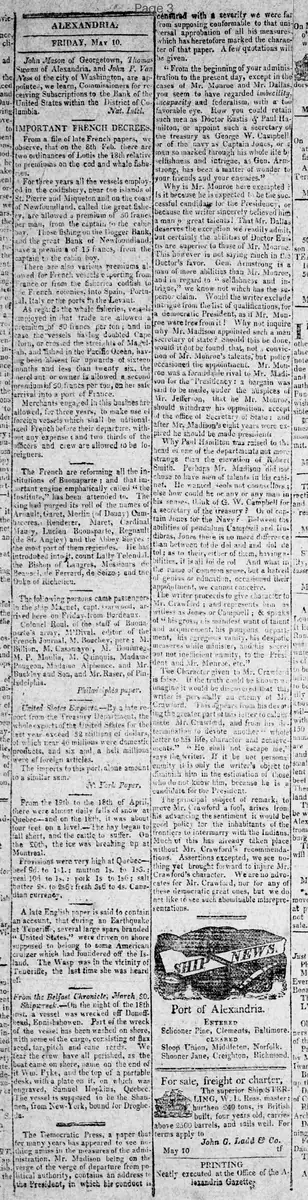
The Democratic Press, a paper that for many years has appeared to see nothing amiss in the measures of the administration, Mr. Madison being on the verge of departure from political authority, contains an address to the President, in which his conduct is censured with a severity we were far from supposing conformable to that universal approbation of all his measures which has heretofore marked the character of that paper. A few quotations will be given.
"From the beginning of your administration to the present day, except in the cases of Mr. Monroe and Mr. Dallas, you seem to have regarded imbecility, incapacity and federalism, with a too favorable eye. How you could retain such men as Doctor Eustis & Paul Hamilton, or appoint such a secretary of the treasury as George W. Campbell or of the navy as Captain Jones, or man so marked through his whole life by selfishness and intrigue, as Gen. Armstrong, has been a matter of wonder to your friends and your enemies."
Why is Mr. Monroe here exempted? Is it because he is expected to be the successful candidate for the Presidency, or because the writer sincerely believed him a man of great talents! That Mr. Dallas deserves the exception we readily admit, but certainly the abilities of Doctor Eustis are superior to those of Mr. Monroe. This however is not saying much in the Doctor's favor. Gen. Armstrong is a man of more abilities than Mr. Monroe, and in regard to "selfishness and intrigue," we know not which has the superior claim. Would the writer exclude intrigue from the list of qualifications, for a democratic President, as if Mr. Monroe were free from it! Why not inquire why Mr. Madison appointed such a man secretary of state? Should this be done, would it not be found that, not a conviction of Mr. Monroe's talents, but policy occasioned the appointment. Mr. Monroe was a formidable rival to Mr. Madison for the Presidency: a bargain was said to be made, under the auspices of Mr. Jefferson, that he Mr. Monroe, should withdraw his opposition, accept of the office of Secretary of State: and after Mr. Madison's eight years were expired he should be made president:
Why Paul Hamilton was raised to the head of one of the departments not more strange than the elevation of Robert Smith. Perhaps Mr. Madison did not choose to have men of talents in his cabinet. He wanted tools not counsellors; else how could he or any man in his senses, think of G. W. Campbell for a secretary of the treasury? Or of captain Jones for the Navy? Between the abilities of pendulum Campbell and Hudibras, Jones there is no more difference than between tol de rol and dol de tol; as to their, either of them, having abilities, it is all foi de rol. And what in the name of common sense, but a hatred of genius or education, occasioned their appointment, we cannot conceive.
The writer proceeds to give character to Mr. Crawford: and represents him as witless as Jones or Campbell: & speaks of "his gross, tis manifest want of talent and acquirement, his pompous deportment, his egregious vanity, his despotic measures while minister, and his secret but inefficient enmity, to the President and Mr. Monroe, etc."
The Character given to Mr. Crawford is false. If the truth could be known we imagine it would be discovered that this writer is personally an enemy of Mr. Crawford. This appears from his devoting the greater part of this letter to calumniate Mr. Crawford, and from his determination to devote another whole letter to his life, character and achievements." "He shall not escape me," says the writer. If it be not personal enmity it is only the writer's object to diminish him in the estimation of those who do not know him, because he is a candidate for the President,
The principal subject of remark, to prove Mr. Crawford a fool, arises from his advancing the sentiment it would be good policy for the inhabitants of the frontiers to intermarry with the Indians. Much of this has already taken place without Mr. Crawford's recommendations. Assertions excepted, we see nothing yet brought forward to injure Mr. Crawford's character. We are no advocates for Mr. Crawford, nor for any of these democratic great ones, but we do not like to see such abominable misrepresentations.
"From the beginning of your administration to the present day, except in the cases of Mr. Monroe and Mr. Dallas, you seem to have regarded imbecility, incapacity and federalism, with a too favorable eye. How you could retain such men as Doctor Eustis & Paul Hamilton, or appoint such a secretary of the treasury as George W. Campbell or of the navy as Captain Jones, or man so marked through his whole life by selfishness and intrigue, as Gen. Armstrong, has been a matter of wonder to your friends and your enemies."
Why is Mr. Monroe here exempted? Is it because he is expected to be the successful candidate for the Presidency, or because the writer sincerely believed him a man of great talents! That Mr. Dallas deserves the exception we readily admit, but certainly the abilities of Doctor Eustis are superior to those of Mr. Monroe. This however is not saying much in the Doctor's favor. Gen. Armstrong is a man of more abilities than Mr. Monroe, and in regard to "selfishness and intrigue," we know not which has the superior claim. Would the writer exclude intrigue from the list of qualifications, for a democratic President, as if Mr. Monroe were free from it! Why not inquire why Mr. Madison appointed such a man secretary of state? Should this be done, would it not be found that, not a conviction of Mr. Monroe's talents, but policy occasioned the appointment. Mr. Monroe was a formidable rival to Mr. Madison for the Presidency: a bargain was said to be made, under the auspices of Mr. Jefferson, that he Mr. Monroe, should withdraw his opposition, accept of the office of Secretary of State: and after Mr. Madison's eight years were expired he should be made president:
Why Paul Hamilton was raised to the head of one of the departments not more strange than the elevation of Robert Smith. Perhaps Mr. Madison did not choose to have men of talents in his cabinet. He wanted tools not counsellors; else how could he or any man in his senses, think of G. W. Campbell for a secretary of the treasury? Or of captain Jones for the Navy? Between the abilities of pendulum Campbell and Hudibras, Jones there is no more difference than between tol de rol and dol de tol; as to their, either of them, having abilities, it is all foi de rol. And what in the name of common sense, but a hatred of genius or education, occasioned their appointment, we cannot conceive.
The writer proceeds to give character to Mr. Crawford: and represents him as witless as Jones or Campbell: & speaks of "his gross, tis manifest want of talent and acquirement, his pompous deportment, his egregious vanity, his despotic measures while minister, and his secret but inefficient enmity, to the President and Mr. Monroe, etc."
The Character given to Mr. Crawford is false. If the truth could be known we imagine it would be discovered that this writer is personally an enemy of Mr. Crawford. This appears from his devoting the greater part of this letter to calumniate Mr. Crawford, and from his determination to devote another whole letter to his life, character and achievements." "He shall not escape me," says the writer. If it be not personal enmity it is only the writer's object to diminish him in the estimation of those who do not know him, because he is a candidate for the President,
The principal subject of remark, to prove Mr. Crawford a fool, arises from his advancing the sentiment it would be good policy for the inhabitants of the frontiers to intermarry with the Indians. Much of this has already taken place without Mr. Crawford's recommendations. Assertions excepted, we see nothing yet brought forward to injure Mr. Crawford's character. We are no advocates for Mr. Crawford, nor for any of these democratic great ones, but we do not like to see such abominable misrepresentations.
What sub-type of article is it?
Partisan Politics
What keywords are associated?
Democratic Press
Madison Administration
Cabinet Appointments
Presidential Candidates
Political Intrigue
Mr Monroe
Mr Crawford
Political Bargain
What entities or persons were involved?
Mr. Madison
Mr. Monroe
Mr. Dallas
Doctor Eustis
Paul Hamilton
George W. Campbell
Captain Jones
Gen. Armstrong
Mr. Crawford
Robert Smith
Mr. Jefferson
Democratic Press
Editorial Details
Primary Topic
Critique Of Democratic Press's Censure Of Madison's Cabinet Appointments And Defense Of Political Figures
Stance / Tone
Defensive Of Madison And Appointees, Critical Of Democratic Press's Misrepresentations
Key Figures
Mr. Madison
Mr. Monroe
Mr. Dallas
Doctor Eustis
Paul Hamilton
George W. Campbell
Captain Jones
Gen. Armstrong
Mr. Crawford
Robert Smith
Mr. Jefferson
Democratic Press
Key Arguments
Democratic Press Previously Supported Madison But Now Severely Censures His Appointments
Monroe Exempted Possibly Due To Presidential Candidacy, Not Superior Talents
Madison Appointed Monroe As Secretary Of State Via Political Bargain To Secure Presidency Succession
Criticisms Of Eustis, Hamilton, Campbell, Jones, And Armstrong Are Questioned Or Defended
Crawford's Character Portrayal As Witless And Vain Is False, Likely Personal Enmity Or To Undermine His Candidacy
Crawford's Idea Of Frontier Intermarriage With Indians Already Occurs And Does Not Prove Folly