Thank you for visiting SNEWPapers!
Sign up free
Editorial
September 20, 1828
Literary Cadet And Rhode Island Statesman
Providence, Providence County, Rhode Island
What is this article about?
An editorial accuses General Andrew Jackson of duplicity and possible treason in his dealings with Aaron Burr during the 1806-1807 conspiracy, citing court records, financial accounts, and Jackson's letter to Governor Claiborne as evidence of hypocrisy in supporting Burr after denouncing him.
Clipping
OCR Quality
95%
Excellent
Full Text
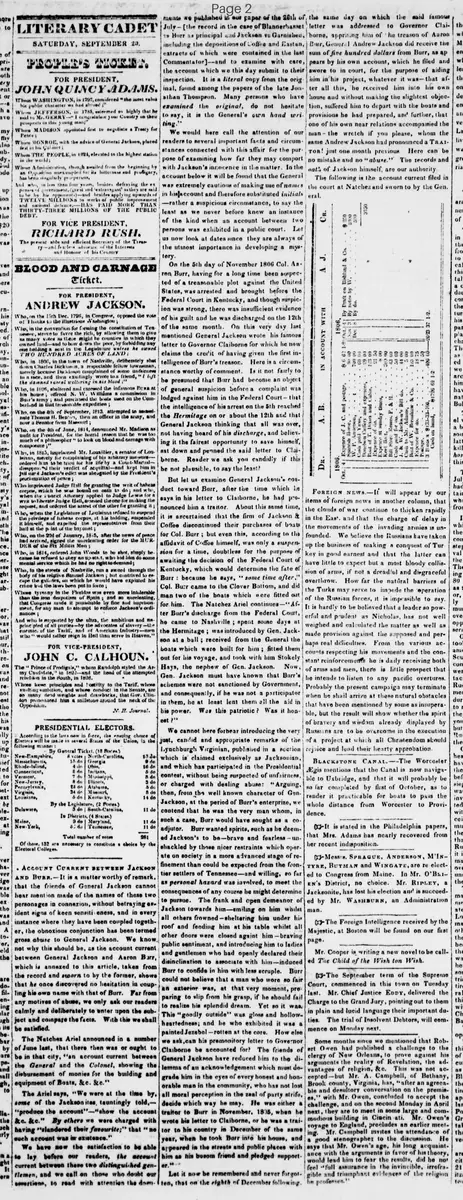
Account Current between Jackson and Burr.—It is a matter worthy of remark, that the friends of General Jackson cannot hear mention made of the names of these two personages in connexion, without betraying evident signs of keen sensitiveness, and in every instance where they have been coupled together, the obnoxious conjunction has been termed gross abuse to General Jackson. We know not why this should be, as the account current between General Jackson and Aaron Burr, which is annexed to this article, taken from the record and sworn to by the former, shows that he once discovered no hesitation in coupling his own name with that of Burr. Far from any motives of abuse, we only ask our readers calmly and deliberately to enter upon the subject and compare the facts. With this we shall be satisfied.
The Natchez Ariel announced in a number of June last, that there then was or ought to be in that city, "an account current between the General and the Colonel, showing the disbursement of monies for the building and equipment of Boats, &c. &c."
The Ariel says, "We were at the time by, some of the Jacksonites, tauntingly told,— 'produce the account'—'show the account &c. &c.' By others we were charged with having 'slandered their favourite;' that 'no such account was in existence.'
We have now the satisfaction to be able to lay before our readers, the account current between these two distinguished gentlemen, and we call on those who doubt our assertions, to read with attention the documents we published in one paper of the 20th of July—[the record in the case of Blennerhassett vs Burr as principal and Jackson vs Garnishee, including the depositions of Coffee and Erasty, extracts of which were contained in the last Commentator]—and to examine with care the account which we this day submit to their inspection. It is a literal copy from the original, found among the papers of the late Jonathan Thompson. Many persons who have examined the original, do not hesitate to say, it is the General's own handwriting
We would here call the attention of our readers to several important facts and circumstances connected with this affair for the purpose of examining how far they may comport with Jackson's innocence in the matter. In the account below it will be found that the General was extremely cautious of making use of names in his account and therefore substituted initials—rather a suspicious circumstance, to say the least as we never before knew an instance of the kind when an account between two persons was exhibited in a public court. Let us now look at dates since they are always of the utmost importance in developing a mystery
On the 5th day of November 1806 Col. Aaron Burr, having for a long time been suspected of a treasonable plot against the United States, was arrested and brought before the Federal Court in Kentucky, and though suspicion was strong, there was insufficient evidence of his guilt and he was discharged on the 12th of the same month. On this very day last mentioned General Jackson wrote his famous letter to Governor Claiborne for which he now claims the credit of having given the first intelligence of Burr's treason. Here is a circumstance worthy of comment. Is it not fairly to be presumed that Burr had become an object of general suspicion before a complaint was lodged against him in the Federal Court—that the intelligence of his arrest on the 5th reached the Hermitage on or about the 12th and that General Jackson thinking that all was over, not having heard of his discharge, and believing it the fairest opportunity to save himself, sat down and penned the said letter to Claiborne. Reader we ask you candidly if this be not plausible, to say the least?
But let us examine General Jackson's conduct toward Burr, after the time which he says in his letter to Claiborne, he had pronounced him a traitor. About this same time, it is ascertained that the firm of Jackson & Coffee discontinued their purchases of boats for Col. Burr; but even this, according to the affidavit of Coffee himself, was only a suspension for a time, doubtless for the purpose of awaiting the decision of the Federal Court of Kentucky, which would determine the fate of Burr: because he says, "some time after," Col. Burr came to the Clover Bottom, and did man two of the boats which were fitted out for him. The Natchez Ariel continues—"After Burr's discharge from the Federal Court, he came to Nashville; spent some days at the Hermitage: was introduced by Gen. Jackson at a ball; received from the General the boats which were built for him; fitted them out for his voyage, and took with him Stokely Hays, the nephew of Gen. Jackson. Now, Gen. Jackson must have known that Burr's schemes were not sanctioned by Government, and consequently, if he was not a participator in them, he at least lent them all the aid in his power. Was this patriotic? Was it honest?'
We cannot here forbear introducing the very just, candid and appropriate remarks of the Lynchburgh Virginian, published in a section which is claimed exclusively as Jacksonian, and which has participated in the Presidential contest, without being suspected of unfairness, or charged with dealing abuse: "Arguing, then, from the well known character of Gen. Jackson, at the period of Burr's enterprize, we contend that he was the very man whom, in such a case, Burr would have sought as a coadjutor. Burr wanted spirits, such as he deemed Jackson's to be—brave and fearless—unshackled by those nicer restraints which operate on society in a more advanced stage of refinement than could be expected from the frontier settlers of Tennessee—and willing, so far as personal hazard was involved, to meet the consequences of any course he might determine to pursue. The frank and open demeanor of Jackson towards him—smiling on him whilst all others frowned—sheltering him under his roof and feeding him at his table whilst all other doors were closed against him—braving public sentiment, and introducing him to ladies and gentlemen who had openly declared their disinclination to associate with him—induced Burr to confide in him with less scruple. Burr could not believe that a man who wore so fair an exterior was, at that very moment, preparing to slip from his grasp, if he should fail to realize his splendid dream. Yet so it was. This "goodly outside" was gloss and hollow-heartedness; and he who exhibited it was a painted Jezebel—rotten at the core. How else we ask, can his premonitory letter to Governor Claiborne be accounted for? The friends of General Jackson have reduced him to the dilemma of an acknowledgement which must degrade him in the eyes of every honest and honorable man in the community, who has not lost all moral perception in the zeal of party strife, decide which way he may, He was either traitor to Burr in November, 1806, when he wrote his letter to Claiborne, or he was a traitor to his country in December of the same year, when he took Burr into his house, and appeared in the streets and public places with him as his bosom friend and pledged supporter."..
Let it now be remembered and never forgotten, that on the eighth of December following, the same day on which the said famous letter was addressed to Governor Claiborne, apprising him of the treason of Aaron Burr, General Andrew Jackson did receive the sum of five hundred dollars from Burr, as appears by his own account, which he filed and swore to in court, for the purpose of aiding him in his project, whatever it was—that after all this, "he received him into his own house and without making the slightest objection, suffered him to depart with the boats and provisions he had prepared, and further, that one of his own near relations accompanied the man—the wretch if you please, whom the same Andrew Jackson had pronounced a TRAITOR! just one month previous.
Here can be no mistake and no "abuse." The records and oaths of Jackson himself, are our authority.
The following is the account current filed in the court at Natchez and sworn to by the General.
The Natchez Ariel announced in a number of June last, that there then was or ought to be in that city, "an account current between the General and the Colonel, showing the disbursement of monies for the building and equipment of Boats, &c. &c."
The Ariel says, "We were at the time by, some of the Jacksonites, tauntingly told,— 'produce the account'—'show the account &c. &c.' By others we were charged with having 'slandered their favourite;' that 'no such account was in existence.'
We have now the satisfaction to be able to lay before our readers, the account current between these two distinguished gentlemen, and we call on those who doubt our assertions, to read with attention the documents we published in one paper of the 20th of July—[the record in the case of Blennerhassett vs Burr as principal and Jackson vs Garnishee, including the depositions of Coffee and Erasty, extracts of which were contained in the last Commentator]—and to examine with care the account which we this day submit to their inspection. It is a literal copy from the original, found among the papers of the late Jonathan Thompson. Many persons who have examined the original, do not hesitate to say, it is the General's own handwriting
We would here call the attention of our readers to several important facts and circumstances connected with this affair for the purpose of examining how far they may comport with Jackson's innocence in the matter. In the account below it will be found that the General was extremely cautious of making use of names in his account and therefore substituted initials—rather a suspicious circumstance, to say the least as we never before knew an instance of the kind when an account between two persons was exhibited in a public court. Let us now look at dates since they are always of the utmost importance in developing a mystery
On the 5th day of November 1806 Col. Aaron Burr, having for a long time been suspected of a treasonable plot against the United States, was arrested and brought before the Federal Court in Kentucky, and though suspicion was strong, there was insufficient evidence of his guilt and he was discharged on the 12th of the same month. On this very day last mentioned General Jackson wrote his famous letter to Governor Claiborne for which he now claims the credit of having given the first intelligence of Burr's treason. Here is a circumstance worthy of comment. Is it not fairly to be presumed that Burr had become an object of general suspicion before a complaint was lodged against him in the Federal Court—that the intelligence of his arrest on the 5th reached the Hermitage on or about the 12th and that General Jackson thinking that all was over, not having heard of his discharge, and believing it the fairest opportunity to save himself, sat down and penned the said letter to Claiborne. Reader we ask you candidly if this be not plausible, to say the least?
But let us examine General Jackson's conduct toward Burr, after the time which he says in his letter to Claiborne, he had pronounced him a traitor. About this same time, it is ascertained that the firm of Jackson & Coffee discontinued their purchases of boats for Col. Burr; but even this, according to the affidavit of Coffee himself, was only a suspension for a time, doubtless for the purpose of awaiting the decision of the Federal Court of Kentucky, which would determine the fate of Burr: because he says, "some time after," Col. Burr came to the Clover Bottom, and did man two of the boats which were fitted out for him. The Natchez Ariel continues—"After Burr's discharge from the Federal Court, he came to Nashville; spent some days at the Hermitage: was introduced by Gen. Jackson at a ball; received from the General the boats which were built for him; fitted them out for his voyage, and took with him Stokely Hays, the nephew of Gen. Jackson. Now, Gen. Jackson must have known that Burr's schemes were not sanctioned by Government, and consequently, if he was not a participator in them, he at least lent them all the aid in his power. Was this patriotic? Was it honest?'
We cannot here forbear introducing the very just, candid and appropriate remarks of the Lynchburgh Virginian, published in a section which is claimed exclusively as Jacksonian, and which has participated in the Presidential contest, without being suspected of unfairness, or charged with dealing abuse: "Arguing, then, from the well known character of Gen. Jackson, at the period of Burr's enterprize, we contend that he was the very man whom, in such a case, Burr would have sought as a coadjutor. Burr wanted spirits, such as he deemed Jackson's to be—brave and fearless—unshackled by those nicer restraints which operate on society in a more advanced stage of refinement than could be expected from the frontier settlers of Tennessee—and willing, so far as personal hazard was involved, to meet the consequences of any course he might determine to pursue. The frank and open demeanor of Jackson towards him—smiling on him whilst all others frowned—sheltering him under his roof and feeding him at his table whilst all other doors were closed against him—braving public sentiment, and introducing him to ladies and gentlemen who had openly declared their disinclination to associate with him—induced Burr to confide in him with less scruple. Burr could not believe that a man who wore so fair an exterior was, at that very moment, preparing to slip from his grasp, if he should fail to realize his splendid dream. Yet so it was. This "goodly outside" was gloss and hollow-heartedness; and he who exhibited it was a painted Jezebel—rotten at the core. How else we ask, can his premonitory letter to Governor Claiborne be accounted for? The friends of General Jackson have reduced him to the dilemma of an acknowledgement which must degrade him in the eyes of every honest and honorable man in the community, who has not lost all moral perception in the zeal of party strife, decide which way he may, He was either traitor to Burr in November, 1806, when he wrote his letter to Claiborne, or he was a traitor to his country in December of the same year, when he took Burr into his house, and appeared in the streets and public places with him as his bosom friend and pledged supporter."..
Let it now be remembered and never forgotten, that on the eighth of December following, the same day on which the said famous letter was addressed to Governor Claiborne, apprising him of the treason of Aaron Burr, General Andrew Jackson did receive the sum of five hundred dollars from Burr, as appears by his own account, which he filed and swore to in court, for the purpose of aiding him in his project, whatever it was—that after all this, "he received him into his own house and without making the slightest objection, suffered him to depart with the boats and provisions he had prepared, and further, that one of his own near relations accompanied the man—the wretch if you please, whom the same Andrew Jackson had pronounced a TRAITOR! just one month previous.
Here can be no mistake and no "abuse." The records and oaths of Jackson himself, are our authority.
The following is the account current filed in the court at Natchez and sworn to by the General.
What sub-type of article is it?
Partisan Politics
Crime Or Punishment
What keywords are associated?
Jackson Burr Connection
Burr Conspiracy
Treason Allegations
Political Smear
Court Records
Financial Account
Hypocrisy
What entities or persons were involved?
General Andrew Jackson
Aaron Burr
Governor Claiborne
John Coffee
Stokely Hays
Natchez Ariel
Lynchburgh Virginian
Editorial Details
Primary Topic
Jackson's Association With Aaron Burr And Allegations Of Treason
Stance / Tone
Strongly Critical Of Jackson, Accusing Hypocrisy And Disloyalty
Key Figures
General Andrew Jackson
Aaron Burr
Governor Claiborne
John Coffee
Stokely Hays
Natchez Ariel
Lynchburgh Virginian
Key Arguments
Jackson's Friends Sensitive To Linking Him With Burr
Court Records Show Jackson Provided Boats And Money To Burr
Jackson Wrote Letter Denouncing Burr On Day He Received Payment From Him
Jackson Hosted Burr After His Arrest And Discharge
Jackson Introduced Burr Socially Despite Suspicions
Jackson Either Betrayed Burr Or His Country
Use Of Initials In Account Suspicious