Thank you for visiting SNEWPapers!
Sign up free
Literary
August 28, 1917
Hopkinsville Kentuckian
Hopkinsville, Christian County, Kentucky
What is this article about?
William LeQueux recounts Count von Heltzendorff's revelations of German court secrets, including Frau Kleist's spying role, the Kaiser's 1908 airplane viewing, and a intrigue leading to the madness and death of diplomat Anton Reitschel's wife after she learned of imperial plots in Turkey. (248 characters)
Clipping
OCR Quality
95%
Excellent
Full Text
HOPKINSVILLE KENTUCKIAN AUG. 23. 1917
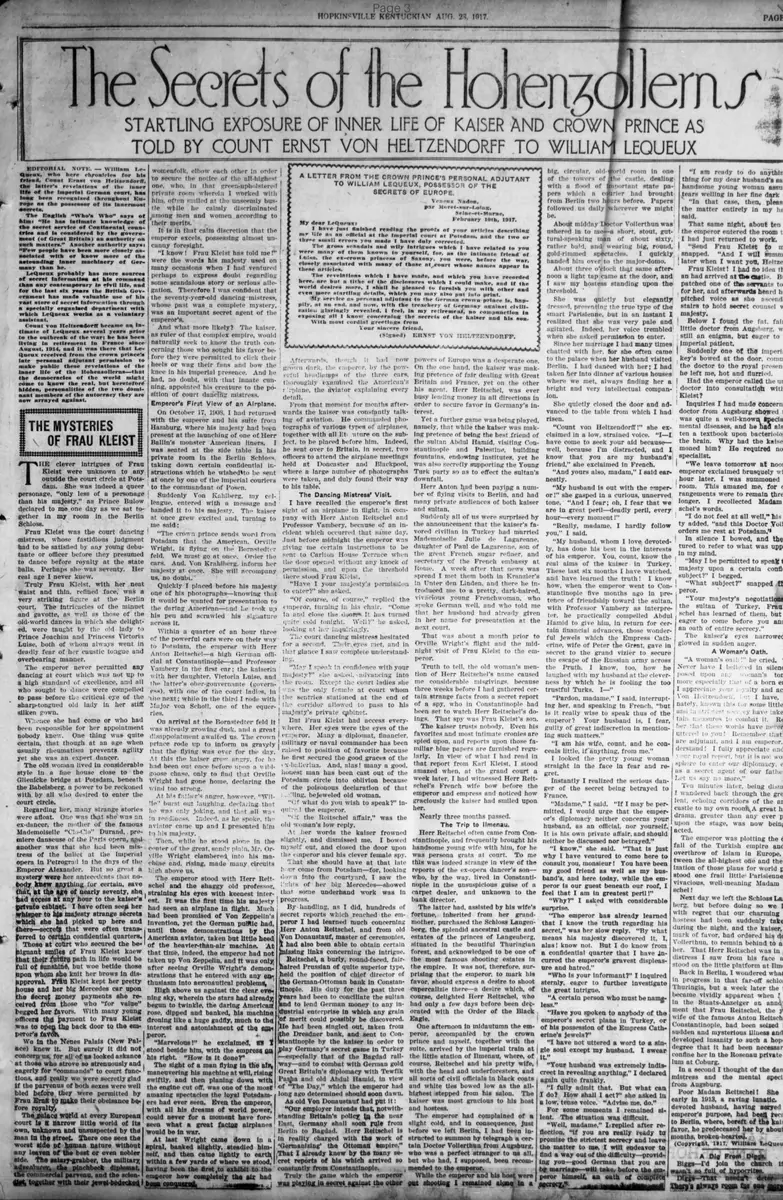
The Secrets of the Hohenzollerns
STARTLING EXPOSURE OF INNER LIFE OF KAISER AND CROWN PRINCE AS TOLD BY COUNT ERNST VON HELTZENDORFF TO WILLIAM LEQUEUX
EDITORIAL NOTE. - William LeQueux, who here chronicles for his friend, Count Ernst von Heltzendorff, the latter's revelations of the inner life of the imperial German court, has long been recognized throughout Europe as the possessor of its innermost secrets. The English "Who's Who" says of him: "He has intimate knowledge of the secret service of Continental countries and is considered by the government (of Great Britain) an authority on such matters." Another authority says: "Few people have been more closely associated with or know more of the astounding inner machinery of Germany than he." LeQueux probably has more sources of secret information at his command than any contemporary in civil life, and for the last six years the British Government has made valuable use of his vast store of secret information through a specially organized department with which LeQueux works as a voluntary assistant. Count von Heltzendorff became an intimate of LeQueux several years prior to the outbreak of the war; he has been living in retirement in France since August, 1914, and it was there that LeQueux received from the crown prince's late personal adjutant permission to make public these revelations of the inner life of the Hohenzollerns-that the democracies of the world might come to know the real, but heretofore hidden, personalities of the two dominant members of the autocracy they are now arrayed against.
THE MYSTERIES OF FRAU KLEIST
The clever intrigues of Frau Kleist were unknown to any outside the court circle at Potsdam. She was indeed a queer personage, "only less of a personage than his majesty," as Prince Bulow declared to me one day as we sat together in my room in the Berlin Schloss. Frau Kleist was the court dancing mistress, whose fastidious judgment had to be satisfied by any young debutante or officer before they presumed to dance before royalty at the state balls. Perhaps she was seventy. Her real age I never knew. Truly Frau Kleist, with her neat waist and thin, refined face, was a very striking figure at the Berlin court. The intricacies of the minuet and gavotte, as well as those of the old-world dances in which she delighted, were taught by the old lady to Prince Joachim and Princess Victoria Luise, both of whom always went in deadly fear of her caustic tongue and overbearing manner. The emperor never permitted any dancing at court which was not up to a high standard of excellence, and all who sought to dance were compelled to pass before the critical eye of the sharp-tongued old lady in her stiff silken gown. Whence she had come or who had been responsible for her appointment nobody knew. One thing was quite certain, that though at an age when usually rheumatism prevents agility yet she was an expert dancer. The old woman lived in considerable style in a fine house close to the Glienicke bridge at Potsdam, beneath the Babelsberg, a power to be reckoned with by all who desired to enter the court circle. Regarding her, many strange stories were afloat. One was that she was an ex-dancer, the mother of the famous Mademoiselle "Cio-Clo" Durand, premiere danseuse of the Paris opera, and another was that she had been mistress of the ballet at the Imperial opera in Petrograd in the days of the Emperor Alexander. But so great a mystery were her antecedents that nobody knew anything for certain, save that, at the age of nearly seventy, she had access at any hour to the kaiser's private cabinet. I have often seen her whisper to his majesty strange secrets which she had picked up here and there-secrets that were often transferred to certain confidential quarters. Those at court who secured the benignant smiles of Frau Kleist knew that their future path in life would be full of sunshine, but woe betide those upon whom she knit her brows in disapproval. Frau Kleist kept her pretty house and her big Mercedes car upon the secret money payments she received from those who "for value" begged her favors. With many young officers the payment to Frau Kleist was to open the back door to the emperor's favor. We in the Neues Palais (New Palace) knew it. But surely it did not concern us, for all of us looked askance at those who strove so strenuously and eagerly for "commands" to court functions, and really we were secretly glad if the parvenus of both sexes were well bled before they were permitted by Frau Erna to make their obeisance before royalty. The palace world at every European court is a narrow little world of its own, unknown and unsuspected by the man in the street. There one sees the worst side of human nature without any leaven of the best or even nobler side. The salary-grabber, the military adventurer, the pinchbeck diplomat, the commercial parvenu, and the scientists, womenfolk, elbow each other in order to secure the notice of the all-highest one, who, in that green-upholstered private room wherein I worked with him, often smiled at the unseemly bustle while he calmly discriminated among men and women according to their merits. It is in that calm discretion that the emperor excels, possessing almost uncanny foresight. "I know! Frau Kleist has told me!" were the words his majesty used on many occasions when I had ventured perhaps to express doubt regarding some scandalous story or serious allegation. Therefore I was confident that the seventy-year-old dancing mistress, whose past was a complete mystery, was an important secret agent of the emperor's. And what more likely? The kaiser as ruler of that complex empire, would naturally seek to know the truth concerning those who sought his favor before they were permitted to click their heels or wag their fans and bow the knee in his imperial presence. And he had, no doubt, with that innate cunning, appointed his creature to the position of court dancing mistress. Emperor's First View of an Airplane. On October 17, 1908, I had returned with the emperor and his suite from Hamburg, where his majesty had been present at the launching of one of Herr Ballin's monster American liners. I was seated at the side table in his private room in the Berlin Schloss, taking down certain confidential instructions which he wished to be sent at once by one of the Imperial couriers to the commandant of Posen. Suddenly Von Kahlberg, my colleague, entered with a message and handed it to his majesty. The kaiser at once grew excited and, turning to me said: "The crown prince sends word from Potsdam that the American, Orville Wright, is flying on the Bornstedter feld. We must go at once. Order the cars. And, Von Kahlberg, inform her majesty at once. She will accompany us, no doubt." Quickly I placed before his majesty one of his photographs-knowing that it would be wanted for presentation to the daring American-and he took up his pen and scrawled his signature across it. Within a quarter of an hour three of the powerful cars were on their way to Potsdam, the emperor with Herr Anton Reitschel-a high German official at Constantinople--and Professor Vambery in the first car; the kaiserin with her daughter, Victoria Luise, and the latter's ober-gouvernante (governess), with one of the court ladies, in the next; while in the third I rode with Major von Scholl, one of the equerries. On arrival at the Bornstedter feld it was already growing dusk, and a great disappointment awaited us. The crown prince rode up to inform us gravely that the flying was over for the day. At this the kaiser grew angry, for he had been out once before upon a wild-goose chase, only to find that Orville Wright had gone home, declaring the wind too strong. At his father's anger, however, "Willie" burst out laughing, declaring that he was only joking, and that all was in readiness. Indeed, as he spoke, the aviator came up and I presented him to his majesty. Then, while he stood alone in the center of the great, sandy plain, Mr. Orville Wright clambered into his machine and, rising, made many circuits high above us. The emperor stood with Herr Reitschel and the shaggy old professor, straining his eyes with keenest interest. It was the first time his majesty had seen an airplane in flight. Much had been promised of Von Zeppelin's invention, yet the German public had, until those demonstrations by the American aviator, taken but little heed of the heavier-than-air machine. At that time, indeed, the emperor had not taken up Von Zeppelin, and it was only after seeing Orville Wright's demonstrations that he entered with any enthusiasm into aeronautical problems. High above us against the clear evening sky, wherein the stars had already begun to twinkle, the daring American rose, dipped and banked, his machine droning like a huge gadfly, much to the interest and astonishment of the emperor. "Marvelous!" he exclaimed, as I stood beside him, with the empress on his right. "How is it done?" The sight of a man flying in the air maneuvering his machine at will, rising swiftly, and then planing down with the engine cut off, was one of the most amazing spectacles the loyal Potsdamers had ever seen. Even the emperor, with all his dreams of world power, could never for a moment have foreseen what a great factor airplanes would be in war. At last Wright came down in a spiral, banked slightly, steadied himself, and then came lightly to earth within a few yards of where we stood, having been the first to exhibit to the emperor how completely the air had been conquered.
Afterwards, though it had now grown dark, the emperor, by the powerful headlamps of the three cars, thoroughly examined the American's airplane, the aviator explaining every detail. From that moment for months afterwards the kaiser was constantly talking of aviation. He commanded photographs of various types of airplanes, together with all literature on the subject, to be placed before him. Indeed, he sent over to Britain, in secret, two officers to attend the airplane meetings held at Doncaster and Blackpool, where a large number of photographs were taken, and duly found their way to his table. The Dancing Mistress' Visit. I have recalled the emperor's first sight of an airplane in flight, in company with Herr Anton Reitschel and Professor Vambery, because of an incident which occurred that same day. Just before midnight the emperor was giving me certain instructions to be sent to Carlton House Terrace when the door opened without any knock or permission, and upon the threshold there stood Frau Kleist. "Have your majesty's permission to enter?" she asked. "Of course, of course," replied the emperor, turning in his chair. "Come in and close the door: it has turned quite cold tonight. Well?" he asked, looking at her inquiringly. The court dancing mistress hesitated for a second. Their eyes met, and in that glance I saw complete understanding. "May I speak in confidence with your majesty?" she asked, advancing into the room. Except the court ladies she was the only female at court whom the sentries stationed at the end of the corridor allowed to pass to his majesty's private cabinet. But Frau Kleist had access everywhere. Her eyes were the eyes of the emperor. Many a diplomat, financier, military or naval commander has been raised to position of favorite because he first secured the good graces of the ex-ballerina. And, alas! many a good, honest man has been cast out of the Potsdam circle into oblivion because of the poisonous declaration of that smiling, bejeweled old woman. "Of what do you wish to speak?" inquired the emperor. "The Reitschel affair," was the old woman's low reply. At her words the kaiser frowned slightly, and dismissed me. I bowed myself out, and closed the door upon the emperor and his clever female spy. That she should have at that late hour come from Potsdam-for, looking down into the courtyard, I saw the lights of her big Mercedes-showed that some underhand work was in progress. By handling, as I did, hundreds of secret reports which reached the emperor I had learned much concerning Herr Anton Reitschel, and from old Von Donaustauf, master of ceremonies, I had also been able to obtain certain missing links concerning the intrigue. Reitschel, a burly, round-faced, fair-haired Prussian of quite superior type, held the position of chief director of the German-Ottoman bank in Constantinople. His duty for the past three years had been to conciliate the sultan and to lend German money to any industrial enterprise in which any grain of merit could possibly be discovered. He had been singled out, taken from the Dresdner bank, and sent to Constantinople by the kaiser in order to play Germany's secret game in Turkey especially that of the Bagdad railway-and to combat with German gold Great Britain's diplomacy with Tewfik Pasha and old Abdul Hamid, in view of "The Day," which the emperor had long ago determined should soon dawn. As old Von Donaustauf had put it: "Our employer intends that, notwithstanding Britain's policy in the near East, Germany shall soon rule from Berlin to Bagdad. Herr Reitschel is in reality charged with the work of 'Germanizing' the Ottoman empire." That I already knew by the many secret reports of his which arrived so constantly from Constantinople. Truly the game which the emperor was playing in secret against the other
powers of Europe was a desperate one. On the one hand, the kaiser was making pretence of fair dealing with Great Britain and France, yet on the other his agent, Herr Reitschel, was ever busy lending money in all directions in order to secure favor in Germany's interest. Yet a further game was being played, namely, that while the kaiser was making pretence of being the best friend of the sultan Abdul Hamid, visiting Constantinople and Palestine, building fountains, endowing institutes, yet he was also secretly supporting the Young Turk party so as to effect the sultan's downfall. Herr Anton had been paying a number of flying visits to Berlin, and had many private audiences of both kaiser and sultan. Suddenly all of us were surprised by the announcement that the kaiser's favored civilian in Turkey had married Mademoiselle Julie de Lagarenne, daughter of Paul de Lagarenne, son of the great French sugar refiner, and secretary of the French embassy at Rome. A week after that news was spread I met them both in Kranzler's in Unter den Linden, and there he introduced me to a pretty, dark-haired, vivacious young Frenchwoman, who spoke German well, and who told me that her husband had already given in her name for presentation at the next court. That was about a month prior to Orville Wright's flight and the midnight visit of Frau Kleist to the emperor. Truth to tell, the old woman's mention of Herr Reitschel's name caused me considerable misgivings, because three weeks before I had gathered certain strange facts from a secret report of a spy, who in Constantinople had been set to watch Herr Reitschel's doings. That spy was Frau Kleist's son. The kaiser trusts nobody. Even his favorites and most intimate cronies are spied upon, and reports upon those familiar blue papers are furnished regularly. In view of what I had read in that report from Karl Kleist, I stood amazed when, at the grand court a week later, I had witnessed Herr Reitschel's French wife bow before the emperor and empress and noticed how graciously the kaiser had smiled upon her. Nearly three months passed. The Trip to Ilmenau. Herr Reitschel often came from Constantinople, and frequently brought his handsome young wife with him, for he was persona grata at court. To me this was indeed strange in view of the reports of the ex-opera dancer's son-who, by the way, lived in Constantinople in the unsuspicious guise of a carpet dealer, and unknown to the bank director. The latter had, assisted by his wife's fortune, inherited from her grandmother, purchased the Schloss Langenberg, the splendid ancestral castle and estates of the princes of Langenberg, situated in the beautiful Thuringian forest, and acknowledged to be one of the most famous shooting estates in the empire. It was not, therefore, surprising that the emperor, to mark his favor, should express a desire to shoot capercailzie there-a desire which, of course, delighted Herr Reitschel, who had only a few days before been decorated with the Order of the Black Eagle. One afternoon in midautumn the emperor, accompanied by the crown prince and myself, together with the suite, arrived by the imperial train at the little station of Ilmenau, where, of course, Reitschel and his pretty wife, with the head and underforesters, and all sorts of civil officials in black coats and white ties bowed low as the all-highest stepped from his salon. The kaiser was most gracious to his host and hostess. The emperor had complained of a slight cold, and in consequence, just before we left Berlin, I had been instructed to summon by telegraph a certain Doctor Vollerthun from Augsburg, who was a perfect stranger to us all, but who had, I supposed, been recommended to the emperor. While the emperor and his host were out shooting I remained alone in a big, circular, old-world room in one of the towers of the castle, dealing with a flood of important state papers which a courier had brought from Berlin two hours before. Papers followed us daily wherever we might be. About midday Doctor Vollerthun was ushered in to me-a short, stout, guttural-speaking man of about sixty, rather bald, and wearing big, round, gold-rimmed spectacles. I quickly handed him over to the major-domo. About three o'clock that same afternoon a light tap came at the door, and I saw my hostess standing upon the threshold. She was quietly but elegantly dressed, presenting the true type of the smart Parisienne, but in an instant I realized that she was very pale and agitated. Indeed, her voice trembled when she asked permission to enter. Since her marriage I had many times chatted with her, for she often came to the palace when her husband visited Berlin. I had danced with her; I had taken her into dinner at various houses where we met, always finding her a bright and very intellectual companion. She quietly closed the door and advanced to the table from which I had risen. "Count von Heltzendorff!" she exclaimed in a low, strained voice. "I-I have come to seek your aid because well, because I'm distracted, and I know that you are my husband's friend." she exclaimed in French. "And yours also, madam," I said earnestly. "My husband is out with the emperor!" she gasped in a curious, unnerved tone. "And I fear: oh, I fear that we are in great peril-deadly peril, every hour-every moment!" "Really, madame, I hardly follow you," I said. "My husband, whom I love devotedly, has done his best in the interests of his emperor. You, count, know the real aims of the kaiser in Turkey. These last six months I have watched, and have learned the truth! I know how, when the emperor went to Constantinople five months ago in pretence of friendship toward the sultan, with Professor Vambery as interpreter, he practically compelled Abdul Hamid to give him, in return for certain financial advances, those wonderful jewels which the Empress Catherine, wife of Peter the Great, gave in secret to the grand vizier to secure the escape of the Russian army across the Pruth. I know, too, how he laughed with my husband at the cleverness by which he is fooling the too trustful Turks. I-" "Pardon, madame," I said, interrupting her, and speaking in French, "but is it really wise to speak thus of the emperor? Your husband is, I fear, guilty of great indiscretion in mentioning such matters." "I am his wife, count, and he conceals little, if anything, from me." I looked the pretty young woman straight in the face in fear and regret. Instantly I realized the serious danger of the secret being betrayed to France. "Madame," I said. "If I may be permitted, I would urge that the emperor's diplomacy neither concerns your husband, as an official, nor yourself. It is his own private affair, and should neither be discussed nor betrayed." "I know," she said. "That is just why I have ventured to come here to consult you, monsieur! You have been my good friend as well as my husband's, and here today, while the emperor is our guest beneath our roof, I feel that I am in greatest peril!" "Why?" I asked with considerable surprise. "The emperor has already learned that I know the truth regarding his secret." was her slow reply. "By what means his majesty discovered it, I, alas! know not. But I do know from a confidential quarter that I have incurred the emperor's gravest displeasure and hatred." "Who is your informant?" I inquired sternly, eager to further investigate the great intrigue. "A certain person who must be nameless." "Have you spoken to anybody of the emperor's secret plans in Turkey, or of his possession of the Empress Catherine's jewels?" "I have not uttered a word to a single soul except my husband. I swear it." "Your husband was extremely indiscreet in revealing anything," I declared again quite frankly. "I fully admit that. But what can I do? How shall I act?" she asked in a low, tense voice. "Advise me, do." For some moments I remained silent. The situation was difficult. "Well, madame," I replied after reflection, "if you are really ready to promise the strictest secrecy and leave the matter to me, I will endeavor to find a way out of the difficulty-providing you-good German that you are by marriage-will take, before the emperor himself, an oath of complete secrecy."
"I am ready to do anything-anything for my dear husband's sake," the handsome young woman assured me, tears welling in her fine dark eyes. "In that case, then, please leave the matter entirely in my hands," I said. That same night, about ten o'clock, the emperor entered the room to which I had just returned to work. "Send Frau Kleist to me," he snapped. "And I will summon you later when I want you, Heltzendorff." Frau Kleist! I had no idea the woman had arrived at the castle. But I dispatched one of the servants to search for her, and afterwards heard her high pitched voice as she ascended the stairs to hold secret counsel with his majesty. Below I found the fat, fair-haired little doctor from Augsburg, who was still an enigma, but eager to see his imperial patient. Suddenly one of the imperial flunkey's bowed at the door, commanding the doctor to the royal presence, and he left me, hot and flurried. Had the emperor called the unknown doctor into consultation with Frau Kleist? Inquiries I had made concerning the doctor from Augsburg showed that he was quite a well-known specialist on mental diseases, and he had also written a textbook upon bacteriology and the brain. Why had the kaiser summoned him? He required no brain specialist. "We leave tomorrow at noon," the emperor exclaimed brusquely when, an hour later, I was summoned to his room. This amazed me, for our arrangements were to remain three days longer. I recollected Madam Reitschel's words. "I do not feel at all well," his majesty added, "and this Doctor Vollerthun orders me rest at Potsdam." In silence I bowed, and then ventured to refer to what was uppermost in my mind. "May I be permitted to speak to your majesty upon a certain confidential subject?" I begged. "What subject?" snapped the emperor. "Your majesty's negotiations with the sultan of Turkey. Frau Reitschel has learned of them, but she is eager to come before you and take an oath of entire secrecy." The kaiser's eyes narrowed and glowed in sudden anger. A Woman's Oath. "A woman's oath" he cried. "Bah! Never have I believed in silence imposed upon any woman's tongue-more especially that of a born enemy! I appreciate your loyalty and acumen, Von Heltzendorff, but I have, fortunately, known this for some little time, and instructions have already been taken certain measures to combat it. Remember that these words have never been uttered to you! Remember that! You are adjutant, and I am emperor. Understand! I fully appreciate and note your loyal report, but it is not woman's sphere to enter our diplomacy, except as a secret agent of our fatherland. Let us say no more." Ten minutes later, being dismissed, I wandered back through the great silent, echoing corridors of the ancient castle to my own room. A great human drama, greater than any ever placed upon the stage, was now being enacted. The emperor was plotting the downfall of the Turkish empire and the overthrow of Islam in Europe. Between the all-highest one and the realization of those plans for world power stood one frail little Parisienne, the vivacious, well-meaning Madam Reitschel! Next day we left the Schloss Langenberg, but before doing so we heard with regret that our charming little hostess had been suddenly taken ill during the night, and the kaiser, as a mark of favor, had ordered his doctor, Vollerthun, to remain behind to attend her. That Herr Reitschel was in great distress I saw from his face as he stood on the little platform at Ilmenau. Back in Berlin, I wondered what was in progress in that far-off schloss in Thuringia, but a week later the truth became vividly apparent when I read in the Staats-Anzeiger an announcement that Frau Reitschel, the young wife of the famous Anton Reitschel of Constantinople, had been seized by a sudden and mysterious illness and had developed insanity to such a hopeless degree that it had been necessary to confine her in the Rosenau private asylum at Coburg. In a second I thought of the dancing mistress and the mental specialist from Augsburg. Poor Madam Reitschel! She died early in 1913, a raving lunatic. Her devoted husband, having served the emperor's purpose, had been recalled to Berlin, where, bereft of the kaiser's favor, he predeceased her by about six months, broken-hearted. (Copyright, 1917, William LeQueux.)
Veneux Nadon, par Moret-sur-Loing, Seine-et-Marne, February 10th, 1917.
My dear LeQueux:
I have just finished reading the proofs of your articles describing my life as an official at the Imperial court at Potsdam, and the two or three small errors you made I have duly corrected. The gross scandals and wily intrigues which I have related to you were many of them known to yourself, for, as the intimate friend of Luisa, the ex-crown princess of Saxony, you were, before the war, closely associated with many of those at court whose names appear in these articles. The revelations which I have made, and which you have recorded here, are but a tithe of the disclosures which I could make, and if the world desires more, I shall be pleased to furnish you with other and even more startling details, which you may also put into print. My service as personal adjutant to the German crown prince is, happily, at an end, and now, with the treachery of Germany against civilization glaringly revealed, I feel, in my retirement, no compunction in exposing all I know concerning the secrets of the kaiser and his son.
With most cordial greetings from
Your sincere friend,
(Signed) ERNST VON HELTZENDORFF.
The Secrets of the Hohenzollerns
STARTLING EXPOSURE OF INNER LIFE OF KAISER AND CROWN PRINCE AS TOLD BY COUNT ERNST VON HELTZENDORFF TO WILLIAM LEQUEUX
EDITORIAL NOTE. - William LeQueux, who here chronicles for his friend, Count Ernst von Heltzendorff, the latter's revelations of the inner life of the imperial German court, has long been recognized throughout Europe as the possessor of its innermost secrets. The English "Who's Who" says of him: "He has intimate knowledge of the secret service of Continental countries and is considered by the government (of Great Britain) an authority on such matters." Another authority says: "Few people have been more closely associated with or know more of the astounding inner machinery of Germany than he." LeQueux probably has more sources of secret information at his command than any contemporary in civil life, and for the last six years the British Government has made valuable use of his vast store of secret information through a specially organized department with which LeQueux works as a voluntary assistant. Count von Heltzendorff became an intimate of LeQueux several years prior to the outbreak of the war; he has been living in retirement in France since August, 1914, and it was there that LeQueux received from the crown prince's late personal adjutant permission to make public these revelations of the inner life of the Hohenzollerns-that the democracies of the world might come to know the real, but heretofore hidden, personalities of the two dominant members of the autocracy they are now arrayed against.
THE MYSTERIES OF FRAU KLEIST
The clever intrigues of Frau Kleist were unknown to any outside the court circle at Potsdam. She was indeed a queer personage, "only less of a personage than his majesty," as Prince Bulow declared to me one day as we sat together in my room in the Berlin Schloss. Frau Kleist was the court dancing mistress, whose fastidious judgment had to be satisfied by any young debutante or officer before they presumed to dance before royalty at the state balls. Perhaps she was seventy. Her real age I never knew. Truly Frau Kleist, with her neat waist and thin, refined face, was a very striking figure at the Berlin court. The intricacies of the minuet and gavotte, as well as those of the old-world dances in which she delighted, were taught by the old lady to Prince Joachim and Princess Victoria Luise, both of whom always went in deadly fear of her caustic tongue and overbearing manner. The emperor never permitted any dancing at court which was not up to a high standard of excellence, and all who sought to dance were compelled to pass before the critical eye of the sharp-tongued old lady in her stiff silken gown. Whence she had come or who had been responsible for her appointment nobody knew. One thing was quite certain, that though at an age when usually rheumatism prevents agility yet she was an expert dancer. The old woman lived in considerable style in a fine house close to the Glienicke bridge at Potsdam, beneath the Babelsberg, a power to be reckoned with by all who desired to enter the court circle. Regarding her, many strange stories were afloat. One was that she was an ex-dancer, the mother of the famous Mademoiselle "Cio-Clo" Durand, premiere danseuse of the Paris opera, and another was that she had been mistress of the ballet at the Imperial opera in Petrograd in the days of the Emperor Alexander. But so great a mystery were her antecedents that nobody knew anything for certain, save that, at the age of nearly seventy, she had access at any hour to the kaiser's private cabinet. I have often seen her whisper to his majesty strange secrets which she had picked up here and there-secrets that were often transferred to certain confidential quarters. Those at court who secured the benignant smiles of Frau Kleist knew that their future path in life would be full of sunshine, but woe betide those upon whom she knit her brows in disapproval. Frau Kleist kept her pretty house and her big Mercedes car upon the secret money payments she received from those who "for value" begged her favors. With many young officers the payment to Frau Kleist was to open the back door to the emperor's favor. We in the Neues Palais (New Palace) knew it. But surely it did not concern us, for all of us looked askance at those who strove so strenuously and eagerly for "commands" to court functions, and really we were secretly glad if the parvenus of both sexes were well bled before they were permitted by Frau Erna to make their obeisance before royalty. The palace world at every European court is a narrow little world of its own, unknown and unsuspected by the man in the street. There one sees the worst side of human nature without any leaven of the best or even nobler side. The salary-grabber, the military adventurer, the pinchbeck diplomat, the commercial parvenu, and the scientists, womenfolk, elbow each other in order to secure the notice of the all-highest one, who, in that green-upholstered private room wherein I worked with him, often smiled at the unseemly bustle while he calmly discriminated among men and women according to their merits. It is in that calm discretion that the emperor excels, possessing almost uncanny foresight. "I know! Frau Kleist has told me!" were the words his majesty used on many occasions when I had ventured perhaps to express doubt regarding some scandalous story or serious allegation. Therefore I was confident that the seventy-year-old dancing mistress, whose past was a complete mystery, was an important secret agent of the emperor's. And what more likely? The kaiser as ruler of that complex empire, would naturally seek to know the truth concerning those who sought his favor before they were permitted to click their heels or wag their fans and bow the knee in his imperial presence. And he had, no doubt, with that innate cunning, appointed his creature to the position of court dancing mistress. Emperor's First View of an Airplane. On October 17, 1908, I had returned with the emperor and his suite from Hamburg, where his majesty had been present at the launching of one of Herr Ballin's monster American liners. I was seated at the side table in his private room in the Berlin Schloss, taking down certain confidential instructions which he wished to be sent at once by one of the Imperial couriers to the commandant of Posen. Suddenly Von Kahlberg, my colleague, entered with a message and handed it to his majesty. The kaiser at once grew excited and, turning to me said: "The crown prince sends word from Potsdam that the American, Orville Wright, is flying on the Bornstedter feld. We must go at once. Order the cars. And, Von Kahlberg, inform her majesty at once. She will accompany us, no doubt." Quickly I placed before his majesty one of his photographs-knowing that it would be wanted for presentation to the daring American-and he took up his pen and scrawled his signature across it. Within a quarter of an hour three of the powerful cars were on their way to Potsdam, the emperor with Herr Anton Reitschel-a high German official at Constantinople--and Professor Vambery in the first car; the kaiserin with her daughter, Victoria Luise, and the latter's ober-gouvernante (governess), with one of the court ladies, in the next; while in the third I rode with Major von Scholl, one of the equerries. On arrival at the Bornstedter feld it was already growing dusk, and a great disappointment awaited us. The crown prince rode up to inform us gravely that the flying was over for the day. At this the kaiser grew angry, for he had been out once before upon a wild-goose chase, only to find that Orville Wright had gone home, declaring the wind too strong. At his father's anger, however, "Willie" burst out laughing, declaring that he was only joking, and that all was in readiness. Indeed, as he spoke, the aviator came up and I presented him to his majesty. Then, while he stood alone in the center of the great, sandy plain, Mr. Orville Wright clambered into his machine and, rising, made many circuits high above us. The emperor stood with Herr Reitschel and the shaggy old professor, straining his eyes with keenest interest. It was the first time his majesty had seen an airplane in flight. Much had been promised of Von Zeppelin's invention, yet the German public had, until those demonstrations by the American aviator, taken but little heed of the heavier-than-air machine. At that time, indeed, the emperor had not taken up Von Zeppelin, and it was only after seeing Orville Wright's demonstrations that he entered with any enthusiasm into aeronautical problems. High above us against the clear evening sky, wherein the stars had already begun to twinkle, the daring American rose, dipped and banked, his machine droning like a huge gadfly, much to the interest and astonishment of the emperor. "Marvelous!" he exclaimed, as I stood beside him, with the empress on his right. "How is it done?" The sight of a man flying in the air maneuvering his machine at will, rising swiftly, and then planing down with the engine cut off, was one of the most amazing spectacles the loyal Potsdamers had ever seen. Even the emperor, with all his dreams of world power, could never for a moment have foreseen what a great factor airplanes would be in war. At last Wright came down in a spiral, banked slightly, steadied himself, and then came lightly to earth within a few yards of where we stood, having been the first to exhibit to the emperor how completely the air had been conquered.
Afterwards, though it had now grown dark, the emperor, by the powerful headlamps of the three cars, thoroughly examined the American's airplane, the aviator explaining every detail. From that moment for months afterwards the kaiser was constantly talking of aviation. He commanded photographs of various types of airplanes, together with all literature on the subject, to be placed before him. Indeed, he sent over to Britain, in secret, two officers to attend the airplane meetings held at Doncaster and Blackpool, where a large number of photographs were taken, and duly found their way to his table. The Dancing Mistress' Visit. I have recalled the emperor's first sight of an airplane in flight, in company with Herr Anton Reitschel and Professor Vambery, because of an incident which occurred that same day. Just before midnight the emperor was giving me certain instructions to be sent to Carlton House Terrace when the door opened without any knock or permission, and upon the threshold there stood Frau Kleist. "Have your majesty's permission to enter?" she asked. "Of course, of course," replied the emperor, turning in his chair. "Come in and close the door: it has turned quite cold tonight. Well?" he asked, looking at her inquiringly. The court dancing mistress hesitated for a second. Their eyes met, and in that glance I saw complete understanding. "May I speak in confidence with your majesty?" she asked, advancing into the room. Except the court ladies she was the only female at court whom the sentries stationed at the end of the corridor allowed to pass to his majesty's private cabinet. But Frau Kleist had access everywhere. Her eyes were the eyes of the emperor. Many a diplomat, financier, military or naval commander has been raised to position of favorite because he first secured the good graces of the ex-ballerina. And, alas! many a good, honest man has been cast out of the Potsdam circle into oblivion because of the poisonous declaration of that smiling, bejeweled old woman. "Of what do you wish to speak?" inquired the emperor. "The Reitschel affair," was the old woman's low reply. At her words the kaiser frowned slightly, and dismissed me. I bowed myself out, and closed the door upon the emperor and his clever female spy. That she should have at that late hour come from Potsdam-for, looking down into the courtyard, I saw the lights of her big Mercedes-showed that some underhand work was in progress. By handling, as I did, hundreds of secret reports which reached the emperor I had learned much concerning Herr Anton Reitschel, and from old Von Donaustauf, master of ceremonies, I had also been able to obtain certain missing links concerning the intrigue. Reitschel, a burly, round-faced, fair-haired Prussian of quite superior type, held the position of chief director of the German-Ottoman bank in Constantinople. His duty for the past three years had been to conciliate the sultan and to lend German money to any industrial enterprise in which any grain of merit could possibly be discovered. He had been singled out, taken from the Dresdner bank, and sent to Constantinople by the kaiser in order to play Germany's secret game in Turkey especially that of the Bagdad railway-and to combat with German gold Great Britain's diplomacy with Tewfik Pasha and old Abdul Hamid, in view of "The Day," which the emperor had long ago determined should soon dawn. As old Von Donaustauf had put it: "Our employer intends that, notwithstanding Britain's policy in the near East, Germany shall soon rule from Berlin to Bagdad. Herr Reitschel is in reality charged with the work of 'Germanizing' the Ottoman empire." That I already knew by the many secret reports of his which arrived so constantly from Constantinople. Truly the game which the emperor was playing in secret against the other
powers of Europe was a desperate one. On the one hand, the kaiser was making pretence of fair dealing with Great Britain and France, yet on the other his agent, Herr Reitschel, was ever busy lending money in all directions in order to secure favor in Germany's interest. Yet a further game was being played, namely, that while the kaiser was making pretence of being the best friend of the sultan Abdul Hamid, visiting Constantinople and Palestine, building fountains, endowing institutes, yet he was also secretly supporting the Young Turk party so as to effect the sultan's downfall. Herr Anton had been paying a number of flying visits to Berlin, and had many private audiences of both kaiser and sultan. Suddenly all of us were surprised by the announcement that the kaiser's favored civilian in Turkey had married Mademoiselle Julie de Lagarenne, daughter of Paul de Lagarenne, son of the great French sugar refiner, and secretary of the French embassy at Rome. A week after that news was spread I met them both in Kranzler's in Unter den Linden, and there he introduced me to a pretty, dark-haired, vivacious young Frenchwoman, who spoke German well, and who told me that her husband had already given in her name for presentation at the next court. That was about a month prior to Orville Wright's flight and the midnight visit of Frau Kleist to the emperor. Truth to tell, the old woman's mention of Herr Reitschel's name caused me considerable misgivings, because three weeks before I had gathered certain strange facts from a secret report of a spy, who in Constantinople had been set to watch Herr Reitschel's doings. That spy was Frau Kleist's son. The kaiser trusts nobody. Even his favorites and most intimate cronies are spied upon, and reports upon those familiar blue papers are furnished regularly. In view of what I had read in that report from Karl Kleist, I stood amazed when, at the grand court a week later, I had witnessed Herr Reitschel's French wife bow before the emperor and empress and noticed how graciously the kaiser had smiled upon her. Nearly three months passed. The Trip to Ilmenau. Herr Reitschel often came from Constantinople, and frequently brought his handsome young wife with him, for he was persona grata at court. To me this was indeed strange in view of the reports of the ex-opera dancer's son-who, by the way, lived in Constantinople in the unsuspicious guise of a carpet dealer, and unknown to the bank director. The latter had, assisted by his wife's fortune, inherited from her grandmother, purchased the Schloss Langenberg, the splendid ancestral castle and estates of the princes of Langenberg, situated in the beautiful Thuringian forest, and acknowledged to be one of the most famous shooting estates in the empire. It was not, therefore, surprising that the emperor, to mark his favor, should express a desire to shoot capercailzie there-a desire which, of course, delighted Herr Reitschel, who had only a few days before been decorated with the Order of the Black Eagle. One afternoon in midautumn the emperor, accompanied by the crown prince and myself, together with the suite, arrived by the imperial train at the little station of Ilmenau, where, of course, Reitschel and his pretty wife, with the head and underforesters, and all sorts of civil officials in black coats and white ties bowed low as the all-highest stepped from his salon. The kaiser was most gracious to his host and hostess. The emperor had complained of a slight cold, and in consequence, just before we left Berlin, I had been instructed to summon by telegraph a certain Doctor Vollerthun from Augsburg, who was a perfect stranger to us all, but who had, I supposed, been recommended to the emperor. While the emperor and his host were out shooting I remained alone in a big, circular, old-world room in one of the towers of the castle, dealing with a flood of important state papers which a courier had brought from Berlin two hours before. Papers followed us daily wherever we might be. About midday Doctor Vollerthun was ushered in to me-a short, stout, guttural-speaking man of about sixty, rather bald, and wearing big, round, gold-rimmed spectacles. I quickly handed him over to the major-domo. About three o'clock that same afternoon a light tap came at the door, and I saw my hostess standing upon the threshold. She was quietly but elegantly dressed, presenting the true type of the smart Parisienne, but in an instant I realized that she was very pale and agitated. Indeed, her voice trembled when she asked permission to enter. Since her marriage I had many times chatted with her, for she often came to the palace when her husband visited Berlin. I had danced with her; I had taken her into dinner at various houses where we met, always finding her a bright and very intellectual companion. She quietly closed the door and advanced to the table from which I had risen. "Count von Heltzendorff!" she exclaimed in a low, strained voice. "I-I have come to seek your aid because well, because I'm distracted, and I know that you are my husband's friend." she exclaimed in French. "And yours also, madam," I said earnestly. "My husband is out with the emperor!" she gasped in a curious, unnerved tone. "And I fear: oh, I fear that we are in great peril-deadly peril, every hour-every moment!" "Really, madame, I hardly follow you," I said. "My husband, whom I love devotedly, has done his best in the interests of his emperor. You, count, know the real aims of the kaiser in Turkey. These last six months I have watched, and have learned the truth! I know how, when the emperor went to Constantinople five months ago in pretence of friendship toward the sultan, with Professor Vambery as interpreter, he practically compelled Abdul Hamid to give him, in return for certain financial advances, those wonderful jewels which the Empress Catherine, wife of Peter the Great, gave in secret to the grand vizier to secure the escape of the Russian army across the Pruth. I know, too, how he laughed with my husband at the cleverness by which he is fooling the too trustful Turks. I-" "Pardon, madame," I said, interrupting her, and speaking in French, "but is it really wise to speak thus of the emperor? Your husband is, I fear, guilty of great indiscretion in mentioning such matters." "I am his wife, count, and he conceals little, if anything, from me." I looked the pretty young woman straight in the face in fear and regret. Instantly I realized the serious danger of the secret being betrayed to France. "Madame," I said. "If I may be permitted, I would urge that the emperor's diplomacy neither concerns your husband, as an official, nor yourself. It is his own private affair, and should neither be discussed nor betrayed." "I know," she said. "That is just why I have ventured to come here to consult you, monsieur! You have been my good friend as well as my husband's, and here today, while the emperor is our guest beneath our roof, I feel that I am in greatest peril!" "Why?" I asked with considerable surprise. "The emperor has already learned that I know the truth regarding his secret." was her slow reply. "By what means his majesty discovered it, I, alas! know not. But I do know from a confidential quarter that I have incurred the emperor's gravest displeasure and hatred." "Who is your informant?" I inquired sternly, eager to further investigate the great intrigue. "A certain person who must be nameless." "Have you spoken to anybody of the emperor's secret plans in Turkey, or of his possession of the Empress Catherine's jewels?" "I have not uttered a word to a single soul except my husband. I swear it." "Your husband was extremely indiscreet in revealing anything," I declared again quite frankly. "I fully admit that. But what can I do? How shall I act?" she asked in a low, tense voice. "Advise me, do." For some moments I remained silent. The situation was difficult. "Well, madame," I replied after reflection, "if you are really ready to promise the strictest secrecy and leave the matter to me, I will endeavor to find a way out of the difficulty-providing you-good German that you are by marriage-will take, before the emperor himself, an oath of complete secrecy."
"I am ready to do anything-anything for my dear husband's sake," the handsome young woman assured me, tears welling in her fine dark eyes. "In that case, then, please leave the matter entirely in my hands," I said. That same night, about ten o'clock, the emperor entered the room to which I had just returned to work. "Send Frau Kleist to me," he snapped. "And I will summon you later when I want you, Heltzendorff." Frau Kleist! I had no idea the woman had arrived at the castle. But I dispatched one of the servants to search for her, and afterwards heard her high pitched voice as she ascended the stairs to hold secret counsel with his majesty. Below I found the fat, fair-haired little doctor from Augsburg, who was still an enigma, but eager to see his imperial patient. Suddenly one of the imperial flunkey's bowed at the door, commanding the doctor to the royal presence, and he left me, hot and flurried. Had the emperor called the unknown doctor into consultation with Frau Kleist? Inquiries I had made concerning the doctor from Augsburg showed that he was quite a well-known specialist on mental diseases, and he had also written a textbook upon bacteriology and the brain. Why had the kaiser summoned him? He required no brain specialist. "We leave tomorrow at noon," the emperor exclaimed brusquely when, an hour later, I was summoned to his room. This amazed me, for our arrangements were to remain three days longer. I recollected Madam Reitschel's words. "I do not feel at all well," his majesty added, "and this Doctor Vollerthun orders me rest at Potsdam." In silence I bowed, and then ventured to refer to what was uppermost in my mind. "May I be permitted to speak to your majesty upon a certain confidential subject?" I begged. "What subject?" snapped the emperor. "Your majesty's negotiations with the sultan of Turkey. Frau Reitschel has learned of them, but she is eager to come before you and take an oath of entire secrecy." The kaiser's eyes narrowed and glowed in sudden anger. A Woman's Oath. "A woman's oath" he cried. "Bah! Never have I believed in silence imposed upon any woman's tongue-more especially that of a born enemy! I appreciate your loyalty and acumen, Von Heltzendorff, but I have, fortunately, known this for some little time, and instructions have already been taken certain measures to combat it. Remember that these words have never been uttered to you! Remember that! You are adjutant, and I am emperor. Understand! I fully appreciate and note your loyal report, but it is not woman's sphere to enter our diplomacy, except as a secret agent of our fatherland. Let us say no more." Ten minutes later, being dismissed, I wandered back through the great silent, echoing corridors of the ancient castle to my own room. A great human drama, greater than any ever placed upon the stage, was now being enacted. The emperor was plotting the downfall of the Turkish empire and the overthrow of Islam in Europe. Between the all-highest one and the realization of those plans for world power stood one frail little Parisienne, the vivacious, well-meaning Madam Reitschel! Next day we left the Schloss Langenberg, but before doing so we heard with regret that our charming little hostess had been suddenly taken ill during the night, and the kaiser, as a mark of favor, had ordered his doctor, Vollerthun, to remain behind to attend her. That Herr Reitschel was in great distress I saw from his face as he stood on the little platform at Ilmenau. Back in Berlin, I wondered what was in progress in that far-off schloss in Thuringia, but a week later the truth became vividly apparent when I read in the Staats-Anzeiger an announcement that Frau Reitschel, the young wife of the famous Anton Reitschel of Constantinople, had been seized by a sudden and mysterious illness and had developed insanity to such a hopeless degree that it had been necessary to confine her in the Rosenau private asylum at Coburg. In a second I thought of the dancing mistress and the mental specialist from Augsburg. Poor Madam Reitschel! She died early in 1913, a raving lunatic. Her devoted husband, having served the emperor's purpose, had been recalled to Berlin, where, bereft of the kaiser's favor, he predeceased her by about six months, broken-hearted. (Copyright, 1917, William LeQueux.)
Veneux Nadon, par Moret-sur-Loing, Seine-et-Marne, February 10th, 1917.
My dear LeQueux:
I have just finished reading the proofs of your articles describing my life as an official at the Imperial court at Potsdam, and the two or three small errors you made I have duly corrected. The gross scandals and wily intrigues which I have related to you were many of them known to yourself, for, as the intimate friend of Luisa, the ex-crown princess of Saxony, you were, before the war, closely associated with many of those at court whose names appear in these articles. The revelations which I have made, and which you have recorded here, are but a tithe of the disclosures which I could make, and if the world desires more, I shall be pleased to furnish you with other and even more startling details, which you may also put into print. My service as personal adjutant to the German crown prince is, happily, at an end, and now, with the treachery of Germany against civilization glaringly revealed, I feel, in my retirement, no compunction in exposing all I know concerning the secrets of the kaiser and his son.
With most cordial greetings from
Your sincere friend,
(Signed) ERNST VON HELTZENDORFF.
What sub-type of article is it?
Essay
Satire
What themes does it cover?
Political
Moral Virtue
What keywords are associated?
Kaiser
Hohenzollerns
Frau Kleist
Court Intrigues
Airplane Flight
Ottoman Empire
Diplomatic Plot
What entities or persons were involved?
Count Ernst Von Heltzendorff To William Lequeux
Literary Details
Title
The Secrets Of The Hohenzollerns
Author
Count Ernst Von Heltzendorff To William Lequeux
Subject
Exposure Of Inner Life Of Kaiser And Crown Prince
Form / Style
Narrative Exposé In Prose
Key Lines
The Clever Intrigues Of Frau Kleist Were Unknown To Any Outside The Court Circle At Potsdam.
It Was The First Time His Majesty Had Seen An Airplane In Flight.
The Emperor Was Plotting The Downfall Of The Turkish Empire And The Overthrow Of Islam In Europe.
Poor Madam Reitschel! She Died Early In 1913, A Raving Lunatic.