Thank you for visiting SNEWPapers!
Sign up free
The Rhode Island Republican
Newport, Newport County, Rhode Island
What is this article about?
Verbal report from Bayonne via Capt. Richards: Soult's 45,000 troops enter Spain, allies lift Pamplona and San Sebastian sieges; French losses 3,000, English prisoners taken. Peace talks hinted; shipping and U.S. prizes in France noted. (Sept. 5, 1813)
Clipping
OCR Quality
Full Text
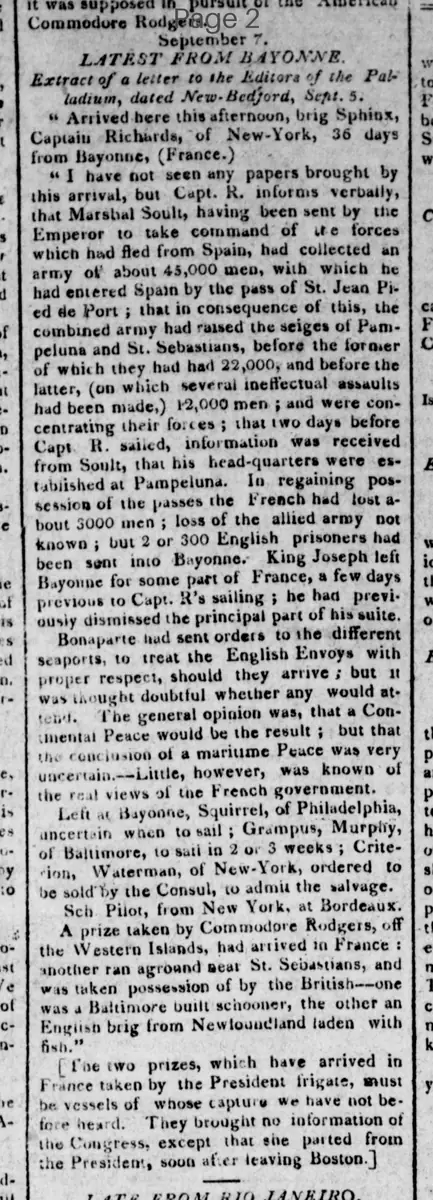
LATEST FROM BAYONNE.
Extract of a letter to the Editors of the Palladium, dated New-Bedford, Sept. 5.
"Arrived here this afternoon, brig Sphinx, Captain Richards, of New-York, 36 days from Bayonne, (France.)
I have not seen any papers brought by this arrival, but Capt. R. informs verbally, that Marshall Soult, having been sent by the Emperor to take command of the forces which had fled from Spain, had collected an army of about 45,000 men, with which he had entered Spain by the pass of St. Jean Pied de Port; that in consequence of this, the combined army had raised the sieges of Pampeluna and St. Sebastians, before the former of which they had had 22,000, and before the latter, (on which several ineffectual assaults had been made,) 12,000 men; and were concentrating their forces; that two days before Capt R. sailed, information was received from Soult, that his head-quarters were established at Pampeluna. In regaining possession of the passes the French had lost about 3000 men; loss of the allied army not known; but 2 or 300 English prisoners had been sent into Bayonne. King Joseph left Bayonne for some part of France, a few days previous to Capt. R's sailing; he had previously dismissed the principal part of his suite.
Bonaparte had sent orders to the different seaports, to treat the English Envoys with proper respect, should they arrive; but it was thought doubtful whether any would attend. The general opinion was, that a Continental Peace would be the result; but that the conclusion of a maritime Peace was very uncertain.—Little, however, was known of the real views of the French government.
Left at Bayonne, Squirrel, of Philadelphia, uncertain when to sail; Grampus, Murphy, of Baltimore, to sail in 2 or 3 weeks; Criterion, Waterman, of New-York, ordered to be sold by the Consul, to admit the salvage.
Sch Pilot, from New York, at Bordeaux.
A prize taken by Commodore Rodgers, off the Western Islands, had arrived in France: another ran aground near St. Sebastians, and was taken possession of by the British—one was a Baltimore built schooner, the other an English brig from Newfoundland laden with fish."
The two prizes, which have arrived in France taken by the President frigate, must be vessels of whose capture we have not before heard. They brought no information of the Congress, except that she parted from the President, soon after leaving Boston.
What sub-type of article is it?
What keywords are associated?
What entities or persons were involved?
Where did it happen?
Foreign News Details
Primary Location
Bayonne, France
Event Date
36 Days Prior To September 5
Key Persons
Outcome
french lost about 3000 men regaining passes; 2 or 300 english prisoners sent to bayonne; combined army raised sieges of pampeluna and st. sebastians; soult's headquarters at pampeluna
Event Details
Brig Sphinx arrived from Bayonne reporting Marshall Soult collected 45,000 men and entered Spain via St. Jean Pied de Port; combined army raised sieges of Pampeluna (22,000 men) and St. Sebastians (12,000 men, several assaults); forces concentrating; information from Soult two days before sailing that headquarters at Pampeluna; King Joseph left Bayonne for France, dismissed suite; Bonaparte ordered respect for English Envoys at seaports, doubtful attendance; opinion of Continental Peace likely, maritime uncertain; little known of French views. Ships at Bayonne: Squirrel, Grampus, Criterion; Sch Pilot at Bordeaux; prizes by Rodgers arrived in France, one by President frigate