Thank you for visiting SNEWPapers!
Sign up free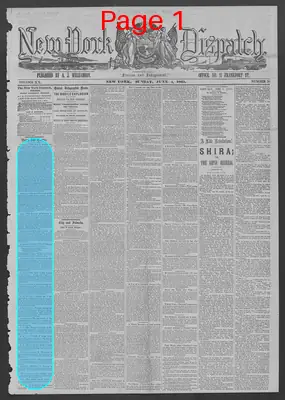
Letter to Editor
June 4, 1865
New York Dispatch
New York, New York County, New York
What is this article about?
Notes and Queries section responds to reader inquiries on diverse topics including legal estate settlement, Civil War regiment locations and losses, national debt, personal advice on marriage and behavior, poetry identification, historical battle facts, military enlistment rules, theater connections, religious statistics, transportation records, currency, officials, and early newspapers.
Clipping

OCR Quality
95%
Excellent
Full Text
Notes and Queries.
Citizen.-- "How long is an administrator allowed by law to settle up an estate, and also what percentage does the law allow an administrator for his trouble?" The period in which the affairs of an estate may be finally closed is limited to eighteen months. See section 77, page 182, vol. 3, Revised Statutes: "An executor or administrator, after the expiration of eighteen months from the granting of letters testamentary or of administration; may render a final account of all his proceedings to the surrogate who appointed him, although not cited to do so, and may obtain a citation to all persons interested in the estate to attend a final settlement of his accounts; which citation shall be served and published in the manner prescribed in the preceding sections of this title; and thereupon the same proceedings shall be had for a final settlement, and with the like effect in all respects as in the case of a settlement at the instance of a creditor".....The percentage authorized is as follows (see section 64, page 180, vol.3, Revised Statutes): "On the settlement of the account of an executor or administrator, the surrogate shall allow to him for his services, and if there be more than one, shall apportion among them, according to the services rendered by them respectively, over and above his or their expenses-l. For receiving and paying out all sums of money not exceeding one thousand dollars, at the rate of five dollars per cent.; For receiving and paying any sums exceeding one thousand dollars and not amounting to five thousand dollars, at the rate of two dollars and fifty per cent.; 3. For all sums of above five thousand dollars, at the rate of one dollar per cent.; and in all cases such allowances shall be made for their actual and necessary expenses as shall appear just and reasonable."
Cavalry.—"Can you inform me of the whereabouts of the First Connecticut Cavalry? Did they suffer much at the battle of Five Forks? If so, how many?" Has any official report of their loss been published?" The delay in answering the questions of this correspondent, was caused by our inability to ascertain the present locality of the regiment. It is now encamped in the vicinity of Alexandria, and is in the First Brigade of the Cavalry Corps of the Army of the Potomac. It was in the review of Tuesday last. Major L. P. Goodwin commands it. The regiment suffered severely in the engagement of April 1, 1865; but so far, we have been unable to get at any official report of its casualties.
Lane—The Herald's subscribers to the "Roll of Honor" will never pay the National debt, but it is hardly fair to assume that all who subscribe do so merely as an "advertising dodge." Some of them honestly mean what they propose, and put their names down for what they are willing to give, without stopping to inquire into the extent of the undertaking. It is estimated that the National debt of the United States now amounts to about one eighth of the value of the whole property of the people. That fact alone tells the whole story. The thing can't be done on the Herald plan.
Susan.—Poverty is not a crime. In a country like this, any young man of talent and enterprise may achieve wealth and position. If the young man you speak of is of good character, and you like him, marry him as soon as he gives you the opportunity, and let the parson be called on with as little delay as possible. This done, go to work with a will to help him win his way to fame and fortune.
B. wants to know which of George P. Morris's poems contains the following stanza:
"Take your Harps from Southern willows!
Shout the chorus of the Free;
States are all distinct, as billows,
Union one, as is the Sea,"
We can't find these lines in anything from the pen of Gen. Morris within our reach. Probably some of our readers may be able to tell us where to find them.
A Limerick Boy.—According to "Appleton's Cyclopaedia of Biography," there were 43,000 British troops at the battle of Waterloo. Wellington's whole force consisted of 67,000; 24,000 of whom were Belgians, who ran away the moment the action commenced. Napoleon's army consisted of 80,000 men. Blucher had 50,000. Wellington's loss is put down at 15,000, and Napoleon's at 40,000—making a total of killed and wounded in the battle of Waterloo, of 55,000.
O. Jones.—The fight at Big Bethel was only a skirmish......It is impossible to decide as to the comparative number of soldiers of foreign birth in the armies of the North and South. We have reason to think, however, that this element was more largely represented in the Army of the Potomac than any other army, either North or South.
Dimple.—"Can a person having furnished a substitute in July, 1864, for one year, obtain any return? If so, the probable amount, and how it may be obtained?" Persons furnishing substitutes in 1864, previous to the last call of the President, are not entitled to any remuneration for substitutes furnished—and in no case for persons who were enlisted for one year's service.
W. H. Merritt.—"Inform me if the Colonel Allen now interested in the Mexican emigration scheme, was ever connected in any manner whatever with the Old Bowery Theatre, either as lessee or manager?" We are decidedly of the impression that Colonel Allen never had aught to do with the Old Bowery Theatre either as manager or lessee.
A New Recruit.—Persons joining the New York State Militia must pay for their own uniforms. The State simply supplies arms. All other expenses fall on the members of the regiments. When called into actual service, the case is different. In that event the Government supplies all that is necessary.
Anonymous.—The last scene of the "Sleeping Beauty" is, by long odds, the finest and more artistic of the two plays you refer to......We don't know Andreas Versalius......Richard B. Connolly was a State Senator two years ago.
E. C.—The Roman Catholic is the largest religious denomination in the United States and the world. The Methodists and Baptists of the United States are nearly equal in point of numbers, with the Catholics.
D. L. S.—"Which of these three steamers—the Oregon, C. Vanderbilt, or Alida, made the quickest time from New York to Albany?" The Alida has the reputation of having made the fastest time of any river steamer plying between New York and Albany.
R. B.—There are two kinds of three cent U. S coins—one of silver and the other of nickel. The first was issued several years ago, while the latter has just made its appearance.
Politician.—James M. Thompson is one of the present Harbor Masters. He was appointed last Winter by Governor Fenton, and is now discharging the duties of the office.
All Hands Around.—The young lady was either thoughtless or vulgar. If the former, time will cure her of it; if the latter, the less you have to say to her the better.
Hendrick.—William C. Conner is County Clerk. The Clerk to the Common Council is David T. Valentine. There is no such office as City Clerk in this city.
Old Subscriber.—The Boston News Letter was the first newspaper printed in the United States. The first number was issued April 4, 1704.
Com.—The naval sword voted to Admiral Porter, was got up under the auspices of the Sanitary Fair in this city.
William H. Bushnell.—The stories are too long for our use. This will explain a question you might ask.
Citizen.-- "How long is an administrator allowed by law to settle up an estate, and also what percentage does the law allow an administrator for his trouble?" The period in which the affairs of an estate may be finally closed is limited to eighteen months. See section 77, page 182, vol. 3, Revised Statutes: "An executor or administrator, after the expiration of eighteen months from the granting of letters testamentary or of administration; may render a final account of all his proceedings to the surrogate who appointed him, although not cited to do so, and may obtain a citation to all persons interested in the estate to attend a final settlement of his accounts; which citation shall be served and published in the manner prescribed in the preceding sections of this title; and thereupon the same proceedings shall be had for a final settlement, and with the like effect in all respects as in the case of a settlement at the instance of a creditor".....The percentage authorized is as follows (see section 64, page 180, vol.3, Revised Statutes): "On the settlement of the account of an executor or administrator, the surrogate shall allow to him for his services, and if there be more than one, shall apportion among them, according to the services rendered by them respectively, over and above his or their expenses-l. For receiving and paying out all sums of money not exceeding one thousand dollars, at the rate of five dollars per cent.; For receiving and paying any sums exceeding one thousand dollars and not amounting to five thousand dollars, at the rate of two dollars and fifty per cent.; 3. For all sums of above five thousand dollars, at the rate of one dollar per cent.; and in all cases such allowances shall be made for their actual and necessary expenses as shall appear just and reasonable."
Cavalry.—"Can you inform me of the whereabouts of the First Connecticut Cavalry? Did they suffer much at the battle of Five Forks? If so, how many?" Has any official report of their loss been published?" The delay in answering the questions of this correspondent, was caused by our inability to ascertain the present locality of the regiment. It is now encamped in the vicinity of Alexandria, and is in the First Brigade of the Cavalry Corps of the Army of the Potomac. It was in the review of Tuesday last. Major L. P. Goodwin commands it. The regiment suffered severely in the engagement of April 1, 1865; but so far, we have been unable to get at any official report of its casualties.
Lane—The Herald's subscribers to the "Roll of Honor" will never pay the National debt, but it is hardly fair to assume that all who subscribe do so merely as an "advertising dodge." Some of them honestly mean what they propose, and put their names down for what they are willing to give, without stopping to inquire into the extent of the undertaking. It is estimated that the National debt of the United States now amounts to about one eighth of the value of the whole property of the people. That fact alone tells the whole story. The thing can't be done on the Herald plan.
Susan.—Poverty is not a crime. In a country like this, any young man of talent and enterprise may achieve wealth and position. If the young man you speak of is of good character, and you like him, marry him as soon as he gives you the opportunity, and let the parson be called on with as little delay as possible. This done, go to work with a will to help him win his way to fame and fortune.
B. wants to know which of George P. Morris's poems contains the following stanza:
"Take your Harps from Southern willows!
Shout the chorus of the Free;
States are all distinct, as billows,
Union one, as is the Sea,"
We can't find these lines in anything from the pen of Gen. Morris within our reach. Probably some of our readers may be able to tell us where to find them.
A Limerick Boy.—According to "Appleton's Cyclopaedia of Biography," there were 43,000 British troops at the battle of Waterloo. Wellington's whole force consisted of 67,000; 24,000 of whom were Belgians, who ran away the moment the action commenced. Napoleon's army consisted of 80,000 men. Blucher had 50,000. Wellington's loss is put down at 15,000, and Napoleon's at 40,000—making a total of killed and wounded in the battle of Waterloo, of 55,000.
O. Jones.—The fight at Big Bethel was only a skirmish......It is impossible to decide as to the comparative number of soldiers of foreign birth in the armies of the North and South. We have reason to think, however, that this element was more largely represented in the Army of the Potomac than any other army, either North or South.
Dimple.—"Can a person having furnished a substitute in July, 1864, for one year, obtain any return? If so, the probable amount, and how it may be obtained?" Persons furnishing substitutes in 1864, previous to the last call of the President, are not entitled to any remuneration for substitutes furnished—and in no case for persons who were enlisted for one year's service.
W. H. Merritt.—"Inform me if the Colonel Allen now interested in the Mexican emigration scheme, was ever connected in any manner whatever with the Old Bowery Theatre, either as lessee or manager?" We are decidedly of the impression that Colonel Allen never had aught to do with the Old Bowery Theatre either as manager or lessee.
A New Recruit.—Persons joining the New York State Militia must pay for their own uniforms. The State simply supplies arms. All other expenses fall on the members of the regiments. When called into actual service, the case is different. In that event the Government supplies all that is necessary.
Anonymous.—The last scene of the "Sleeping Beauty" is, by long odds, the finest and more artistic of the two plays you refer to......We don't know Andreas Versalius......Richard B. Connolly was a State Senator two years ago.
E. C.—The Roman Catholic is the largest religious denomination in the United States and the world. The Methodists and Baptists of the United States are nearly equal in point of numbers, with the Catholics.
D. L. S.—"Which of these three steamers—the Oregon, C. Vanderbilt, or Alida, made the quickest time from New York to Albany?" The Alida has the reputation of having made the fastest time of any river steamer plying between New York and Albany.
R. B.—There are two kinds of three cent U. S coins—one of silver and the other of nickel. The first was issued several years ago, while the latter has just made its appearance.
Politician.—James M. Thompson is one of the present Harbor Masters. He was appointed last Winter by Governor Fenton, and is now discharging the duties of the office.
All Hands Around.—The young lady was either thoughtless or vulgar. If the former, time will cure her of it; if the latter, the less you have to say to her the better.
Hendrick.—William C. Conner is County Clerk. The Clerk to the Common Council is David T. Valentine. There is no such office as City Clerk in this city.
Old Subscriber.—The Boston News Letter was the first newspaper printed in the United States. The first number was issued April 4, 1704.
Com.—The naval sword voted to Admiral Porter, was got up under the auspices of the Sanitary Fair in this city.
William H. Bushnell.—The stories are too long for our use. This will explain a question you might ask.
What sub-type of article is it?
Informative
What themes does it cover?
Military War
Politics
Social Issues
What keywords are associated?
Estate Administration
Connecticut Cavalry
National Debt
Marriage Advice
George P Morris
Battle Of Waterloo
Big Bethel
Military Substitutes
Bowery Theatre
Militia Uniforms
Religious Denominations
River Steamers
Three Cent Coins
Harbor Master
First Newspaper
Admiral Porter Sword
Notes And Queries
Letter to Editor Details
Notable Details
References Revised Statutes Vol. 3 For Estate Settlement And Administrator Fees
Details On First Connecticut Cavalry At Five Forks April 1 1865
Discussion Of Herald's Roll Of Honor And National Debt
Advice On Marriage To A Poor But Talented Young Man
Query On George P. Morris Poem Stanza
Statistics On Battle Of Waterloo
Info On Big Bethel Skirmish And Foreign Born Soldiers
Rules On 1864 Substitutes
Colonel Allen Not Connected To Old Bowery Theatre
Ny State Militia Uniform Costs
Comparison Of Sleeping Beauty Play Scenes
Andreas Versalius Unknown Richard B. Connolly Was State Senator
Largest Us Religious Denominations
Fastest Steamer Alida Ny To Albany
Us Three Cent Coins Silver And Nickel
James M. Thompson Harbor Master
Advice On Young Lady's Behavior
County Clerk William C. Conner Common Council Clerk David T. Valentine No City Clerk
First Us Newspaper Boston News Letter April 4 1704
Naval Sword To Admiral Porter From Sanitary Fair
Stories Too Long For Publication