Thank you for visiting SNEWPapers!
Sign up free
Story
June 26, 1867
The Evening Telegraph
Philadelphia, Philadelphia County, Pennsylvania
What is this article about?
A 1867 article describes Williamsport, Pa., as a rapidly growing city from a 1790 settlement to 15,000-18,000 population, driven by lumber trade, with details on history, scenery, churches, schools, court house, and the grand Herdic House hotel.
Clipping
OCR Quality
95%
Excellent
Full Text
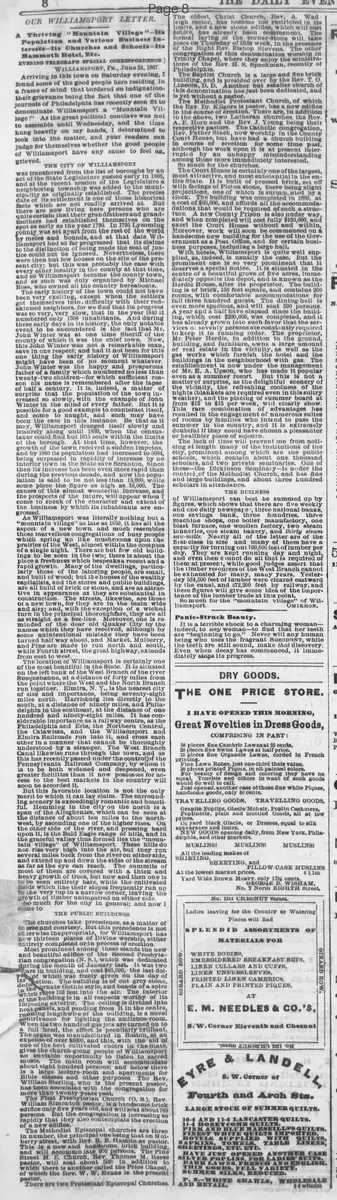
OUR WILLIAMSPORT LETTER.
A Thriving "Mountain Village"-Its Population and Various Business Interests-Its Churches and Schools-Its Mammoth Hotel, Etc.
EVENING TELEGRAPH SPECIAL CORRESPONDENCE
WILLIAMSPORT, Pa., June 24, 1867.
Arriving in this town on Saturday evening, I found some of the good people here residing in a frame of mind that bordered on indignation, their grievance being the fact that one of the journals of Philadelphia has recently seen fit to denominate Williamsport a "Mountain Village!" As the great political conclave was not to assemble until Wednesday, and the time hung heavily on my hands, I determined to look into the matter, and your readers can judge for themselves whether the good people of Williamsport have any cause to feel aggrieved.
THE CITY OF WILLIAMSPORT
was transferred from the list of boroughs by an act of the State Legislature passed early in 1866, and at the recent session of the Legislature a neighboring township was added to the municipality as originally established. The precise facts which are not readily arrived at. But the date of its settlement is one of those historical facts which are now living here persons who are quite certain that their grandfathers had established themselves on the spot as early as the year 1790. In 1795 Lycoming county was set apart from the rest of the world by metes and bounds, and at that date Williamsport had so far progressed that its claims to the distinction of being made the seat of justice could not be ignored. Nevertheless there were then but few houses on the site of the present city, and so every other locality in the county at that time, and so Williamsport became the county town and as such was duly organized by Michael Ross, who owned all the country hereabouts.
The early history of the town could not have been very exciting, except when the settlers got themselves into difficulty with their red-skinned neighbors, for we find that its progress was so very, very slow, that in the year 1840 it numbered only 1300 inhabitants. And during these early days in its history the only notable event to be encountered is the fact that Mr. John Winter was at one time Sheriff of the county of which it was the chief town. Now, this John Winter was not a remarkable man, save in one respect; and had it not been for this one thing the early history of Williamsport might have been of no moment whatever.
John Winter was the happy and prosperous father of a family which numbered no less than twenty-two children—for which sufficient reason his name is remembered after the lapse of half a century. It is indeed a matter of surprise that the population of the town increased so slowly, with the example of John Winter in the mind of every father. But it is possible for a good example to counteract itself, and come to naught, and such may have been the case in this instance. Be that as it may, Williamsport dragged itself slowly and leisurely along until 1850, when the census-taker could find but 1615 souls within the limits of the borough. At that time, however, the growth of the town received a sudden impetus, and by 1860 its population had increased to 5661, being surpassed in rapidity of increase by no interior town in the State save Scranton. Since then its increase has been even more rapid than during the previous decade, and now the population is said to be not less than 15,000, while some place the figure as high as 18,000. The causes of this almost wonderful increase, and the prospects of the future, will appear when I come to speak of the character and extent of the business by which its inhabitants are engrossed.
As Williamsport was literally nothing but a "mountain village" as late as 1850, it has all the aspect of a new town, and much resembles those marvellous congregations of busy people which spring up like mushrooms upon the prairies of the West, almost within the compass of a single night. There are but few old buildings to be seen in the town; there is about the place a freshness which bespeaks a recent and a rapid growth. Many of the dwellings, particularly those of the laboring people, are small, and built of wood; but the houses of the wealthy capitalists, and the stores and public buildings, are all built of brick or stone, and are as attractive in appearance as they are substantial in construction. The streets, likewise, are those of a new town, for they are in the main wide and airy; and, with the exception of a wicked turn in the principal thoroughfare, they are all as straight as a bee-line. Moreover, one is reminded of the dear old Quaker City by the names which they have received, although by some unintentional mistake they have been turned half way about, and Market, Mulberry, and Pine are made to run north and south, while Fourth street, the great highway, extends from east to west.
The location of Williamsport is certainly one of the most beautiful in the State. It is situated on the left bank of the West Branch of the river Susquehanna, at a distance of forty miles from the point where the West and the North Branch run together. Elmira, N. Y., is the nearest city of size and importance, being seventy-eight miles north. Harrisburg lies directly to the south, at a distance of ninety miles, and Philadelphia to the southeast, at the distance of one hundred and ninety-eight miles. It has considerable importance as a railway centre, as the Philadelphia and Erie, the Northern Central, the Catawissa, and the Williamsport and Elmira Railroads run into it, and cross each other in a manner that cannot be thoroughly understood by a stranger. The West Branch Canal likewise runs through the town, and as this has recently passed under the control of the Pennsylvania Railroad Company, by whom it is to be both widened and deepened, even greater facilities than it now possesses for access to the best markets in the country will soon be accorded it.
But this favorable location is not the only merit to which it can lay claim. The surrounding scenery is exceedingly romantic and beautiful. Hemming in the city on the north is a span of the Alleghenies, which can be seen at the distance of about ten miles to the northwest, by ascending one of the higher rises. On the other side of the river, and pressing hard upon it, is the Bald Eagle range of hills, and in the graceful valley thus formed lies the "mountain village" of Williamsport. These hills do not rise very high into the air, but they run several miles back from the river on either side, and extend up and down the sides of the stream as far as the eye can reach. The summits of most of them are covered with a thick and heavy growth of trees, but now and then one is to be seen entirely bare, while the cultivated fields which line their slopes frequently run up to the very top in a narrow corner, leaving the growth of timber unimpaired on either side.
So much for the city in general; and now I come to
THE PUBLIC BUILDINGS.
The churches take precedence, as a matter of course and courtesy. But this precedence is not otherwise inappropriate, for Williamsport has now thirteen places of Divine worship, either entirely completed or in process of erection. Most prominent among these stands the new and beautiful edifice of the Second Presbyterian congregation (N. S.), which was dedicated during the month of January last. It was two years in building, and cost $40,000, the last dollar of which was freely given on the day of dedication. The building is of cut grey stone, in the ornate Gothic style, and boasts of a spire which is in all respects worthy of its imposing exterior. The interior is finished in neat panels, and pending from it in the centre, running lengthwise of the building, is a novel contrivance for lighting the audience-room. When its two hundred gas jets are turned on to a full head, the effect is peculiarly brilliant. The organ was manufactured in Boston, at an expense of over $3000, and this, with the aid of one of the best cultivated choirs in the State, gives the church-going people of Williamsport an enviable opportunity to listen to sacred music.
The main room will accommodate about eight hundred persons; and below there is a large lecture-room and apartments for Bible classes and other purposes. The Rev. William Sterling, who is the present pastor, has been associated with the congregation for more than twenty years past.
The First Presbyterian Church (O. S.), Rev. William Simonton, pastor, is a handsome brick edifice only five years old, and will seat about 700 persons. The congregation is increasing so rapidly that they also contemplate the erection of a new edifice.
The Methodist Episcopal churches are three in number, the principal one being that on Mulberry street, with Rev. Hamlin as pastor. This is a new and handsome brick building, and will accommodate 600 persons. The Pine Street Church, Rev. Thomas pastor, will seat about 500; in addition to which there is another called the Price Chapel, of which the Rev. W. W. Evans is the present pastor.
There are two Protestant Episcopal Churches. The oldest, Christ Church, Rev. A. W. Lechler rector, has become too restricted in its limits, and a new stone edifice, which will cost $40,000, has already been commenced. The formal laying of the corner-stone will take place on Thursday of this week, in the presence of the Right Rev. Bishop Stevens. The other congregation of this denomination worship in Trinity Chapel, where they enjoy the ministrations of the Rev. H. S. Spackman, recently of Philadelphia.
The Baptist Church is a large and fine brick building, and is presided over by the Rev. T. O. Lincoln, D. D. Another but smaller church of this denomination has just been dedicated, and is yet without a pastor.
The Methodist Protestant Church, of which the Rev. Dr. Kilgore is pastor, has a new edifice in the course of erection. There are, in addition to the above, two Lutheran churches, the Rev. A. E. Horn and the Rev. J. Young being their respective pastors. The Catholic congregation, Rev. Father Stack, now worship in the County Court House, but have had a church building in course of erection for some time past, although the work upon it is at present interrupted by an unhappy misunderstanding among those more immediately interested.
So much for the churches.
The Court House is certainly one of the largest, most attractive, and most substantial in the entire State. It is built of pressed brick, set off with facings of Pictou stone, there being slight projections, one of which is surmounted by a clock. The building was completed in 1860, at a cost of $60,000, and affords all the accommodations that would be required of such a structure. A new County Prison is also under way, and when completed will cost fully $150,000, and excel the Court House without and within.
Moreover, work will soon be commenced on a handsome new building for the use of the Government as a Post Office, and for certain business purposes, including a large hall.
With hotels, Williamsport is quite well supplied, as, indeed, is usually the case. But the prominent one is so very prominent that it deserves a special notice. It is situated in the centre of a beautiful grove of five acres, immediately opposite the depot, and is known as the Herdic House, after its proprietor. The building is of brick, 156 feet square, and contains 200 rooms, with comfortable accommodations for full three hundred guests. The dining-hall is even more spacious, and will seat 500 persons. A year and a half have elapsed since the building, which cost $200,000, was completed, and it has already grown into such favor that the services of seventy persons are constantly required to keep it in running order. The proprietor, Mr. Peter Herdic, in addition to the ground, building, and furniture, owns a large amount of real estate in the vicinity, as well as the gas works which furnish the hotel and the buildings in the neighborhood with gas. The establishment is now under the management of Mr. E. A. Upson, who has made it popular even as a summer resort. But this is not a matter of surprise, as the delightful scenery of the vicinity, the refreshing coolness of the nights (blankets are required even in this sultry weather), and the placing of summer board at from $12 to $15 per week, will clearly show. This rare combination of advantages has resulted in the engagement of numerous suites of rooms by families who intend to pass the summer in the country, and it is extremely doubtful if they could have chosen a pleasanter or healthier place of sojourn.
The lack of time will prevent me from noticing at length many of the institutions of the city, prominent among which are the public schools, which contain about one thousand scholars, and two private seminaries. One of these—the Dickinson Seminary—is under the control of the Methodist Church, and has fine and large buildings, and about three hundred scholars in attendance.
THE BUSINESS
of Williamsport can best be summed up by figures, which shows that there are five weekly and one daily newspaper, three national banks, one savings bank, three foundries, three machine shops, one boiler manufactory, one blast furnace, one woollen factory, two steam tanneries, one steam bakery, and thirty steam saw-mills. Nearly all of the latter are of the first-class in size and many of them have a capacity for turning out 100,000 feet of lumber per day. They are kept running day and night, and even then cannot do all that is required of them at present, while good judges assert that the timber resources of the West Branch cannot be exhausted for many, many years. Yesterday 534,500 feet of lumber were cleared eastward by the canal, and 572,200 feet by railway, and these figures will give some idea of the importance of the lumber trade at this point.
So much for the "mountain village" of Williamsport.
OMIKRON.
A Thriving "Mountain Village"-Its Population and Various Business Interests-Its Churches and Schools-Its Mammoth Hotel, Etc.
EVENING TELEGRAPH SPECIAL CORRESPONDENCE
WILLIAMSPORT, Pa., June 24, 1867.
Arriving in this town on Saturday evening, I found some of the good people here residing in a frame of mind that bordered on indignation, their grievance being the fact that one of the journals of Philadelphia has recently seen fit to denominate Williamsport a "Mountain Village!" As the great political conclave was not to assemble until Wednesday, and the time hung heavily on my hands, I determined to look into the matter, and your readers can judge for themselves whether the good people of Williamsport have any cause to feel aggrieved.
THE CITY OF WILLIAMSPORT
was transferred from the list of boroughs by an act of the State Legislature passed early in 1866, and at the recent session of the Legislature a neighboring township was added to the municipality as originally established. The precise facts which are not readily arrived at. But the date of its settlement is one of those historical facts which are now living here persons who are quite certain that their grandfathers had established themselves on the spot as early as the year 1790. In 1795 Lycoming county was set apart from the rest of the world by metes and bounds, and at that date Williamsport had so far progressed that its claims to the distinction of being made the seat of justice could not be ignored. Nevertheless there were then but few houses on the site of the present city, and so every other locality in the county at that time, and so Williamsport became the county town and as such was duly organized by Michael Ross, who owned all the country hereabouts.
The early history of the town could not have been very exciting, except when the settlers got themselves into difficulty with their red-skinned neighbors, for we find that its progress was so very, very slow, that in the year 1840 it numbered only 1300 inhabitants. And during these early days in its history the only notable event to be encountered is the fact that Mr. John Winter was at one time Sheriff of the county of which it was the chief town. Now, this John Winter was not a remarkable man, save in one respect; and had it not been for this one thing the early history of Williamsport might have been of no moment whatever.
John Winter was the happy and prosperous father of a family which numbered no less than twenty-two children—for which sufficient reason his name is remembered after the lapse of half a century. It is indeed a matter of surprise that the population of the town increased so slowly, with the example of John Winter in the mind of every father. But it is possible for a good example to counteract itself, and come to naught, and such may have been the case in this instance. Be that as it may, Williamsport dragged itself slowly and leisurely along until 1850, when the census-taker could find but 1615 souls within the limits of the borough. At that time, however, the growth of the town received a sudden impetus, and by 1860 its population had increased to 5661, being surpassed in rapidity of increase by no interior town in the State save Scranton. Since then its increase has been even more rapid than during the previous decade, and now the population is said to be not less than 15,000, while some place the figure as high as 18,000. The causes of this almost wonderful increase, and the prospects of the future, will appear when I come to speak of the character and extent of the business by which its inhabitants are engrossed.
As Williamsport was literally nothing but a "mountain village" as late as 1850, it has all the aspect of a new town, and much resembles those marvellous congregations of busy people which spring up like mushrooms upon the prairies of the West, almost within the compass of a single night. There are but few old buildings to be seen in the town; there is about the place a freshness which bespeaks a recent and a rapid growth. Many of the dwellings, particularly those of the laboring people, are small, and built of wood; but the houses of the wealthy capitalists, and the stores and public buildings, are all built of brick or stone, and are as attractive in appearance as they are substantial in construction. The streets, likewise, are those of a new town, for they are in the main wide and airy; and, with the exception of a wicked turn in the principal thoroughfare, they are all as straight as a bee-line. Moreover, one is reminded of the dear old Quaker City by the names which they have received, although by some unintentional mistake they have been turned half way about, and Market, Mulberry, and Pine are made to run north and south, while Fourth street, the great highway, extends from east to west.
The location of Williamsport is certainly one of the most beautiful in the State. It is situated on the left bank of the West Branch of the river Susquehanna, at a distance of forty miles from the point where the West and the North Branch run together. Elmira, N. Y., is the nearest city of size and importance, being seventy-eight miles north. Harrisburg lies directly to the south, at a distance of ninety miles, and Philadelphia to the southeast, at the distance of one hundred and ninety-eight miles. It has considerable importance as a railway centre, as the Philadelphia and Erie, the Northern Central, the Catawissa, and the Williamsport and Elmira Railroads run into it, and cross each other in a manner that cannot be thoroughly understood by a stranger. The West Branch Canal likewise runs through the town, and as this has recently passed under the control of the Pennsylvania Railroad Company, by whom it is to be both widened and deepened, even greater facilities than it now possesses for access to the best markets in the country will soon be accorded it.
But this favorable location is not the only merit to which it can lay claim. The surrounding scenery is exceedingly romantic and beautiful. Hemming in the city on the north is a span of the Alleghenies, which can be seen at the distance of about ten miles to the northwest, by ascending one of the higher rises. On the other side of the river, and pressing hard upon it, is the Bald Eagle range of hills, and in the graceful valley thus formed lies the "mountain village" of Williamsport. These hills do not rise very high into the air, but they run several miles back from the river on either side, and extend up and down the sides of the stream as far as the eye can reach. The summits of most of them are covered with a thick and heavy growth of trees, but now and then one is to be seen entirely bare, while the cultivated fields which line their slopes frequently run up to the very top in a narrow corner, leaving the growth of timber unimpaired on either side.
So much for the city in general; and now I come to
THE PUBLIC BUILDINGS.
The churches take precedence, as a matter of course and courtesy. But this precedence is not otherwise inappropriate, for Williamsport has now thirteen places of Divine worship, either entirely completed or in process of erection. Most prominent among these stands the new and beautiful edifice of the Second Presbyterian congregation (N. S.), which was dedicated during the month of January last. It was two years in building, and cost $40,000, the last dollar of which was freely given on the day of dedication. The building is of cut grey stone, in the ornate Gothic style, and boasts of a spire which is in all respects worthy of its imposing exterior. The interior is finished in neat panels, and pending from it in the centre, running lengthwise of the building, is a novel contrivance for lighting the audience-room. When its two hundred gas jets are turned on to a full head, the effect is peculiarly brilliant. The organ was manufactured in Boston, at an expense of over $3000, and this, with the aid of one of the best cultivated choirs in the State, gives the church-going people of Williamsport an enviable opportunity to listen to sacred music.
The main room will accommodate about eight hundred persons; and below there is a large lecture-room and apartments for Bible classes and other purposes. The Rev. William Sterling, who is the present pastor, has been associated with the congregation for more than twenty years past.
The First Presbyterian Church (O. S.), Rev. William Simonton, pastor, is a handsome brick edifice only five years old, and will seat about 700 persons. The congregation is increasing so rapidly that they also contemplate the erection of a new edifice.
The Methodist Episcopal churches are three in number, the principal one being that on Mulberry street, with Rev. Hamlin as pastor. This is a new and handsome brick building, and will accommodate 600 persons. The Pine Street Church, Rev. Thomas pastor, will seat about 500; in addition to which there is another called the Price Chapel, of which the Rev. W. W. Evans is the present pastor.
There are two Protestant Episcopal Churches. The oldest, Christ Church, Rev. A. W. Lechler rector, has become too restricted in its limits, and a new stone edifice, which will cost $40,000, has already been commenced. The formal laying of the corner-stone will take place on Thursday of this week, in the presence of the Right Rev. Bishop Stevens. The other congregation of this denomination worship in Trinity Chapel, where they enjoy the ministrations of the Rev. H. S. Spackman, recently of Philadelphia.
The Baptist Church is a large and fine brick building, and is presided over by the Rev. T. O. Lincoln, D. D. Another but smaller church of this denomination has just been dedicated, and is yet without a pastor.
The Methodist Protestant Church, of which the Rev. Dr. Kilgore is pastor, has a new edifice in the course of erection. There are, in addition to the above, two Lutheran churches, the Rev. A. E. Horn and the Rev. J. Young being their respective pastors. The Catholic congregation, Rev. Father Stack, now worship in the County Court House, but have had a church building in course of erection for some time past, although the work upon it is at present interrupted by an unhappy misunderstanding among those more immediately interested.
So much for the churches.
The Court House is certainly one of the largest, most attractive, and most substantial in the entire State. It is built of pressed brick, set off with facings of Pictou stone, there being slight projections, one of which is surmounted by a clock. The building was completed in 1860, at a cost of $60,000, and affords all the accommodations that would be required of such a structure. A new County Prison is also under way, and when completed will cost fully $150,000, and excel the Court House without and within.
Moreover, work will soon be commenced on a handsome new building for the use of the Government as a Post Office, and for certain business purposes, including a large hall.
With hotels, Williamsport is quite well supplied, as, indeed, is usually the case. But the prominent one is so very prominent that it deserves a special notice. It is situated in the centre of a beautiful grove of five acres, immediately opposite the depot, and is known as the Herdic House, after its proprietor. The building is of brick, 156 feet square, and contains 200 rooms, with comfortable accommodations for full three hundred guests. The dining-hall is even more spacious, and will seat 500 persons. A year and a half have elapsed since the building, which cost $200,000, was completed, and it has already grown into such favor that the services of seventy persons are constantly required to keep it in running order. The proprietor, Mr. Peter Herdic, in addition to the ground, building, and furniture, owns a large amount of real estate in the vicinity, as well as the gas works which furnish the hotel and the buildings in the neighborhood with gas. The establishment is now under the management of Mr. E. A. Upson, who has made it popular even as a summer resort. But this is not a matter of surprise, as the delightful scenery of the vicinity, the refreshing coolness of the nights (blankets are required even in this sultry weather), and the placing of summer board at from $12 to $15 per week, will clearly show. This rare combination of advantages has resulted in the engagement of numerous suites of rooms by families who intend to pass the summer in the country, and it is extremely doubtful if they could have chosen a pleasanter or healthier place of sojourn.
The lack of time will prevent me from noticing at length many of the institutions of the city, prominent among which are the public schools, which contain about one thousand scholars, and two private seminaries. One of these—the Dickinson Seminary—is under the control of the Methodist Church, and has fine and large buildings, and about three hundred scholars in attendance.
THE BUSINESS
of Williamsport can best be summed up by figures, which shows that there are five weekly and one daily newspaper, three national banks, one savings bank, three foundries, three machine shops, one boiler manufactory, one blast furnace, one woollen factory, two steam tanneries, one steam bakery, and thirty steam saw-mills. Nearly all of the latter are of the first-class in size and many of them have a capacity for turning out 100,000 feet of lumber per day. They are kept running day and night, and even then cannot do all that is required of them at present, while good judges assert that the timber resources of the West Branch cannot be exhausted for many, many years. Yesterday 534,500 feet of lumber were cleared eastward by the canal, and 572,200 feet by railway, and these figures will give some idea of the importance of the lumber trade at this point.
So much for the "mountain village" of Williamsport.
OMIKRON.
What sub-type of article is it?
Historical Event
What themes does it cover?
Fortune Reversal
Triumph
What keywords are associated?
Williamsport
Population Growth
Lumber Industry
Churches
Public Buildings
Herdic House
What entities or persons were involved?
John Winter
Michael Ross
Peter Herdic
Where did it happen?
Williamsport, Pa.
Story Details
Key Persons
John Winter
Michael Ross
Peter Herdic
Location
Williamsport, Pa.
Event Date
1790 1867
Story Details
Detailed account of Williamsport's transformation from a slow-growing settlement in 1790 to a thriving city by 1867, highlighting population increase, lumber industry, churches, schools, public buildings, and the Herdic House hotel.