Thank you for visiting SNEWPapers!
Sign up free
The Daily Alaska Empire
Juneau, Juneau County, Alaska
What is this article about?
John Thomas Scopes, famed from the 1925 Tennessee evolution trial, is now unemployed at 31 and nominated by Kentucky Socialists for Congress. Living in Paducah with his father, he avoids discussing the trial, focusing on Socialist principles amid joblessness after studies and work abroad.
Merged-components note: Story 'Evolution Case Dead Issue to Scopes' merged with its accompanying image due to spatial inclusion and reading order proximity.
Clipping
OCR Quality
Full Text
Jobless Now, He Seeks Congress Post
PADUCAH, Ky., Sept. 22. John Thomas Scopes, youthful school teacher upon whom the full glare of publicity blazed seven years ago during the famous test case of Tennessee's anti-evolution law, today is a private in the army of the unemployed.
Seven years have passed since the slender, sandy-haired youth came to the decision in a drug store at Dayton, Tenn., that led to one of the most unusual cases in American jurisprudence.
He is 31 years old now, and a mustache adorns his upper lip. But in other ways he is the same shy school teacher that moved in that astonishing drama.
Case "Closed" To Him
He will scarcely talk of it now. The case is a "dead issue" he says.
"The weather was terribly warm. I could not get accustomed to interviews by the press and the resulting publicity," is all that he cares to recall of his impressions of those days.
Scopes almost disappeared from the news after the two intellectual giants, William Jennings Bryan and Clarence Darrow, had wrestled over the issue he had created.
But recently he came to public attention again when Kentucky Socialists nominated him for Congressman-at-Large.
It is Socialism, not evolution, that he talks to visitors now. His father is a Socialist, and Scopes has been a Socialist since he was old enough to formulate political views. He will talk at length to anyone he thinks interested in Socialist principles.
Few Speeches
But he is as diffident a campaigner as he was defendant in the trial. He plans to make but few speeches, possibly only one and that in Louisville.
He has been living for the past year at the home of his father, Thomas Scopes, on a small farm at the edge of Paducah. He spends the time working in the garden, mowing the grass in the neat lawn and reading-principally reading.
"Since the trial," he says, "I have been studying, working sometimes, trying to make a living all the time. For two years I was a student at the University of Chicago. I worked three years as a geologist in Venezuela, and then I spent another year as student in Chicago. For the past year or more I have been a private in the army of the unemployed."
Scopes concludes his story with a smile.
No, he answers, he has not taught in Tennessee since the trial, and he does not think that case changed anything.
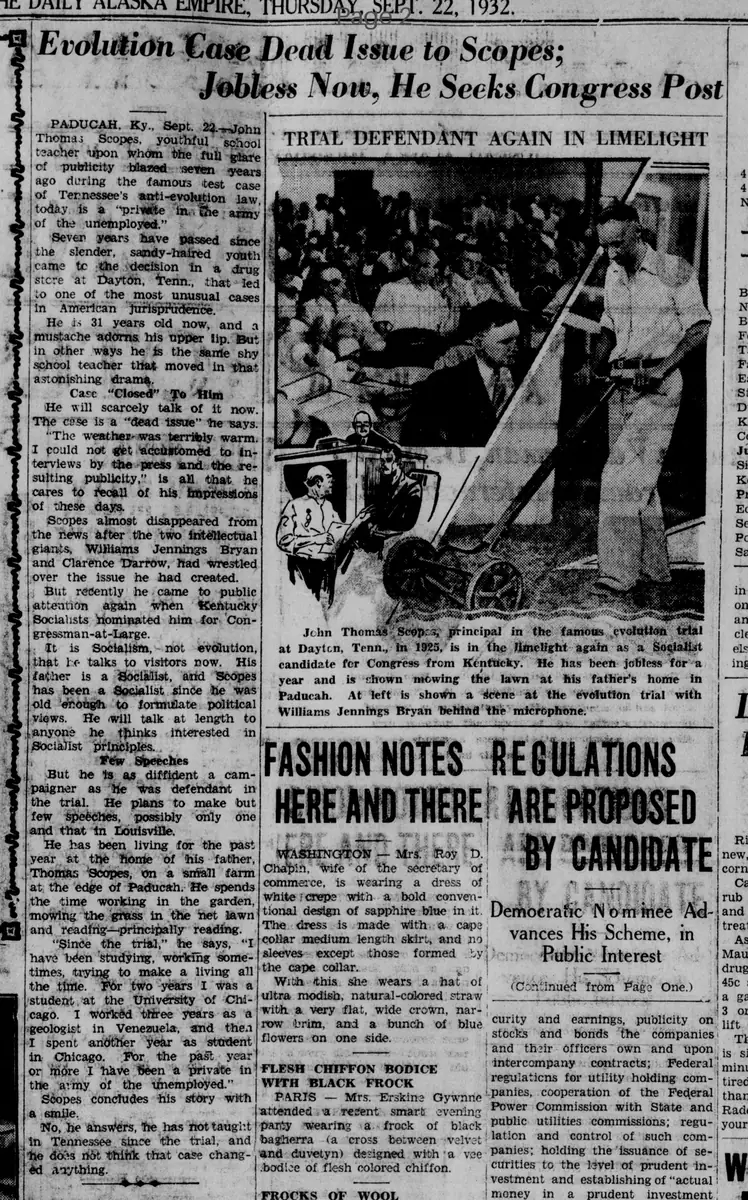
John Thomas Scopes, principal in the famous evolution trial at Dayton, Tenn., in 1925, is in the limelight again as a Socialist candidate for Congress from Kentucky. He has been jobless for a year and is shown mowing the lawn at his father's home in Paducah. At left is shown a scene at the evolution trial with William Jennings Bryan behind the microphone.
What sub-type of article is it?
What themes does it cover?
What keywords are associated?
What entities or persons were involved?
Where did it happen?
Story Details
Key Persons
Location
Paducah, Ky.
Event Date
Sept. 22
Story Details
John Thomas Scopes, central figure in the 1925 Tennessee evolution trial, is now 31, unemployed, living with his father in Paducah, Ky., and running as a Socialist candidate for Congress. He reflects briefly on the trial as a dead issue and discusses his life since: studying in Chicago, working as a geologist in Venezuela, and current unemployment.