Thank you for visiting SNEWPapers!
Sign up free
Virginia Argus
Richmond, Virginia
What is this article about?
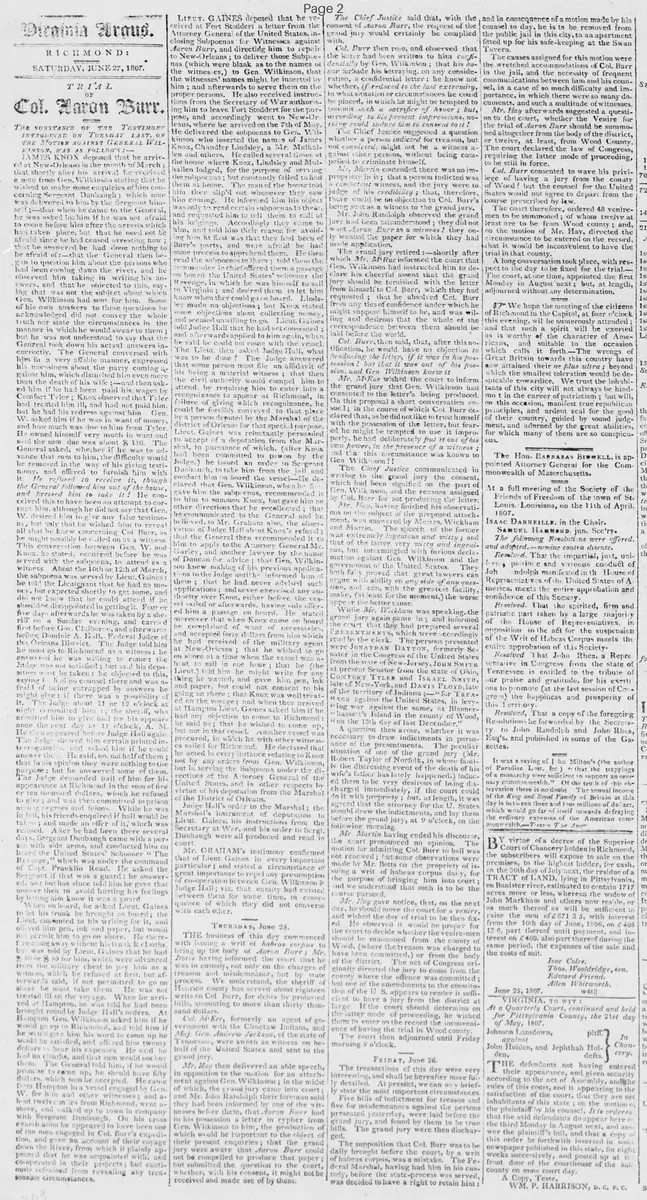
Virginia Argus report from June 27, 1807, on Aaron Burr's treason trial in Richmond, detailing witness testimonies by James Knox and Lt. Gaines against Gen. Wilkinson, grand jury presentments for treason against associates, and procedural discussions on bail, jury selection, and trial date.
Clipping
OCR Quality
Full Text
RICHMOND:
SATURDAY, JUNE 27, 1807.
TRIAL
OF
Col. Aaron Burr.
THE SUBSTANCE OF THE TESTIMONY
INTRODUCED ON TUESDAY LAST, ON
THE ACTION AGAINST GENERAL WILKINSON, WAS AS FOLLOWS:-
JAMES KNOX deposed that he arrived
at New-Orleans in the month of March;
that shortly after his arrival he received
a note from Gen. Wilkinson stating that he
wished to make some enquiries of him con-
cerning Sergeant Dunbaugh: which note
was delivered to him by the Sergeant him-
self:--that when he came to the General,
he was asked by him if he was not afraid
to come before him after the arrests which
had taken place, but that he need not be
afraid since he had ceased arresting now;
that he answered he had done nothing to
be afraid of:-that the General then be-
gan to question him about the persons who
had been coming down the river, and he
observed him taking in writing his an-
swers, and that he objected to this, say-
ing that was not the subject about which
Gen. Wilkinson had sent for him. Some
of his own answers to those questions he
acknowledged did not convey the whole
truth nor state the circumstances in the
manner in which he would swear to them;
but he was not understood to say that the
General took down his actual answers in-
correctly. The General conversed with
him in a very affable manner, expressed
his uneasiness about the party coming a-
gainst him, which disturbed him even more
than the death of his wife ;--and then ask-
ed him if he had been paid his wages by
Comfort Tyler: Knox observed that Tyler
had treated him ill, and had not paid him.
but he had his redress against him Gen.
W. asked him if he was in want of money,
and how much was due to him from Tyler.
He owned himself very much in want and
said the sum due was about 150. The
General asked, whether if he was to ad-
vance that sum to him, the difficulty would
be removed in the way of his giving testi-
mony, and offered to furnish him with
it. He refused to receive it, though
the General followed him out of the house,
and pressed him to take it! He con-
ceived this to have been an attempt to cor-
rupt him, although he did not say that Gen.
W. desired him to give any false testimo-
ny, but only that he wished him to reveal
all that he knew concerning Col Burr, as
he might possibly be called on as a witness.
This conversation between Gen. W. and
Knox, he stated, occurred before he was
served with the subpoena, to attend as a
witness. About the 10th or 12th of March,
the subpoena was served by Lieut. Gaines:
he told the Lieutenant that he had no mo-
ney, but expected shortly to get some, and
did not know that he could attend if he
should be disappointed in getting it. Four or
five days afterwards he was taken by a she-
riff on a Sunday evening, and carried
first before Gov. Claiborne, and afterwards
before Dominic A. Hall, Federal Judge of
the Orleans District. The Judge told him
he must go to Richmond as a witness: he
answered he was willing to come: the
Judge was not satisfied: but said his depo-
sition must be taken: he objected to this,
saying he had no counsel there and was a-
fraid of being entrapped by answers he
might give: if there was a possibility of
it. The Judge about 11 or 12 o'clock at
night committed him to the sheriff, who
admitted him to give bail for his appear-
ance the next day at 11 o'clock, A. M.
He then appeared before Judge Hall again.
The Judge showed him certain printed in-
terrogatories, and asked him if he could
answer them. He said, no, not half of them;
that in his opinion they were nothing to the
purpose: but he answered some of them.
The Judge demanded bail of him for his
appearance at Richmond in the sum of five
or ten thousand dollars, which he refused
to give: and was then committed to prison
among negroes and felons. While he was
in jail, his friends enquired if bail would be
taken: and made an offer of it, which was
refused. After he had been there several
days, Sergeant Dunbaugh came with a per-
son with side arms, and conducted him on
board the United States' Schooner "The
Revenge," which was under the command
of Capt. Franklin Read. He asked the
Sergeant if that was a guard: he answer-
ed, no: but has since told him he gave that
answer then to avoid hurting his feelings
by letting him know it was a guard.
When on board, he asked Lieut. Gaines
to let his trunk be brought on board; the
Lieut. consented to his writing for it, and
offered him pen, ink and paper, but would
not permit him to go on shore. He there-
fore came away without his trunk &c. clothes
but was told by Lieut. Gaines that he had
40 or 50 for him, which were advanced
from the military chest to pay him as a
witness, which he refused at first, but af-
terwards said, if not permitted to go on
shore he must take them. He was not
treated ill on the voyage. When he arri-
ved at Hampton, he was told he had been
brought round by Judge Hall's orders. At
Hampton Gen. Wilkinson asked him if he
would go up to Richmond, and told him if
he would give him his word to come up he
would be satisfied, and offered him twenty
dollars to bear his expenses. He said he
had no clothes, and that sum would not buy
them. The General told him, if he would
promise to come up, he should have fifty
dollars, which sum he accepted. He came
from Hampton in a vessel engaged by Gen.
W. for him and other witnesses; and a-
bout twelve miles from Richmond, went a-
shore, and walked up to town in company
with Sergeant Dunbaugh. On his cross
examination he appeared to have been one
of the men engaged in Col. Burr's expedi-
tion, and gave an account of their voyage
down the River, from which it plainly ap-
peared that he was acquainted with, and
co-operated in their projects; but cauti-
ously refrained from revealing any trea-
sonable circumstances,
LIEUT. GAINES deposed that he re-
ceived at Fort Stoddert a letter from the
Attorney General of the United States, in-
closing Subpoenas for Witnesses against
Aaron Burr, and directing him to repair
to New-Orleans; to deliver those Subpoe-
nas (which were blank as to the names of
the witnesses,) to Gen. Wilkinson, that
the witnesses' names might be inserted by
him; and afterwards to serve them on the
proper persons. He also received instruc-
tions from the Secretary of War authoris-
ing him to leave Fort Stoddert for the pur-
pose, and accordingly went to New-Or-
leans, where he arrived on the 7th of May.
He delivered the subpoenas to Gen. Wil-
kinson who inserted the names of James
Knox, Chandler Lindsley, a Mr. Mulhal-
len and others. He called several times at
the house where Knox, Lindsley and Mul-
hallen lodged, for the purpose of serving
the subpoenas; but constantly failed to find
them at home. The man of the house told
him they slipp'd out whenever they saw
him coming. He informed him his object
was only to read certain subpoenas to them.
and requested him to tell them to call at
his lodgings. Accordingly they came to
him, and told him their reason for avoid-
ing him at first was that they had been of
Burr's party, and were afraid he had
some process to apprehend them. He then
read the subpoenas to them: told them the
commander in chief offered them a passage
on board the United States' schooner the
Revenge, in which he was himself to sail
to Virginia; and desired them to let him
know when they could go on board. Linds-
ley made no objections: but Knox stated
some objections about collecting money,
and seemed unwilling to go. Lieut. Gaines
told Judge Hall that he had not consented;
and afterwards applied to him again, when
he said he could not come with the vessel.
The Lieut. then asked Judge Hall, what
was to be done? The Judge answered
that some person must file an affidavit of
his being a material witness; that then
the civil authority would compel him to
attend, by requiring him to enter into a
recognizance to appear at Richmond, in
failure of giving which recognizance, he
could be forcibly conveyed to that place
by a person deputed by the Marshal of the
district of Orleans for that special purpose.
Lieut. Gaines was reluctantly persuaded
to accept of a deputation from the Mar-
shal, in pursuance of which, (after Knox
had been committed to prison by the
Judge,) he issued an order to Sergeant
Dunbaugh, to take him from the jail and
conduct him on board the vessel. He de-
clared that Gen. Wilkinson, when he gave
him the subpoenas, recommended it
to him to summon Knox, but gave him no
other directions that he recollected: that
he communicated to the General and he
believed, to Mr. Graham also, the obser-
vation of Judge Hall about Knox's refusal;
that the General then recommended it to
him to apply to the Attorney General Mr.
Gurley, and another lawyer by the name
of Duncan for advice: that Gen. Wilkin-
son knew nothing of his previous applica-
tions to the Judge until he informed him of
them; that he had never advised such
applications; and never exercised any au-
thority over Knox, either before the ves-
sel sailed or afterwards, having only offer-
ed him a passage on board. He stated
moreover that when Knox came on board
he complained of want of necessaries,
and accepted forty dollars from him which
he had received of the military agent
at New-Orleans; that he wished to go
on shore at a time when the vessel was a-
bout to sail in one hour; that he (the
Lieut.) told him he might write for any-
thing he wanted, and gave him pen, ink
and paper, but could not consent to his
going on shore; that Knox was well treat-
ed on the voyage; and when they arrived
at Hampton Lieut. Gaines asked him if he
had any objection to come to Richmond:
he said no; that he wished to come up,
but not in that vessel. Another vessel was
procured, in which he with other witness-
es sailed for Richmond. He declared that
he acted in every instance relating to Knox
not by any orders from Gen. Wilkinson,
but in serving the Subpoena under the di-
rections of the Attorney General of the
United States, and in other respects by
virtue of his deputation from the Marshal
of the District of Orleans.
Judge Hall's order to the Marshal; the
Marshal's instrument of deputation to
Lieut. Gaines, his instructions from the
Secretary at War, and his order to Sgt.
Dunbaugh were all produced and read in
court.
Mr. GRAHAM's testimony confirmed
that of Lieut. Gaines in every important
particular; and stated a circumstance of
great importance to repel any presumption
of co-operation between Gen. Wilkinson &
Judge Hall; viz. that enmity had existed
between them for some time, in conse-
quence of which they did not converse
with each other.
THURSDAY, June 25.
THE business of this day commenced
with issuing a writ of habeas corpus to
bring up the body of Aaron Burr: Mr.
Botts having informed the court that he
was in custody, not only on the charges of
treason and misdemeanor, but by state
process. We understand, the sheriff of
Henrico county has served about eighteen
writs on Col Burr, for debts by protested
bills, amounting to more than thirty thou-
sand dollars.
Col. McKee, formerly an agent of go-
vernment with the Chickasaw Indians, and
Maj. Gen. Andrew Jackson, of the state of
Tennessee, were sworn as witnesses on be-
half of the United States and sent to the
grand jury.
Mr. Hay then delivered an able speech,
in opposition to the motion for an attach-
ment against Gen. Wilkinson; in the midst
of which, the grand jury came into court;
and Mr. John Randolph their foreman said
they had been informed by one of the wit-
nesses before them, that Aaron Burr had
in his possession a letter in cypher from
Gen. Wilkinson to him, the production of
which would be important to the object of
their present enquiries; that the grand
jury were aware that Aaron Burr could
not be compelled to produce that paper;
but submitted the question to the court,
whether, with his consent, it might not be
received and made use of by them.
The Chief Justice said that, with the
consent of Aaron Burr, the request of the
grand jury would certainly be complied
with.
Col. Burr then rose, and observed that
the letter had been written to him confi-
dentially by Gen. Wilkinson: that his ho-
nor forbade his betraying, on any conside-
ration, a confidential letter: he knew not
whether, if reduced to the last extremity,
in what situation or circumstances he could
be placed, in which he might be tempted to
commit such a sacrifice of honor; but,
according to his present impressions, no-
thing could induce him to consent to it!
The Chief Justice suggested a question
whether a person indicted for treason, but
not convicted, might not be a witness a-
gainst other persons, without being com-
pelled to criminate himself.
Mr. Martin contended there was no im-
propriety in it; that a person indicted was
a competent witness, and the jury were to
judge of his credibility; that, therefore,
there could be no objection to Col. Burr's
being sent as a witness to the grand jury.
Mr. John Randolph observed the grand
jury had been misunderstood; they did not
want Aaron Burr as a witness! they on-
ly wanted the paper for which they had
made application.
The grand jury retired:- shortly after
which Mr. McRae informed the court that
Gen. Wilkinson had instructed him to de-
clare his cheerful assent that the grand
jury should be furnished with the letter
from himself to Col Burr, which they had
requested: that he absolved Col. Burr
from any ties of confidence under which he
might suppose himself to be, and was wil-
ling and desirous that the whole of the
correspondence between them should be
laid before the world.
Col. Burr then said, that, after this no-
tification, he would have no objection to
producing the letter, if it was in his pos-
session! but that it was out of his pos-
session, and Gen Wilkinson knew it.
Mr. McRae wished the court to inform
the grand jury that Gen. Wilkinson had
consented to the letter's being produced.
On this proposal a short conversation en-
sued: in the course of which Col. Burr de-
clared that, as he did not like to trust himself
with the possession of the letter, but fear-
ed he might be tempted to use it impro-
perly, he had deliberately put it out of his
own power, in the presence of a witness;
and that this circumstance was known to
Gen Wilkinson!!
The Chief Justice communicated in
writing to the grand jury the consent,
which had been signified on the part of
Gen. Wilkinson, and the reasons assigned
by Col. Burr for not producing the letter.
Mr. Hay, having finished his observati-
ons on the subject of the proposed attach-
ment, was answered by Messrs. Wickham
and Martin. The speech of the former
was extremely ingenious and witty; and
that of the latter very witty and ingeni-
ous, but intermingled with furious decla-
mation against Gen Wilkinson and the
government of the United States. They
both fully proved that great lawyers can
argue with ability on any side of any ques-
tion, and can, with the greatest facility,
make, (at least for the moment,) the worse
appear the better cause.
While Mr. Wickham was speaking, the
grand jury again came in; and informed
the court that they had prepared several
PRESENTMENTS, which were accordingly
read by the clerk. The persons presented
were Jonathan Dayton, formerly Se-
nator in the Congress of the United States
from the state of New-Jersey, John Smith
at present Senator from the state of Ohio,
Comfort Tyler and Israel Smith,
late of New-York, and Davis Floyd, late
of the territory of Indiana ;-"for TREA-
"SON against the United States, in levy-
"ing war against the same, at Blenner-
"hassett's Island in the county of Wood,
"on the 13th day of last December."
A question then arose, whether it was
necessary to draw indictments in pursu-
ance of the presentments. The peculiar
situation of one of the grand jury (Mr.
Robert Taylor of Norfolk, in whose fa-
mily the distressing event of the death of his
wife's father has lately happened.) induc-
ed them to be very desirous of being dis-
charged immediately, if the court could
do it with propriety; but, at length, it was
agreed that the attorney for the U. States
should draw the indictments, and lay them
before the grand jury, at 9 o'clock, on the
following morning.
Mr. Martin having ended his discourse,
the court pronounced no opinion. The
motion for admitting Col. Burr to bail was
not renewed; but some observations were
made by Mr. Botts on the propriety of is-
suing a writ of habeas corpus daily, for
the purpose of bringing him into court;
and we understand that such is to be the
course pursued.
Mr. Hay gave notice, that, on the next
day, he should move the court for a venire,
and wished the day of trial to be then fix-
ed. He observed it would be proper for
the court to decide whether the venire-men
should be summoned from the county of
Wood, (where the treason was charged to
have been committed,) or from the body
of the district. The act of Congress ori-
ginally directed the jury to come from the
county where the offence was committed;
but one of the amendments to the constitu-
tion of the U S. appears to render it suffi-
cient to have a jury from the district at
large. If the court should determine on
the latter mode of proceeding, he wished
them to enter on the record the inconve-
nience of having the trial in Wood county.
The court then adjourned until Friday
morning 9 o'clock.
FRIDAY, June 26.
The transactions of this day were very
interesting, and shall be hereafter more ful-
ly detailed. At present, we can only brief-
ly state the most important circumstances.
Five bills of indictment for treason and
five for misdemeanors against the persons
presented yesterday, were laid before the
grand jury, and found by them to be true
bills. The grand jury were then dischar-
ged.
The supposition that Col. Burr was to be
daily brought before the court, by a writ
of habeas corpus, was a mistake. The Fe-
deral Marshal, having had him in his cus-
tody, before the state-process was served,
was decided to have a right to retain him:
and in consequence of a motion made by his
counsel to day, he is to be removed from
the public jail in this city, to an apartment
fitted up for his safe-keeping at the Swan
Tavern.
The causes assigned for this motion were
the wretched accommodations of Col. Burr
in the jail, and the necessity of frequent
communications between him and his coun-
sel, in a case of so much difficulty and im-
portance, in which there were so many do-
cuments, and such a multitude of witnesses.
Mr. Hay afterwards suggested a questi-
on to the court, whether the Venire for
the trial of Aaron Burr should be summo-
ed altogether from the body of the district,
or twelve, at least, from Wood County.
The court declared the law of Congress,
requiring the latter mode of proceeding,
to be still in force.
Col. Burr consented to waive his privi-
lege of having a jury from the county
of Wood? but the counsel for the United
States would not agree to depart from the
course prescribed by law.
The court therefore, ordered 48 venire-
men to be summoned; of whom twelve at
least are to be from Wood county; and,
on the motion of Mr. Hay, directed the
circumstance to be entered on the record,
that it would be inconvenient to have the
trial in that county.
A long conversation took place, with res-
pect to the day to be fixed for the trial.-
The court, at one time, appointed the first
Monday in August next; but, at length,
adjourned without any determination.
What sub-type of article is it?
What themes does it cover?
What keywords are associated?
What entities or persons were involved?
Where did it happen?
Story Details
Key Persons
Location
Richmond
Event Date
June 1807
Story Details
Testimony from James Knox alleging Gen. Wilkinson's attempt to influence his witness account in Burr's treason trial; Lt. Gaines details serving subpoenas and transporting witnesses; grand jury issues presentments and indictments for treason against Burr's associates; discussions on bail, jury selection from Wood County, and trial scheduling.