Thank you for visiting SNEWPapers!
Sign up free
Editorial
September 22, 1859
Smyrna Times
Smyrna, Kent County, Delaware
What is this article about?
An editorial quoting Morton McMichael praises the construction of railroads in Delaware's rural areas, arguing they will bring prosperity and civilization to the state, similar to other regions. It highlights the Delaware Railroad and planned extensions as key to unlocking the peninsula's potential for a million inhabitants.
Clipping
OCR Quality
95%
Excellent
Full Text
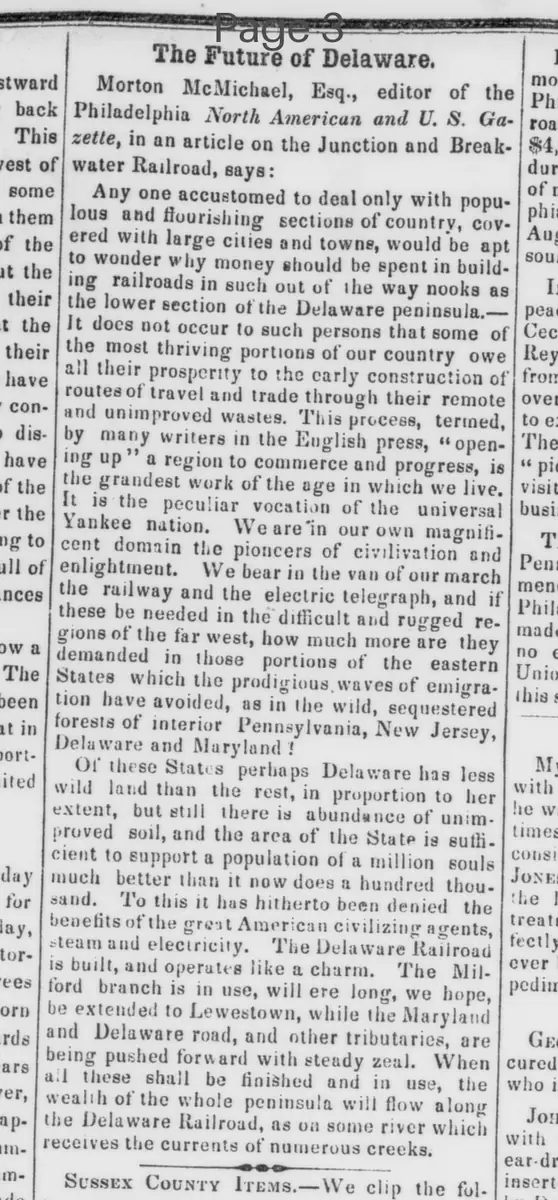
The Future of Delaware.
Morton McMichael, Esq.,
editor of the
Philadelphia North American and U. S. Ga-
zette, in an article on the Junction and Break-
water Railroad, says:
Any one accustomed to deal only with popu-
lous and flourishing sections of country, cov-
ered with large cities and towns, would be apt
to wonder why money should be spent in build-
ing railroads in such out of the way nooks as
the lower section of the Delaware peninsula.—
It does not occur to such persons that some of
the most thriving portions of our country owe
all their prosperity to the early construction of
routes of travel and trade through their remote
and unimproved wastes. This process, termed,
by many writers in the English press, "open-
ing up" a region to commerce and progress, is
the grandest work of the age in which we live.
It is the peculiar vocation of the universal
Yankee nation. We are in our own magnifi-
cent domain the pioneers of civilization and
enlightenment. We bear in the van of our march
the railway and the electric telegraph, and if
these be needed in the difficult and rugged re-
gions of the far west, how much more are they
demanded in those portions of the eastern
States which the prodigious waves of emigra-
tion have avoided, as in the wild, sequestered
forests of interior Pennsylvania, New Jersey,
Delaware and Maryland?
Of these States perhaps Delaware has less
wild land than the rest, in proportion to her
extent, but still there is abundance of uncul-
tivated soil, and the area of the State is suffi-
cient to support a population of a million souls
much better than it now does a hundred thou-
sand. To this it has hitherto been denied the
benefits of the great American civilizing agents,
steam and electricity. The Delaware Railroad
is built, and operates like a charm. The Mil-
ford branch is in use, will ere long, we hope,
be extended to Lewes town, while the Maryland
and Delaware road, and other tributaries, are
being pushed forward with steady zeal. When
all these shall be finished and in use, the
wealth of the whole peninsula will flow along
the Delaware Railroad, as on some river which
receives the currents of numerous creeks.
Morton McMichael, Esq.,
editor of the
Philadelphia North American and U. S. Ga-
zette, in an article on the Junction and Break-
water Railroad, says:
Any one accustomed to deal only with popu-
lous and flourishing sections of country, cov-
ered with large cities and towns, would be apt
to wonder why money should be spent in build-
ing railroads in such out of the way nooks as
the lower section of the Delaware peninsula.—
It does not occur to such persons that some of
the most thriving portions of our country owe
all their prosperity to the early construction of
routes of travel and trade through their remote
and unimproved wastes. This process, termed,
by many writers in the English press, "open-
ing up" a region to commerce and progress, is
the grandest work of the age in which we live.
It is the peculiar vocation of the universal
Yankee nation. We are in our own magnifi-
cent domain the pioneers of civilization and
enlightenment. We bear in the van of our march
the railway and the electric telegraph, and if
these be needed in the difficult and rugged re-
gions of the far west, how much more are they
demanded in those portions of the eastern
States which the prodigious waves of emigra-
tion have avoided, as in the wild, sequestered
forests of interior Pennsylvania, New Jersey,
Delaware and Maryland?
Of these States perhaps Delaware has less
wild land than the rest, in proportion to her
extent, but still there is abundance of uncul-
tivated soil, and the area of the State is suffi-
cient to support a population of a million souls
much better than it now does a hundred thou-
sand. To this it has hitherto been denied the
benefits of the great American civilizing agents,
steam and electricity. The Delaware Railroad
is built, and operates like a charm. The Mil-
ford branch is in use, will ere long, we hope,
be extended to Lewes town, while the Maryland
and Delaware road, and other tributaries, are
being pushed forward with steady zeal. When
all these shall be finished and in use, the
wealth of the whole peninsula will flow along
the Delaware Railroad, as on some river which
receives the currents of numerous creeks.
What sub-type of article is it?
Infrastructure
Economic Policy
What keywords are associated?
Delaware Railroads
Infrastructure Development
Peninsula Prosperity
Civilizing Agents
Yankee Nation
What entities or persons were involved?
Morton Mcmichael
Philadelphia North American And U. S. Gazette
Delaware Railroad
Milford Branch
Lewes Town
Maryland And Delaware Road
Editorial Details
Primary Topic
Railroad Development In Delaware
Stance / Tone
Supportive Of Infrastructure Expansion
Key Figures
Morton Mcmichael
Philadelphia North American And U. S. Gazette
Delaware Railroad
Milford Branch
Lewes Town
Maryland And Delaware Road
Key Arguments
Remote Areas Benefit Greatly From Early Railroad Construction
Railroads And Telegraphs Pioneer Civilization In Undeveloped Regions
Delaware Has Untapped Potential To Support A Million People
Current Railroads Like Delaware Railroad Are Successful
Future Extensions Will Channel Peninsula's Wealth