Thank you for visiting SNEWPapers!
Sign up free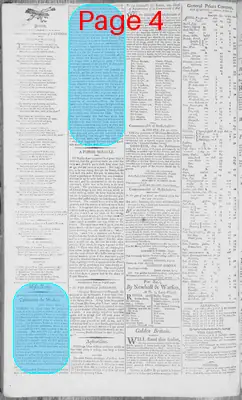
Story
April 8, 1799
The Gazette
Portland, Cumberland County, Maine
What is this article about?
Historical sketch from Tenhove's Memoirs depicting Catherine de Medici as a treacherous, ambitious ruler who governed France for 30 years, fostering chaos and cruelty, and educating her children, especially Charles IX, in barbarity through violent spectacles.
Clipping
OCR Quality
95%
Excellent
Full Text
Miscellany.
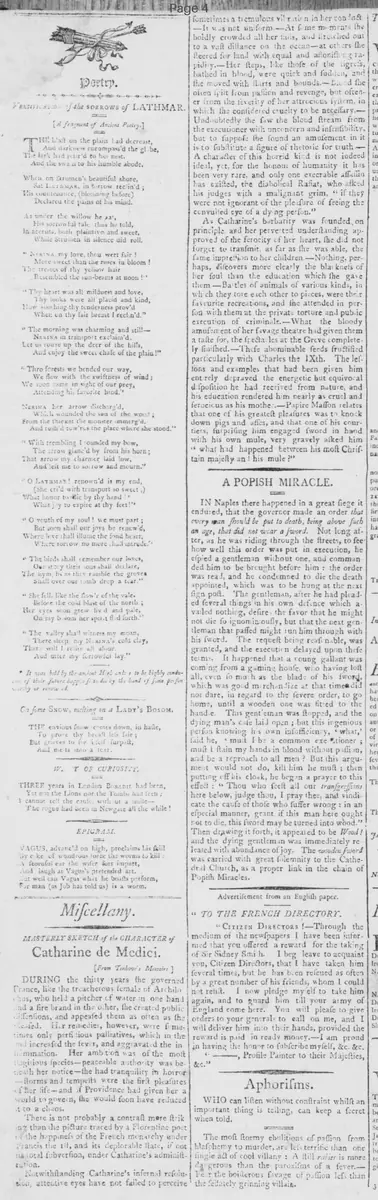
MASTERLY SKETCH of the CHARACTER of
Catharine de Medici.
[From Tenhove's Memoirs]
DURING the thirty years she governed
France, like the treacherous female of Archilochus, who held a pitcher of water in one hand
and a fire brand in the other, she created public
dissensions, and appeased them as often as the
necessity required. Her remedies, however, were sometimes only perfidious palliatives, which in the
end increased the fever, and aggravated the in
flammation. Her ambition was of the most
ambitious species—peaceable authority was beneath her notice—she had tranquility in horror
—storms and tempests were the first pleasures
of her life—and if Providence had given her a
world to govern, she would soon have reduced
it to chaos.
There is not probably a contrast more striking
than the picture traced by a Florentine poet
of the happiness of the French monarchy under
Francis the 1st, and its deplorable state, if not
its total subversion, under Catharine's administration.
Notwithstanding Catharine's infernal resolution, attentive eyes have not failed to perceive
sometimes a tremulous vibration in her conduct
—It was not uniform.—At some moments she
boldly crowded all her sails, and stretched out
to a vast distance on the ocean—at others she
steered for land with equal and astonishing ra-
pidity.—Her steps, like those of the tigress,
bathed in blood, were quick and sudden, and
she moved with starts and bounds.—Lured she
often first from passion and revenge, but often-
er from the severity of her atrocious system, in
which she considered cruelty to be necessary.—
Undoubtedly she saw the blood stream from
the executioner with unconcern and insensibility,
but to suppose she found an amusement in it
is to substitute a figure of rhetoric for truth—
A character of this horrid kind is not indeed
ideal, yet, for the honour of humanity it has
been very rare, and only one execrable assassin
has existed, the diabolical Ravillac, who asked
his judges with a malignant grin, "if they
were not ignorant of the pleasure of seeing the
convulsed eye of a dying person."
As Catharine's barbarity was founded on
principle, and her perverted understanding ap-
proved of the ferocity of her heart, she did not
forget to transmit, as far as she was able, the
same impression to her children—Nothing, per-
haps, discovers more clearly the blackness of
her soul than the education which she gave
them—Battles of animals of various kinds, in
which they tore each other to pieces, were their
favourite recreations, and she attended in per-
son with them at the private torture and public
execution of criminals.—What the bloody
amusement of her savage theatre had given them
a taste for, the spectacles at the Greve completely finished.—These abominable seeds fructified
particularly with Charles the IXth. The les-
ons and examples that had been given him
entirely depraved the energetic but equivocal
disposition he had received from nature, and
his education rendered him nearly as cruel and
ferocious as his mother.—Papire Masson relates
that one of his greatest pleasures was to knock
down pigs and asses, and that one of his cour-
tiers, surprising him engaged sword in hand
with his own mule, very gravely asked him
"what had happened between his most Christian majesty and his mule?"
MASTERLY SKETCH of the CHARACTER of
Catharine de Medici.
[From Tenhove's Memoirs]
DURING the thirty years she governed
France, like the treacherous female of Archilochus, who held a pitcher of water in one hand
and a fire brand in the other, she created public
dissensions, and appeased them as often as the
necessity required. Her remedies, however, were sometimes only perfidious palliatives, which in the
end increased the fever, and aggravated the in
flammation. Her ambition was of the most
ambitious species—peaceable authority was beneath her notice—she had tranquility in horror
—storms and tempests were the first pleasures
of her life—and if Providence had given her a
world to govern, she would soon have reduced
it to chaos.
There is not probably a contrast more striking
than the picture traced by a Florentine poet
of the happiness of the French monarchy under
Francis the 1st, and its deplorable state, if not
its total subversion, under Catharine's administration.
Notwithstanding Catharine's infernal resolution, attentive eyes have not failed to perceive
sometimes a tremulous vibration in her conduct
—It was not uniform.—At some moments she
boldly crowded all her sails, and stretched out
to a vast distance on the ocean—at others she
steered for land with equal and astonishing ra-
pidity.—Her steps, like those of the tigress,
bathed in blood, were quick and sudden, and
she moved with starts and bounds.—Lured she
often first from passion and revenge, but often-
er from the severity of her atrocious system, in
which she considered cruelty to be necessary.—
Undoubtedly she saw the blood stream from
the executioner with unconcern and insensibility,
but to suppose she found an amusement in it
is to substitute a figure of rhetoric for truth—
A character of this horrid kind is not indeed
ideal, yet, for the honour of humanity it has
been very rare, and only one execrable assassin
has existed, the diabolical Ravillac, who asked
his judges with a malignant grin, "if they
were not ignorant of the pleasure of seeing the
convulsed eye of a dying person."
As Catharine's barbarity was founded on
principle, and her perverted understanding ap-
proved of the ferocity of her heart, she did not
forget to transmit, as far as she was able, the
same impression to her children—Nothing, per-
haps, discovers more clearly the blackness of
her soul than the education which she gave
them—Battles of animals of various kinds, in
which they tore each other to pieces, were their
favourite recreations, and she attended in per-
son with them at the private torture and public
execution of criminals.—What the bloody
amusement of her savage theatre had given them
a taste for, the spectacles at the Greve completely finished.—These abominable seeds fructified
particularly with Charles the IXth. The les-
ons and examples that had been given him
entirely depraved the energetic but equivocal
disposition he had received from nature, and
his education rendered him nearly as cruel and
ferocious as his mother.—Papire Masson relates
that one of his greatest pleasures was to knock
down pigs and asses, and that one of his cour-
tiers, surprising him engaged sword in hand
with his own mule, very gravely asked him
"what had happened between his most Christian majesty and his mule?"
What sub-type of article is it?
Biography
Historical Event
What themes does it cover?
Deception
Tragedy
Misfortune
What keywords are associated?
Catharine De Medici
French Monarchy
Treachery
Cruelty
Royal Education
Charles Ix
Historical Sketch
What entities or persons were involved?
Catharine De Medici
Francis The 1st
Charles The Ixth
Ravillac
Papire Masson
Where did it happen?
France
Story Details
Key Persons
Catharine De Medici
Francis The 1st
Charles The Ixth
Ravillac
Papire Masson
Location
France
Event Date
Thirty Years She Governed France
Story Details
Portrait of Catherine de Medici as a treacherous ruler who incited and quelled dissensions in France, reveling in chaos and ambition; contrasted with happier times under Francis I; her inconsistent yet cruel conduct; education of her children in violence and executions, making Charles IX as barbarous as her.