Thank you for visiting SNEWPapers!
Sign up free
United Automobile Worker
Detroit, Wayne County, Michigan
What is this article about?
During WWII, British government subsidies stabilize food prices, keeping the cost-of-living index at 30% above pre-war levels since 1941, with food index falling to 20%. Details on subsidy mechanisms, costs, and price reductions for essentials like bread, meat, and milk.
Merged-components note: Merged image (likely the chart mentioned), main text, and table detailing subsidy costs, all part of the article on British subsidies and cost-of-living controls.
Clipping
OCR Quality
Full Text
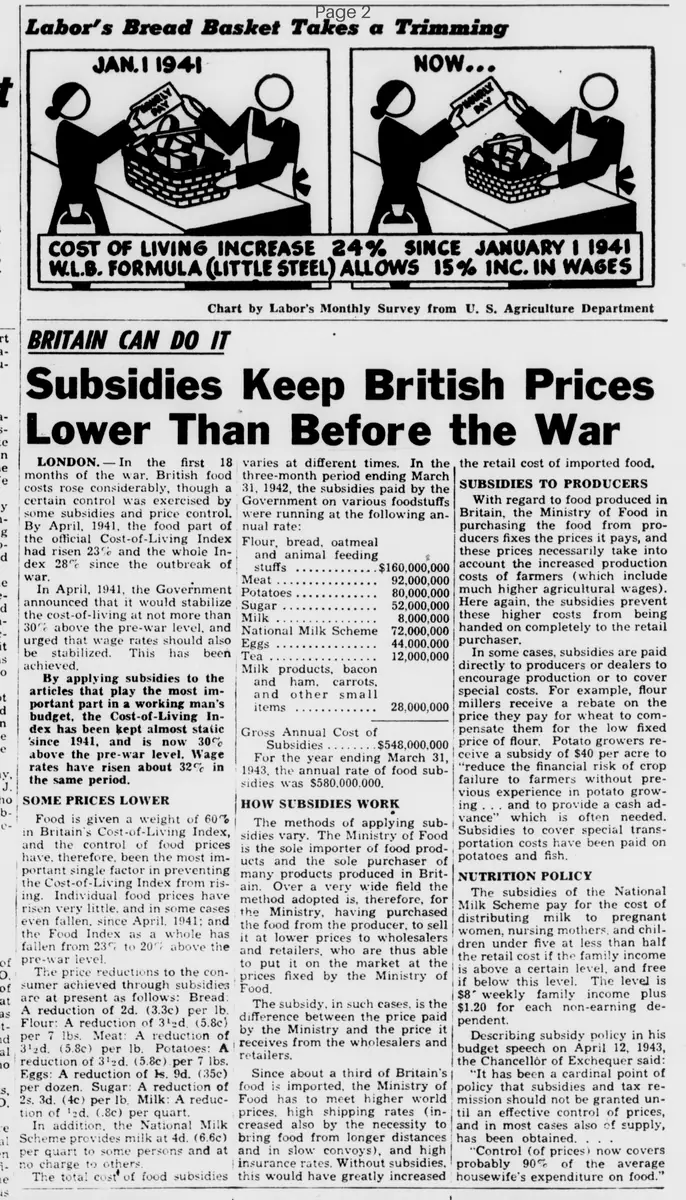
Bread
7
Basket
Takes a
Trimming
Chart by Labor's Monthly Survey from U. S. Agriculture Department
BRITAIN
CAN
DO
IT
Subsidies
Keep
British
Prices
Lower
Than
Before
the
War
LONDON.—In the first 18 months of the war, British food costs rose considerably, though a certain control was exercised by some subsidies and price control.
By April, 1941, the food part of the official Cost-of-Living Index had risen 23% and the whole Index 28% since the outbreak of war.
In April, 1941, the Government announced that it would stabilize the cost-of-living at not more than 30% above the pre-war level, and urged that wage rates should also be stabilized. This has been achieved.
By applying subsidies to the articles that play the most important part in a working man's budget, the Cost-of-Living Index has been kept almost static since 1941, and is now 30% above the pre-war level. Wage rates have risen about 32% in the same period.
SOME PRICES LOWER
Food is given a weight of 60% in Britain's Cost-of-Living Index, and the control of food prices have, therefore, been the most important single factor in preventing the Cost-of-Living Index from rising. Individual food prices have risen very little, and in some cases even fallen, since April, 1941; and the Food Index as a whole has fallen from 23% to 20% above the pre-war level.
The price reductions to the consumer achieved through subsidies are at present as follows: Bread, a reduction of 2d. (3.3c) per lb. Flour: A reduction of 3½d. (5.8c) per 7 lbs. Meat: A reduction of 3½d. (5.8c) per lb. Potatoes: A reduction of 3½d. (5.8c) per 7 lbs. Eggs: A reduction of 1s. 9d. (35c) per dozen. Sugar: A reduction of 2s. 3d. (4c) per lb. Milk: A reduction of ½d. (.8c) per quart.
In addition, the National Milk Scheme provides milk at 4d. (6.6c) per quart to some persons and at no charge to others.
The total cost of food subsidies varies at different times. In the three-month period ending March 31, 1942, the subsidies paid by the Government on various foodstuffs were running at the following annual rate:
Flour, bread, oatmeal and animal feeding
Gross Annual Cost of Subsidies .. ..... .$548,000,000
For the year ending March 31, 1943, the annual rate of food subsidies was $580,000,000.
HOW SUBSIDIES WORK
The methods of applying subsidies vary. The Ministry of Food is the sole importer of food products and the sole purchaser of many products produced in Britain.
Over a very wide field the method adopted is, therefore, for the Ministry, having purchased the food from the producer, to sell it at lower prices to wholesalers and retailers, who are thus able to put it on the market at the prices fixed by the Ministry of Food.
The subsidy, in such cases, is the difference between the price paid by the Ministry and the price it receives from the wholesalers and retailers.
Since about a third of Britain's food is imported, the Ministry of Food has to meet higher world prices, high shipping rates (increased also by the necessity to bring food from longer distances and in slow convoys), and high insurance rates. Without subsidies, this would have greatly increased the retail cost of imported food.
SUBSIDIES TO PRODUCERS
With regard to food produced in Britain, the Ministry of Food in purchasing the food from producers fixes the prices it pays, and these prices necessarily take into account the increased production costs of farmers (which include much higher agricultural wages).
Here again, the subsidies prevent these higher costs from being handed on completely to the retail purchaser.
In some cases, subsidies are paid directly to producers or dealers to encourage production or to cover special costs. For example, flour millers receive a rebate on the price they pay for wheat to compensate them for the low fixed price of flour. Potato growers receive a subsidy of $40 per acre to "reduce the financial risk of crop failure to farmers without previous experience in potato growing . . . and to provide a cash advance" which is often needed.
Subsidies to cover special transportation costs have been paid on potatoes and fish.
NUTRITION POLICY
The subsidies of the National Milk Scheme pay for the cost of distributing milk to pregnant women, nursing mothers, and children under five at less than half the retail cost if the family income is above a certain level, and free if below this level. The level is $8 weekly family income plus $1.20 for each non-earning dependent.
Describing subsidy policy in his budget speech on April 12, 1943, the Chancellor of Exchequer said:
"It has been a cardinal point of policy that subsidies and tax remission should not be granted until an effective control of prices, and in most cases also of supply, has been obtained.
"Control (of prices) now covers probably 90% of the average housewife's expenditure on food."
| stuffs | $160,000,000 |
| Meat | 92,000,000 |
| Potatoes | 80,000,000 |
| Sugar | 52,000,000 |
| Milk | 8,000,000 |
| National Milk Scheme | 72,000,000 |
| Eggs | 44,000,000 |
| Tea | 12,000,000 |
| Milk products, bacon and ham, carrots, and other small items | 28,000,000 |
What sub-type of article is it?
What keywords are associated?
What entities or persons were involved?
Where did it happen?
Foreign News Details
Primary Location
Britain
Event Date
Outbreak Of War To April 1943
Key Persons
Outcome
cost-of-living index stabilized at 30% above pre-war level; food index reduced to 20% above pre-war; annual food subsidies $580,000,000 by march 1943
Event Details
British government uses subsidies and price controls to manage wartime food costs, stabilizing the cost-of-living index at 30% above pre-war since April 1941. Ministry of Food imports and purchases domestically, selling at fixed low prices. Specific reductions on bread, flour, meat, potatoes, eggs, sugar, milk. National Milk Scheme provides subsidized or free milk to vulnerable groups. Subsidies cover higher import costs and production expenses, with direct payments to producers for encouragement.