Thank you for visiting SNEWPapers!
Sign up free
Watertown Republican
Watertown, Jefferson County, Dodge County, Wisconsin
What is this article about?
NYT London correspondent explains British sympathy for the South in the US Civil War as stemming from widespread English ignorance of American geography and politics, leading to misguided support for rebellions abroad.
Clipping
OCR Quality
Full Text
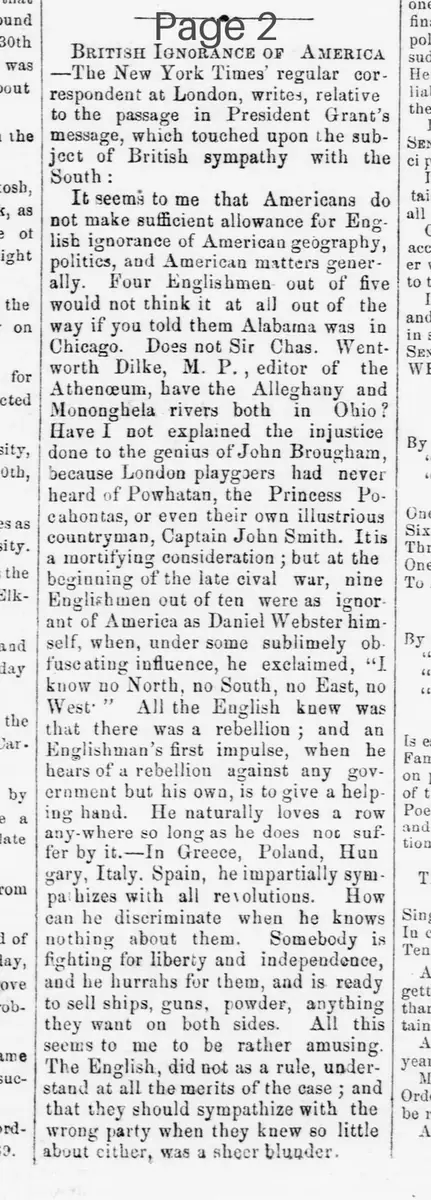
The New York Times' regular correspondent at London, writes, relative to the passage in President Grant's message, which touched upon the subject of British sympathy with the South:
It seems to me that Americans do not make sufficient allowance for English ignorance of American geography, politics, and American matters generally. Four Englishmen out of five would not think it at all out of the way if you told them Alabama was in Chicago. Does not Sir Chas. Wentworth Dilke, M. P., editor of the Athenæum, have the Alleghany and Mononghela rivers both in Ohio? Have I not explained the injustice done to the genius of John Brougham, because London playgoers had never heard of Powhatan, the Princess Pocahontas, or even their own illustrious countryman, Captain John Smith. It is a mortifying consideration; but at the beginning of the late civil war, nine Englishmen out of ten were as ignorant of America as Daniel Webster himself, when, under some sublimely obfuscating influence, he exclaimed, "I know no North, no South, no East, no West." All the English knew was that there was a rebellion; and an Englishman's first impulse, when he hears of a rebellion against any government but his own, is to give a helping hand. He naturally loves a row anywhere so long as he does not suffer by it. In Greece, Poland, Hungary, Italy, Spain, he impartially sympathizes with all revolutions. How can he discriminate when he knows nothing about them. Somebody is fighting for liberty and independence, and he hurrahs for them, and is ready to sell ships, guns, powder, anything they want on both sides. All this seems to me to be rather amusing. The English, did not as a rule, understand at all the merits of the case: and that they should sympathize with the wrong party when they knew so little about either, was a sheer blunder.
What sub-type of article is it?
What keywords are associated?
What entities or persons were involved?
Where did it happen?
Foreign News Details
Primary Location
London
Key Persons
Event Details
A New York Times correspondent in London comments on British ignorance of American geography, politics, and matters, exemplified by misconceptions like placing Alabama in Chicago or mislocating rivers. At the start of the American Civil War, most Englishmen were ignorant of America and sympathized with the rebellion due to a general impulse to support revolts against other governments, leading to impartial aid to revolutionaries in various countries without understanding the merits.