Thank you for visiting SNEWPapers!
Sign up free
South Branch Intelligencer
Romney, Hampshire County, West Virginia
What is this article about?
Report on the 43rd Congress sessions from January 28 to February 2, covering Senate and House debates on financial policy, Louisiana government legitimacy, army appropriations, life-saving stations, and other bills including inquiries into General Howard and Judge Busteed.
Clipping
OCR Quality
Full Text
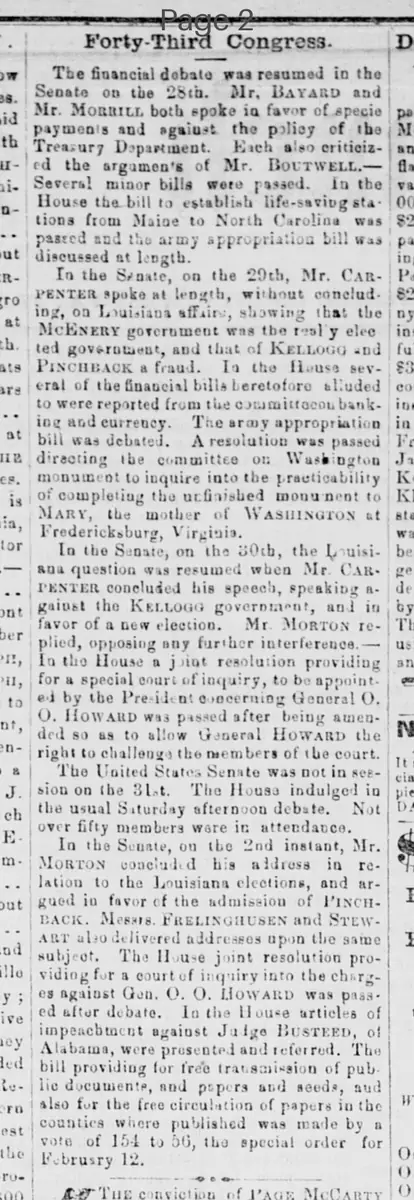
The financial debate was resumed in the Senate on the 28th. Mr. Bayard and Mr. Morrill both spoke in favor of specie payments and against the policy of the Treasury Department. Each also criticized the arguments of Mr. Boutwell.—Several minor bills were passed. In the House the bill to establish life-saving stations from Maine to North Carolina was passed and the army appropriation bill was discussed at length.
In the Senate, on the 29th, Mr. Carpenter spoke at length, without concluding, on Louisiana affairs, showing that the McEnery government was the real elected government, and that of Kellogg and Pinchback a fraud. In the House several of the financial bills heretofore alluded to were reported from the committee on banking and currency. The army appropriation bill was debated. A resolution was passed directing the committee on Washington monument to inquire into the practicability of completing the unfinished monument to Mary, the mother of Washington at Fredericksburg, Virginia.
In the Senate, on the 30th, the Louisiana question was resumed when Mr. Carpenter concluded his speech, speaking against the Kellogg government, and in favor of a new election. Mr. Morton replied, opposing any further interference.—In the House a joint resolution providing for a special court of inquiry, to be appointed by the President concerning General O. O. Howard was passed after being amended so as to allow General Howard the right to challenge the members of the court. The United States Senate was not in session on the 31st. The House indulged in the usual Saturday afternoon debate. Not over fifty members were in attendance.
In the Senate, on the 2nd instant, Mr. Morton concluded his address in relation to the Louisiana elections, and argued in favor of the admission of Pinchback. Messrs. Frelinghuysen and Stewart also delivered addresses upon the same subject. The House joint resolution providing for a court of inquiry into the charges against Gen. O. O. Howard was passed after debate. In the House articles of impeachment against Judge Busteed, of Alabama, were presented and referred. The bill providing for free transmission of public documents, and papers and seeds, and also for the free circulation of papers in the counties where published was made a special order for February 12.
What sub-type of article is it?
What themes does it cover?
What keywords are associated?
What entities or persons were involved?
Where did it happen?
Story Details
Key Persons
Location
Washington, D.C.
Event Date
28th To 2nd Instant
Story Details
Congressional proceedings included debates on financial policy favoring specie payments, criticism of Treasury, Louisiana government legitimacy favoring McEnery over Kellogg and Pinchback, passage of life-saving stations bill, army appropriations discussion, resolution for Howard inquiry court, impeachment articles against Busteed, and other bills.