Thank you for visiting SNEWPapers!
Sign up free
Editorial
April 19, 1875
Daily Kennebec Journal
Augusta, Kennebec County, Maine
What is this article about?
The Daily Kennebec Journal editorial enthusiastically endorses General Selden Connor, a Civil War veteran from Augusta, Maine, for the Republican nomination for Governor. It details his biography, military service, injuries, and widespread support across the state, predicting a strong victory.
Clipping
OCR Quality
98%
Excellent
Full Text
Daily Kennebec Journal
AUGUST
MONDAY MORNING. April 19, 1875.
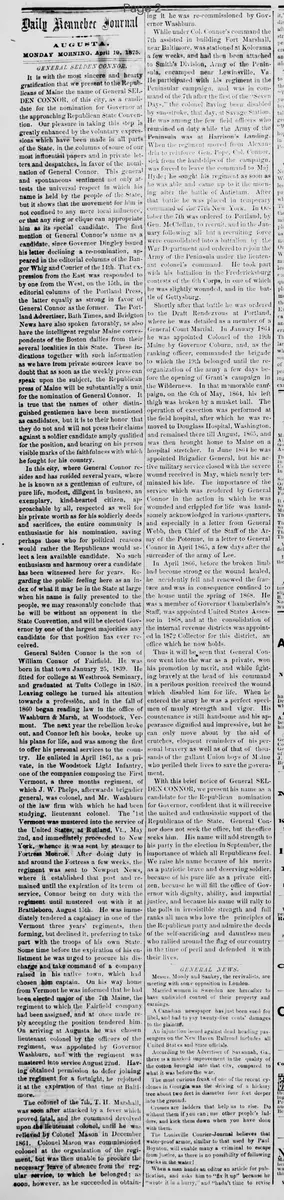
GENERAL SELDEN CONNOR
It is with the most sincere and hearty gratification that we present to the Republicans of Maine the name of General SELDEN CONNOR, of this city, as a candidate for the nomination for Governor at the approaching Republican State Convention. Our pleasure in taking this step is greatly enhanced by the voluntary expressions which have been made in all parts of the State, in the columns of some of our most influential papers and in private letters and despatches, in favor of the nomination of General Connor. This general and spontaneous sentiment not only attests the universal respect in which his name is held by the people of the State, but it shows that the movement for him is not confined to any mere local influence, or that any ring or clique can appropriate him as its special candidate. The first mention of General Connor's name as a candidate, since Governor Dingley issued his letter declining a re-nomination, appeared in the editorial columns of the Bangor Whig and Courier of the 14th. That expression from the East was responded to by one from the West, on the 15th, in the editorial columns of the Portland Press, the latter equally as strong in favor of General Connor as the former. The Portland Advertiser, Bath Times, and Bridgton News have also spoken favorably, as also have the intelligent regular Maine correspondents of the Boston dailies from their several localities in this State. These indications together with such information as we have from private sources leave no doubt that as soon as the weekly press can speak upon the subject, the Republican press of Maine will be substantially a unit for the nomination of General Connor. It is true that the names of other distinguished gentlemen have been mentioned as candidates, but it is to their honor that they do not and will not press their claims against a soldier candidate amply qualified for the position, and bearing on his person visible marks of the faithfulness with which he fought for his country.
In this city, where General Connor resides and has resided several years, where he is known as a gentleman of culture, of pure life, modest, diligent in business, an exemplary, kind-hearted citizen, approachable by all, respected as well for his private worth as for his soldierly deeds and sacrifices, the entire community is enthusiastic for his nomination, saving perhaps those who for political reasons would rather the Republicans would select a less available candidate. No such enthusiasm and harmony over a candidate has been witnessed here for years. Regarding the public feeling here as an index of what it may be in the State at large when his name is fully presented to the people, we may reasonably conclude that he will be without an opponent in the State Convention, and will be elected Governor by one of the largest majorities any candidate for that position has ever received.
General Selden Connor is the son of William Connor of Fairfield. He was born in that town January 25, 1839. He fitted for college at Westbrook Seminary, and graduated at Tufts College in 1859. Leaving college he turned his attention towards a profession, and in the fall of 1860 began reading law in the office of Washburn & Marsh, at Woodstock, Vermont. The next year the rebellion broke out, and Connor left his books, broke up his plans for life, and was among the first to offer his personal services to the country. He enlisted in April 1861, as a private, in the Woodstock Light Infantry, one of the companies composing the First Vermont, a three months regiment, of which J. W. Phelps, afterwards brigadier general, was colonel, and Mr. Washburn of the law firm with which he had been studying, lieutenant colonel. The 1st Vermont was mustered into the service of the United States, at Rutland, Vt., May 2nd, and immediately proceeded to New York, whence it was sent by steamer to Fortress Monroe. After doing duty in and around the Fortress a few weeks, the regiment was sent to Newport News, where it established that post and remained until the expiration of its term of service, Connor being on duty with the regiment until mustered out with it at Brattleboro, August 15th. He was immediately tendered a captaincy in one of the Vermont three years' regiments, then forming, but declined it, preferring to take part with the troops of his own State. Some time before the expiration of his enlistment he was urged to procure his discharge and take command of a company raised in his native town, which had chosen him captain. On his way home from Vermont he was informed that he had been elected major of the 7th Maine, the regiment to which the Fairfield company had been assigned, and at once made reply accepting the position tendered him. On arriving at Augusta he was chosen lieutenant colonel by the officers of the regiment, was appointed by Governor Washburn, and with the regiment was mustered into service August 22nd. Having obtained permission to defer joining the regiment for a fortnight, he rejoined it at the expiration of that time at Baltimore.
The colonel of the 7th, T. H. Marshall, was soon after attacked by a fever which proved fatal, and the command devolved upon the lieutenant colonel, until he was relieved by Colonel Mason in December 1861. Colonel Mason was commissioned colonel at the organization of the regiment, but was then unable to procure the necessary leave of absence from the regular service, to which he belonged; as soon, however, as he succeeded in obtaining it he was re-commissioned by Governor Washburn.
While under Col. Connor's command the 7th assisted in building Fort Marshall, near Baltimore, was stationed at Kalorama a few weeks, and had then been attached to Smith's Division, Army of the Peninsula, encamped near Lewinsville, Va. He participated with his regiment in the Peninsular campaign, and was in command of the 7th after the first of the "Seven Days," the colonel having been disabled by sun-stroke, that day, at Savage Station. He was among the few field officers who remained on duty while the Army of the Peninsula was at Harrison's Landing. When the regiment moved from Alexandria to reinforce Gen. Pope, Col. Connor, sick from the hardships of the campaign, was forced to leave the command to Maj. Hyde; he sought his regiment as soon as he was able and came up to it the morning after the battle of Antietam. After that battle he was placed in temporary command of the 77th New York. In October the 7th was ordered to Portland, by Gen. McClellan, to recruit, and in the January following all but a recruiting force were consolidated into a battalion by the War Department and ordered to rejoin the Army of the Peninsula under the lieutenant colonel's command. He took part with his battalion in the Fredericksburg contests of the 6th Corps, in one of which he was slightly wounded, and in the battle of Gettysburg.
Shortly after that battle he was ordered to the Draft Rendezvous at Portland, where he was detailed as a member of a General Court Martial. In January 1864 he was appointed Colonel of the 19th Maine by Governor Coburn, and, as the ranking officer, commanded the brigade to which the 19th belonged until the re-organization of the army a few days before the opening of Grant's campaign in the Wilderness. In that memorable campaign, on the 6th of May, 1864, his left thigh was broken by a musket ball. The operation of excision was performed at the field hospital, after which he was removed to Douglass Hospital, Washington, and remained there till August, 1865, and was then brought home to Maine on a hospital stretcher. In June 1864 he was appointed Brigadier General, but his active military service closed with the severe wound received in May, which nearly terminated his life. The importance of the service which was rendered by General Connor in the action in which he was wounded and crippled for life was handsomely acknowledged in various quarters, and especially in a letter from General Webb, then Chief of the Staff of the Army of the Potomac, in a letter to General Connor in April 1865, a few days after the surrender of the army of Lee.
In April 1866, before the broken limb had become strong or the wound healed, he accidentally fell and renewed the fracture and was in consequence confined to the house until the spring of 1868. He was a member of Governor Chamberlain's Staff, was appointed United States Assessor in 1868, and at the consolidation of the internal revenue districts was appointed in 1872 Collector for this district, an office which he now holds.
Thus it will be seen that General Connor went into the war as a private, won his promotion by merit, and while fighting bravely at the head of his command in a perilous position received the wound which disabled him for life. When he entered the army he was a perfect specimen of manly strength and vigor. His countenance is still handsome and his appearance dignified and impressive, but he can only move about by the aid of crutches, eloquent reminders of his personal bravery as well as of that of thousands of the gallant Union boys of Maine who periled their lives to save the government.
With this brief notice of General SELDEN CONNOR, we present his name as a candidate for the Republican nomination for Governor, confident that it will receive the united and enthusiastic support of the Republicans of the State. General Connor does not seek the office, but the office seeks him. His name will add strength to his party in the election in September, the importance of which all Republicans feel. We raise his name because of his merits as a patriotic brave and deserving soldier, because of his pure life as a private citizen, because he will fill the office of Governor with dignity, ability, and impartial justice, and because his name will rally to the polls in irresistible strength and full ranks all men who love the principles of the Republican party and admire the deeds of the self-sacrificing and dauntless men who rallied around the flag of our country in the time of peril and defended it with their lives.
AUGUST
MONDAY MORNING. April 19, 1875.
GENERAL SELDEN CONNOR
It is with the most sincere and hearty gratification that we present to the Republicans of Maine the name of General SELDEN CONNOR, of this city, as a candidate for the nomination for Governor at the approaching Republican State Convention. Our pleasure in taking this step is greatly enhanced by the voluntary expressions which have been made in all parts of the State, in the columns of some of our most influential papers and in private letters and despatches, in favor of the nomination of General Connor. This general and spontaneous sentiment not only attests the universal respect in which his name is held by the people of the State, but it shows that the movement for him is not confined to any mere local influence, or that any ring or clique can appropriate him as its special candidate. The first mention of General Connor's name as a candidate, since Governor Dingley issued his letter declining a re-nomination, appeared in the editorial columns of the Bangor Whig and Courier of the 14th. That expression from the East was responded to by one from the West, on the 15th, in the editorial columns of the Portland Press, the latter equally as strong in favor of General Connor as the former. The Portland Advertiser, Bath Times, and Bridgton News have also spoken favorably, as also have the intelligent regular Maine correspondents of the Boston dailies from their several localities in this State. These indications together with such information as we have from private sources leave no doubt that as soon as the weekly press can speak upon the subject, the Republican press of Maine will be substantially a unit for the nomination of General Connor. It is true that the names of other distinguished gentlemen have been mentioned as candidates, but it is to their honor that they do not and will not press their claims against a soldier candidate amply qualified for the position, and bearing on his person visible marks of the faithfulness with which he fought for his country.
In this city, where General Connor resides and has resided several years, where he is known as a gentleman of culture, of pure life, modest, diligent in business, an exemplary, kind-hearted citizen, approachable by all, respected as well for his private worth as for his soldierly deeds and sacrifices, the entire community is enthusiastic for his nomination, saving perhaps those who for political reasons would rather the Republicans would select a less available candidate. No such enthusiasm and harmony over a candidate has been witnessed here for years. Regarding the public feeling here as an index of what it may be in the State at large when his name is fully presented to the people, we may reasonably conclude that he will be without an opponent in the State Convention, and will be elected Governor by one of the largest majorities any candidate for that position has ever received.
General Selden Connor is the son of William Connor of Fairfield. He was born in that town January 25, 1839. He fitted for college at Westbrook Seminary, and graduated at Tufts College in 1859. Leaving college he turned his attention towards a profession, and in the fall of 1860 began reading law in the office of Washburn & Marsh, at Woodstock, Vermont. The next year the rebellion broke out, and Connor left his books, broke up his plans for life, and was among the first to offer his personal services to the country. He enlisted in April 1861, as a private, in the Woodstock Light Infantry, one of the companies composing the First Vermont, a three months regiment, of which J. W. Phelps, afterwards brigadier general, was colonel, and Mr. Washburn of the law firm with which he had been studying, lieutenant colonel. The 1st Vermont was mustered into the service of the United States, at Rutland, Vt., May 2nd, and immediately proceeded to New York, whence it was sent by steamer to Fortress Monroe. After doing duty in and around the Fortress a few weeks, the regiment was sent to Newport News, where it established that post and remained until the expiration of its term of service, Connor being on duty with the regiment until mustered out with it at Brattleboro, August 15th. He was immediately tendered a captaincy in one of the Vermont three years' regiments, then forming, but declined it, preferring to take part with the troops of his own State. Some time before the expiration of his enlistment he was urged to procure his discharge and take command of a company raised in his native town, which had chosen him captain. On his way home from Vermont he was informed that he had been elected major of the 7th Maine, the regiment to which the Fairfield company had been assigned, and at once made reply accepting the position tendered him. On arriving at Augusta he was chosen lieutenant colonel by the officers of the regiment, was appointed by Governor Washburn, and with the regiment was mustered into service August 22nd. Having obtained permission to defer joining the regiment for a fortnight, he rejoined it at the expiration of that time at Baltimore.
The colonel of the 7th, T. H. Marshall, was soon after attacked by a fever which proved fatal, and the command devolved upon the lieutenant colonel, until he was relieved by Colonel Mason in December 1861. Colonel Mason was commissioned colonel at the organization of the regiment, but was then unable to procure the necessary leave of absence from the regular service, to which he belonged; as soon, however, as he succeeded in obtaining it he was re-commissioned by Governor Washburn.
While under Col. Connor's command the 7th assisted in building Fort Marshall, near Baltimore, was stationed at Kalorama a few weeks, and had then been attached to Smith's Division, Army of the Peninsula, encamped near Lewinsville, Va. He participated with his regiment in the Peninsular campaign, and was in command of the 7th after the first of the "Seven Days," the colonel having been disabled by sun-stroke, that day, at Savage Station. He was among the few field officers who remained on duty while the Army of the Peninsula was at Harrison's Landing. When the regiment moved from Alexandria to reinforce Gen. Pope, Col. Connor, sick from the hardships of the campaign, was forced to leave the command to Maj. Hyde; he sought his regiment as soon as he was able and came up to it the morning after the battle of Antietam. After that battle he was placed in temporary command of the 77th New York. In October the 7th was ordered to Portland, by Gen. McClellan, to recruit, and in the January following all but a recruiting force were consolidated into a battalion by the War Department and ordered to rejoin the Army of the Peninsula under the lieutenant colonel's command. He took part with his battalion in the Fredericksburg contests of the 6th Corps, in one of which he was slightly wounded, and in the battle of Gettysburg.
Shortly after that battle he was ordered to the Draft Rendezvous at Portland, where he was detailed as a member of a General Court Martial. In January 1864 he was appointed Colonel of the 19th Maine by Governor Coburn, and, as the ranking officer, commanded the brigade to which the 19th belonged until the re-organization of the army a few days before the opening of Grant's campaign in the Wilderness. In that memorable campaign, on the 6th of May, 1864, his left thigh was broken by a musket ball. The operation of excision was performed at the field hospital, after which he was removed to Douglass Hospital, Washington, and remained there till August, 1865, and was then brought home to Maine on a hospital stretcher. In June 1864 he was appointed Brigadier General, but his active military service closed with the severe wound received in May, which nearly terminated his life. The importance of the service which was rendered by General Connor in the action in which he was wounded and crippled for life was handsomely acknowledged in various quarters, and especially in a letter from General Webb, then Chief of the Staff of the Army of the Potomac, in a letter to General Connor in April 1865, a few days after the surrender of the army of Lee.
In April 1866, before the broken limb had become strong or the wound healed, he accidentally fell and renewed the fracture and was in consequence confined to the house until the spring of 1868. He was a member of Governor Chamberlain's Staff, was appointed United States Assessor in 1868, and at the consolidation of the internal revenue districts was appointed in 1872 Collector for this district, an office which he now holds.
Thus it will be seen that General Connor went into the war as a private, won his promotion by merit, and while fighting bravely at the head of his command in a perilous position received the wound which disabled him for life. When he entered the army he was a perfect specimen of manly strength and vigor. His countenance is still handsome and his appearance dignified and impressive, but he can only move about by the aid of crutches, eloquent reminders of his personal bravery as well as of that of thousands of the gallant Union boys of Maine who periled their lives to save the government.
With this brief notice of General SELDEN CONNOR, we present his name as a candidate for the Republican nomination for Governor, confident that it will receive the united and enthusiastic support of the Republicans of the State. General Connor does not seek the office, but the office seeks him. His name will add strength to his party in the election in September, the importance of which all Republicans feel. We raise his name because of his merits as a patriotic brave and deserving soldier, because of his pure life as a private citizen, because he will fill the office of Governor with dignity, ability, and impartial justice, and because his name will rally to the polls in irresistible strength and full ranks all men who love the principles of the Republican party and admire the deeds of the self-sacrificing and dauntless men who rallied around the flag of our country in the time of peril and defended it with their lives.
What sub-type of article is it?
Partisan Politics
Military Affairs
What keywords are associated?
Selden Connor
Governor Nomination
Republican Party
Maine Politics
Civil War Veteran
State Convention
What entities or persons were involved?
Selden Connor
Republicans Of Maine
Governor Dingley
Bangor Whig And Courier
Portland Press
Editorial Details
Primary Topic
Endorsement Of Selden Connor For Republican Governor Nomination
Stance / Tone
Enthusiastic Support And Endorsement
Key Figures
Selden Connor
Republicans Of Maine
Governor Dingley
Bangor Whig And Courier
Portland Press
Key Arguments
Widespread Voluntary Support Across Maine
Connor's Distinguished Civil War Service From Private To Brigadier General
Severe War Wound Demonstrating Bravery
Respected Citizen Of Culture And Integrity
Predicted Unanimous Nomination And Large Electoral Majority