Thank you for visiting SNEWPapers!
Sign up free
The Freeman's Journal, Or, New Hampshire Gazette
Portsmouth, Rockingham County, New Hampshire
What is this article about?
A letter arguing that the depreciation of Continental paper money stems from trade disruptions and manufacturing shortages, not excess supply. It criticizes heavy taxation as an ineffective remedy that could cause disunion, urging instead promotion of commerce and industry to stabilize currency during the American Revolution.
Clipping
OCR Quality
Full Text
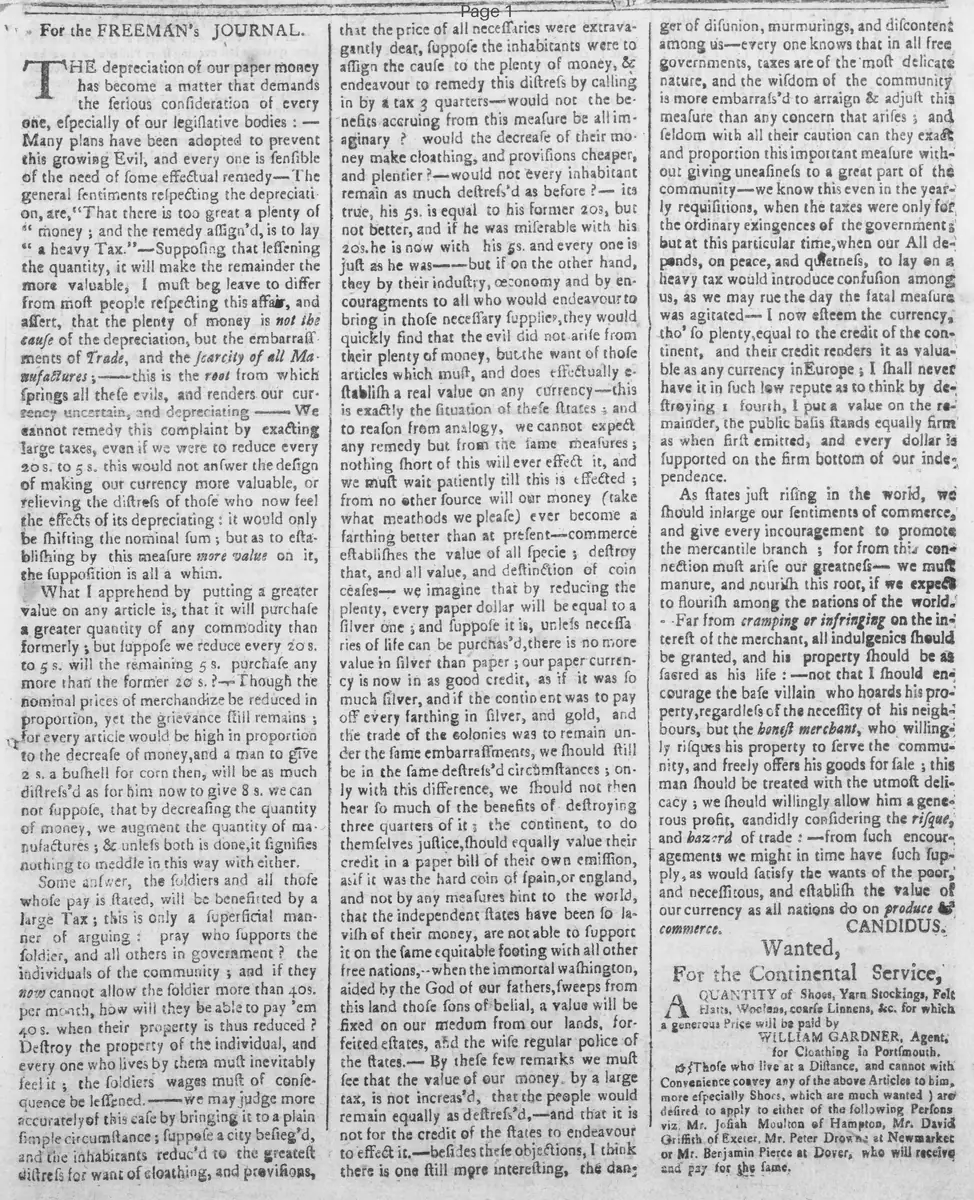
THE depreciation of our paper money has become a matter that demands the serious consideration of every one, especially of our legislative bodies: -
Many plans have been adopted to prevent this growing Evil, and every one is sensible of the need of some effectual remedy-- The general sentiments respecting the depreciation, are, "That there is too great a plenty of money; and the remedy assign'd, is to lay a heavy Tax."
Supposing that lessening the quantity, it will make the remainder the more valuable, I must beg leave to differ from most people respecting this affair, and assert, that the plenty of money is not the cause of the depreciation, but the embarrassments of Trade, and the scarcity of all Manufactures; -and this is the root from which springs all these evils, and renders our currency uncertain, and depreciating -
We cannot remedy this complaint by exacting large taxes, even if we were to reduce every 20 s. to 5 s. this would not answer the design of making our currency more valuable, or relieving the distress of those who now feel the effects of its depreciating: it would only be shifting the nominal sum; but as to establishing by this measure more value on it, the supposition is all a whim.
What I apprehend by putting a greater value on any article is, that it will purchase a greater quantity of any commodity than formerly; but suppose we reduce every 20 s. to 5 s. will the remaining 5 s. purchase any more than the former 20 s.?-- Though the nominal prices of merchandize be reduced in proportion, yet the grievance still remains; for every article would be high in proportion to the decrease of money, and a man to give 2 s. a bushell for corn then, will be as much distress'd as for him now to give 8 s. we cannot suppose, that by decreasing the quantity of money, we augment the quantity of manufactures; & unless both is done, it signifies nothing to meddle so this way with either.
Some answer, the soldiers and all those whose pay is stated, will be benefitted by a large Tax; this is only a superficial manner of arguing: pray who supports the soldier, and all others in government? the individuals of the community; and if they now cannot allow the soldier more than 40s. per month, how will they be able to pay 'em 80 s. when their property is thus reduced?
Destroy the property of the individual, and every one who lives by them must inevitably feel it; the soldiers wages must of consequence be lessened. -
We may judge more accurately of this case by bringing it to a plain simple circumstance; suppose a city being d, and the inhabitants reduc'd to the greatest distress for want of cloathing, and provisions,
that the price of all necessaries were extravagantly dear, suppose the inhabitants were to assign the cause to the plenty of money, & endeavour to remedy this distress by calling in by a tax 3 quarters-would not the benefits accruing from this measure be all imaginary? would the decrease of their money make cloathing, and provisions cheaper, and plentier? -would not every inhabitant remain as much distress'd as before? -- its true, his 5s. is equal to his former 20s, but not better, and if he was miserable with his 20s. he is now with his 5s. and every one is just as he was-me-but if on the other hand,
they by their industry, œconomy and by encouragments to all who would endeavour to bring in those necessary supplies, they would quickly find that the evil did not arise from their plenty of money, but the want of those articles which must, and does effectually establish a real value on any currency--this is exactly the situation of these states; and to reason from analogy, we cannot expect any remedy but from the same measures;
nothing short of this will ever effect it, and we must wait patiently till this is effected from no other source will our money (take what methods we please) ever become a farthing better than at present-commerce establishes the value of all specie; destroy that, and all value, and distinction of coin ceases-- we imagine that by reducing the plenty, every paper dollar will be equal to a silver one; and suppose it is, unless necessaries of life can be purchas'd, there is no more value in silver than paper; our paper currency is now in as good credit, as if it was so much silver, and if the continent was to pay off every farthing in silver, and gold, and the trade of the colonies was to remain under the same embarrassments, we should still be in the same distress'd circumstances; only with this difference, we should not then hear so much of the benefits of - destroying three quarters of it; the continent, to do themselves justice, should equally value their credit in a paper bill of their own emission, as if it was the hard coin of Spain, or England, and not by any measures hint to the world, that the independent states have been so lavish of their money, are not able to support it on the same equitable footing with all other free nations, - when the immortal Washington, aided by the God of our fathers, sweeps from this land those sons of Belial, a value will be fixed on our medium from our lands, forfeited estates, and the wise regular police of the states.-- By these few remarks we must see that the value of our money, by a large tax, is not increas'd, that the people would remain equally as distress'd,-and that it is not for the credit of the states to endeavour to effect it. -besides these objections, I think there is one still more interesting, the danger of disunion, murmurings, and discontent among us--every one knows that in all free governments, taxes are of the most delicate nature, and the wisdom of the community is more embarrass'd to arraign & adjust this measure than any concern that arises; and seldom with all their caution can they exact and proportion this important measure without giving uneasiness to a great part of the community--we know this even in the yearly requisitions, when the taxes were only for the ordinary exigencies of the governments but at this particular time, when our All depends, on peace, and quietness, to lay on a heavy tax would introduce confusion among us, as we may rue the day the fatal measure was agitated-- I now esteem the currency, tho' so plenty, equal to the credit of the continent, and their credit renders it as valuable as any currency in Europe; I shall never have it in such low repute as to think by destroying one fourth, I put a value on the remainder, the public basis stands equally firm as when first emitted, and every dollar is supported on the firm bottom of our independence.
As states just rising in the world, we should enlarge our sentiments of commerce, and give every encouragement to promote the mercantile branch: for from this connection must arise our greatness-- we must manure, and nourish this root, if we expect to flourish among the nations of the world.
Far from cramping or infringing on the interest of the merchant, all indulgences should be granted, and his property should be as sacred as his life: --not that I should encourage the base villain who hoards his property, regardless of the necessity of his neighbours, but the honest merchant, who willingly risks his property to serve the community, and freely offers his goods for sale; this man should be treated with the utmost delicacy; we should willingly allow him a generous profit, candidly considering the risk and hazard of trade: -from such encouragements we might in time have such supply, as would satisfy the wants of the poor and necessitous, and establish the value of our currency as all nations do on produce & commerce.
CANDIDUS.
What sub-type of article is it?
What themes does it cover?
What keywords are associated?
What entities or persons were involved?
Letter to Editor Details
Author
Candidus.
Recipient
Freeman's Journal
Main Argument
the depreciation of paper money is due to trade embarrassments and scarcity of manufactures, not excess quantity; heavy taxes to reduce money supply will not increase its value or relieve distress but may cause disunion; promote commerce and industry instead to establish real currency value.
Notable Details