Thank you for visiting SNEWPapers!
Sign up free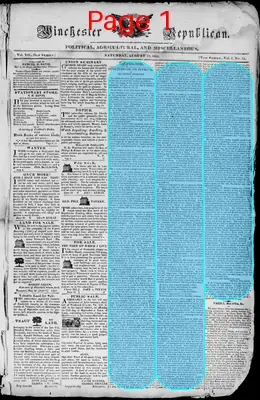
Letter to Editor
August 18, 1821
Winchester Republican
Winchester, Virginia
What is this article about?
Peter Pegasus responds to attacks by 'In Petto' and others in the Winchester Republican, defending his right to comment on a protracted medical controversy via light verse, criticizing their scurrility and poor writing, and advocating for decorum in public discourse.
Clipping
OCR Quality
98%
Excellent
Full Text
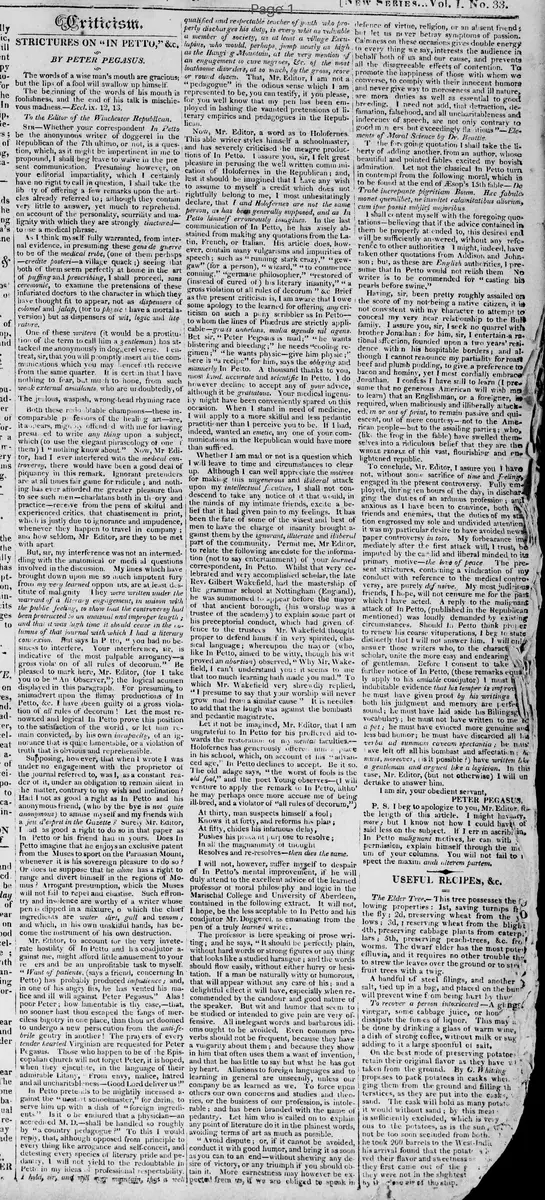
Criticism.
STRICTURES ON "IN PETTO," &c.
BY PETER PEGASUS.
The words of a wise man's mouth are gracious; but the lips of a fool will swallow up himself. The beginning of the words of his mouth is foolishness, and the end of his talk is mischievous madness.—Eccl. ix. 12, 13.
To the Editor of the Winchester Republican.
SIR—Whether your correspondent In Petto be the anonymous writer of doggerel in the Republican of the 7th ultimo, or not, is a question, which, as it might be impertinent in me to propound, I shall beg leave to waive in the present communication. Presuming however, on your editorial impartiality, which I certainly have no right to call in question, I shall take the liberty of offering a few remarks upon the articles already referred to; although they contain very little to answer, yet much to reprehend, on account of the personality, scurrility and malignity with which they are strongly tinctured—to use a medical phrase.
As I think myself fully warranted, from internal evidence, in presuming these gens de guerre to be of the medical tribe, (one of them perhaps—credite posteri—a village quack;) seeing that both of them seem perfectly at home in the art of puffing and prescribing, I shall proceed, sans ceremonie, to examine the pretensions of these infuriated doctors to the character in which they have thought fit to appear, not as dispensers of colomel and jalap, (for to physic I have a mortal aversion) but as dispensers of wit, logic and literature.
One of these writers (it would be a prostitution of the term to call him a gentleman) has attacked me anonymously in doggerel verse. I entreat, sir, that you will promptly insert all the communications which you may henceforth receive from the same quarter. It is certain that I have nothing to fear, but much to hope, from such weak external assailants, who are undoubtedly, of
The jealous, waspish, wrong-head rhyming race
Both these redoubtable champions—these incomparable professors of the healing art—are, it appears, mightily offended with me for having presumed to write any thing upon a subject, which (to use the elegant phraseology of one of them) I "nothing know about." Now, Mr Editor, had I ever interfered with the medical controversy, there would have been a good deal of piquancy in this remark. Ignorant pretenders are at all times fair game for ridicule; and nothing has ever afforded me greater pleasure than to see such men—charlatans both in theory and practice—receive from the pens of skilful and experienced critics, that chastisement in print, which is justly due to ignorance and impudence, whenever they happen to travel in company; and how seldom, Mr Editor, are they to be met with apart.
But, sir, my interference was not an intermeddling with the anatomical or medical questions involved in the discussion. My lines which have brought down upon me so much impotent fury from my very learned opponents, are at least destitute of malignity. They were written under the warrant of a literary engagement, in unison with the public feeling, to show that the controversy had been protracted to an unusual and improper length; and that it was high time it should cease in the columns of that journal with which I had a literary connexion. But says In Petto, "you had no business to interfere, Your interference, sir, is indicative of the most palpable arrogancy—a gross violation of all rules of decorum." Be pleased to mark here, Mr. Editor, (for I take you to be "An Observer,";) the logical acumen displayed in this paragraph. For presuming to animadvert upon the flimsy productions of In Petto, &c. I have been guilty of a gross violation of all rules of decorum! Let the most renowned and logical In Petto prove this position to the satisfaction of the world, or let him remain convicted, by his own incapacity, of an ignorance that is quite lamentable, or a violation of truth that is obvious and reprehensible.
Supposing, however, that when I wrote I was under no engagement with the proprietor of the journal referred to, was I, as a constant reader of it, under an obligation to remain silent in the matter, contrary to my wish and inclination? Had I not as good a right as In Petto and his anonymous friend, (who by the bye is not quite anonymous) to amuse myself and my friends with a jeu d'esprit in the Gazette? Surely Mr. Editor, I had as good a right to do so in that paper as In Petto or his friend had in yours. Does In Petto imagine that he enjoys an exclusive patent from the Muses to sport on the Parnassian Mount, whenever it is his sovereign pleasure to do so? Or does he suppose that he alone has a right to range and divert himself in the regions of Momus? Arrogant presumption, which the Muses will not fail to repel and chastise. Such effrontery and insolence are worthy of a writer whose pen is dipped in a mixture, of which the chief ingredients are water, dirt, gall and venom; and which, in his own unskilful hands, has become the instrument of his own destruction.
Mr. Editor, to account for the very inveterate hostility of In Petto and his coadjutor against me, might afford little amusement to your readers and be an unprofitable task to myself. "Want of patients, (says a friend, concerning In Petto) has probably produced impatience; and, in one of his angry fits, he has vented his malice and ill will against Peter Pegasus." Alas! poor Peter; how lamentable is thy case,—that, no sooner hast thou escaped the fangs of merciless bigotry in one place, than thou art doomed to undergo a new persecution from the anti-febrile gentry in another! The prayers of every tender hearted Virginian are requested for Peter Pegasus. Those who happen to be of the Episcopal church will not forget Peter, it is hoped, when they ejaculate, in the language of their admirable Litany, "From envy, malice, hatred and all uncharitableness—Good Lord deliver us!"
In Petto pretends to be mightily incensed against the "upstart schoolmaster," for daring to serve him up with a dish of "foreign ingredients." Is it to be endured that a physician—an accredited M. D.—shall be handled so roughly by "a country pedagogue?" To this I would reply, that, although opposed from principle to every thing like arrogance and self-conceit, and detesting every species of literary pride and pedantry, I will not yield to the redoubtable In Petto in my ideas of professional respectability. I think, sir, and will therefore maintain, that a well qualified and respectable teacher of youth who properly discharges his duty, is every whit as valuable a member of society, as at least a village Esculapius, who would, perhaps, jump nearly as high as the Hanging Mountain, at the very mention of an engagement to cure negroes, &c. of the most loathsome disorders, at so much, by the gross, score or round dozen. That, Mr. Editor, I am not a "pedagogue" in the odious sense which I am represented to be, you can testify, if you please, for you well know that my pen has been employed in lashing the vaunted pretensions of literary empirics and pedagogues in the Republican.
Now, Mr. Editor, a word as to Holofernes. This able writer styles himself a schoolmaster, and has severely criticised the meagre productions of In Petto. I assure you, sir, I felt great pleasure in perusing the well written communication of Holofernes in the Republican; and, lest it should be imagined that I have any wish to assume to myself a credit which does not rightfully belong to me, I most unhesitatingly declare, that I and Holofernes are not the same person, as has been generally supposed, and as In Petto himself erroneously imagines. In the last communication of In Petto, he has wisely abstained from making any quotations from the Latin, French, or Italian. His article does, however, contain many vulgarisms and impurities of speech; such as "running stark crazy," "gewwaw" (for a person), "wizard," "to commence conning," "germane philosopher," "restored of (instead of cured of) his literary insanity," "a gross violation of all rules of decorum" &c. Brief as the present criticism is, I am aware that I owe some apology to the learned for offering any criticism on such a puny scribbler as In Petto—to whom the lines of Phaedrus are strictly applicable—gratis anhelans, multa agendo nil agens.
But sir, "Peter Pegasus is mad;" "he wants blistering and bleeding;" he needs "cooling regimen;" "he wants physic—give him physic;" here is "a recipe" for him, says the obliging and mannerly In Petto. A thousand thanks to you, most kind, accurate and scientific In Petto. I do however decline to accept any of your advice, although it be gratuitous. Your medical ingenuity might have been conveniently spared on this occasion. When I stand in need of medicine, I will apply to a more skilful and less pedantic practitioner than I perceive you to be. If I had, indeed, wanted an emetic, any one of your communications in the Republican would have more than sufficed.
Whether I am mad or not is a question which I will leave to time and circumstances to clear up. Although I can well appreciate the motives for making this ungenerous and illiberal attack upon my intellectual faculties, I shall not condescend to take any notice of it that would, in the minds of my intimate friends, excite a belief that it had given pain to my feelings. It has been the fate of some of the wisest and best of men to have the charge of insanity brought against them by the ignorant, illiterate and illiberal part of the community. Permit me, Mr Editor, to relate the following anecdote for the information (not to say entertainment) of your learned correspondent, In Petto. Whilst that very celebrated and very accomplished scholar, the late Rev. Gilbert Wakefield, had the mastership of the grammar school at Nottingham (England), he was summoned to appear before the mayor of that ancient borough, (his worship was a trustee of the academy) to explain some part of his preceptorial conduct, which had given offence to the trustees. Mr. Wakefield thought proper to defend himself in very spirited, classical language; whereupon the mayor (who, like In Petto, aimed to be witty, though his wit proved an abortion) observed, "Why Mr. Wakefield, I can't understand you: it seems to me that too much learning hath made you mad." To which Mr. Wakefield very shrewdly replied, "I presume to say that your worship will never grow mad from a similar cause." It is needless to add that the laugh was against the bombastic and pedantic magistrate.
Let it not be imagined, Mr, Editor, that I am ungrateful to In Petto for his proffered aid towards the restoration of my mental faculties.— Holofernes has generously offered him a place in his school, which, on account of his "advanced age," In Petto declines to accept. Be it so. The old adage says, "the worst of fools is the old fool," and the poet Young observes—(I will venture to apply the remark to In Petto, altho' he may perhaps once more accuse me of being ill-bred, and a violator of "all rules of decorum,"
At thirty, man suspects himself a fool;
Knows it at forty, and reforms his plan:
At fifty, chides his infamous delay,
Pushes his prudent purpose to resolve;
In all the magnanimity of thought
Resolves and re-resolves—then dies the same.
I will not, however, suffer myself to despair of In Petto's mental improvement, if he will duly attend to the excellent advice of the learned professor of moral philosophy and logic in the Marischal College and University of Aberdeen, contained in the following extract. It will not, I hope, be the less acceptable to In Petto and his coadjutor Mr. Doggerel, as emanating from the pen of a truly learned writer.
The professor is here speaking of prose writing; and he says, "It should be perfectly plain, without hard words or strong figures or any thing that looks like a studied harangue; and the words should flow easily, without either hurry or hesitation. If a man be naturally witty or humorous, that will appear without any care of his; and a delightful effect it will have, especially when recommended by the candour and good nature of the speaker. But wit and humor that seem to be studied or intended to give pain are very offensive. All inelegant words and barbarous idioms ought to be avoided. Even common proverbs should not be frequent, because they have a vulgarity about them; and because they show in him that often uses them a want of invention, and that he has little to say but what he has got by heart. Allusions to foreign languages and to learning in general are unseemly, unless our company be as learned as we. To force upon others our own concerns and studies and theories, or the business of our profession, is intolerable; and has been branded with the name of pedantry. Let him who is called on to explain any point of literature do it in the plainest words, avoiding terms of art as much as possible.
"Avoid dispute; or, if it cannot be avoided, conduct it with good humor, and bring it as soon as you can to an end—without shewing any desire of victory, or any triumph if you should obtain it. More earnestness may however be expected from us, if we are obliged to speak in
defence of virtue, religion, or an absent friend. But let us never betray symptoms of passion. Calmness on these occasions gives double energy to every thing we say, interests the audience in behalf of both us and our cause, and prevents all the disagreeable effects of contention. To promote the happiness of those with whom we converse, to comply with their innocent humors and never give way to moroseness and ill nature, are moral duties as well as essential to good breeding. I need not add, that detraction, defamation, falsehood, and all uncharitableness and indecency of speech, are not only contrary to good manners but exceedingly factious"—Elements of Moral Science by Dr. Beattie
To the foregoing quotation I shall take the liberty of adding another, from an author, whose beautiful and pointed fables excited my boyish admiration. Let not the classical In Petto turn in contempt from the following moral, which is to be found at the end of Esop's 15th fable— De Arbore increpante pigritiam Boum. Hec fabula monet quemlibet, ne insultet calamitatibus aliorum, cum ipse possit subjici majoribus.
I shall content myself with the foregoing quotations—believing that if the advice contained in them be properly attended to, this desired end will be sufficiently answered, without any reference to other authorities. I might, indeed, have taken other quotations from Addison and Johnson; but, as these are English authorities, I presume that In Petto would not relish them. No writer is to be commended for "casting his pearls before swine,"
Having, sir, been pretty roughly assailed on the score of my not being a native citizen, it is not consistent with my character to attempt to conceal my very near relationship to the Bull family. I assure you, sir, I seek no quarrel with brother Jonathan: for him, sir, I entertain a rational affection, founded upon a two years' residence within his hospitable borders; and although I cannot renounce my partiality for roast beef and plumb pudding, to give a preference to bacon and hominy, yet I most cordially embrace Jonathan. I confess I have still to learn (I presume that no generous American will wish me to learn) that an Englishman, or a foreigner, required, when maliciously and illiberally attacked, in or out of print, to remain passive and quiescent, out of mere courtesy—not to the American people—but to the assailing parties; who, (like the frog in the fable) have swelled themselves into a ridiculous belief that they are the WHOLE PEOPLE of this vast, flourishing and enlightened republic.
To conclude, Mr. Editor, I assure you I have not, without some sacrifice of time and feeling engaged in the present controversy. Fully employed, during ten hours of the day, in discharging the duties of an arduous profession; and anxious as I have been to convince, both my friends and enemies, that the duties of my station engrossed my sole and undivided attention it was my particular desire to have avoided newspaper controversy in toto. My forbearance immediately after the first attack will, I trust, be imputed by the candid and liberal minded to its primary motive—the love of peace. The present strictures, containing a vindication of my conduct with reference to the medical controversy, are purely defensive. My most judicious friends, I hope, will not censure me for the part which I have acted. A reply to the malignant attack of In Petto, (published in the Republican mentioned) was loudly demanded by existing circumstances. Should In Petto think proper to renew his coarse vituperations, I beg to state distinctly that I will not answer him. I will only answer those writers who, to the character of scholar, unite the more easy and endearing qualities of gentleman. Before I consent to take further notice of In Petto, (these remarks equally apply to his amiable coadjutor) I must have indubitable evidence that his temper is amended—he must have given proof by his writings both his judgment and memory are perfectly sound; he must have laid aside his Billingsgate vocabulary; he must not have written to me in a pet; he must have evinced more genuine and less bad humor; he must have discarded all his verba ad summam caveam spectantia; he must have left off all his bombast and affectation; he must, moreover, (is it possible?) have written like a gentleman and argued like a logician. In this case, Mr. Editor, (but not otherwise) I will undertake to answer him.
P. S. I beg to apologize to you, Mr. Editor, for the length of this article. I might have said more; but I know not how I could have said less on the subject. If I err in ascribing to In Petto malignant motives, he can, with permission, explain himself through the medium of your columns. You will not fail to respect the maxim audi alteram partem.
PETER PEGASUS.
STRICTURES ON "IN PETTO," &c.
BY PETER PEGASUS.
The words of a wise man's mouth are gracious; but the lips of a fool will swallow up himself. The beginning of the words of his mouth is foolishness, and the end of his talk is mischievous madness.—Eccl. ix. 12, 13.
To the Editor of the Winchester Republican.
SIR—Whether your correspondent In Petto be the anonymous writer of doggerel in the Republican of the 7th ultimo, or not, is a question, which, as it might be impertinent in me to propound, I shall beg leave to waive in the present communication. Presuming however, on your editorial impartiality, which I certainly have no right to call in question, I shall take the liberty of offering a few remarks upon the articles already referred to; although they contain very little to answer, yet much to reprehend, on account of the personality, scurrility and malignity with which they are strongly tinctured—to use a medical phrase.
As I think myself fully warranted, from internal evidence, in presuming these gens de guerre to be of the medical tribe, (one of them perhaps—credite posteri—a village quack;) seeing that both of them seem perfectly at home in the art of puffing and prescribing, I shall proceed, sans ceremonie, to examine the pretensions of these infuriated doctors to the character in which they have thought fit to appear, not as dispensers of colomel and jalap, (for to physic I have a mortal aversion) but as dispensers of wit, logic and literature.
One of these writers (it would be a prostitution of the term to call him a gentleman) has attacked me anonymously in doggerel verse. I entreat, sir, that you will promptly insert all the communications which you may henceforth receive from the same quarter. It is certain that I have nothing to fear, but much to hope, from such weak external assailants, who are undoubtedly, of
The jealous, waspish, wrong-head rhyming race
Both these redoubtable champions—these incomparable professors of the healing art—are, it appears, mightily offended with me for having presumed to write any thing upon a subject, which (to use the elegant phraseology of one of them) I "nothing know about." Now, Mr Editor, had I ever interfered with the medical controversy, there would have been a good deal of piquancy in this remark. Ignorant pretenders are at all times fair game for ridicule; and nothing has ever afforded me greater pleasure than to see such men—charlatans both in theory and practice—receive from the pens of skilful and experienced critics, that chastisement in print, which is justly due to ignorance and impudence, whenever they happen to travel in company; and how seldom, Mr Editor, are they to be met with apart.
But, sir, my interference was not an intermeddling with the anatomical or medical questions involved in the discussion. My lines which have brought down upon me so much impotent fury from my very learned opponents, are at least destitute of malignity. They were written under the warrant of a literary engagement, in unison with the public feeling, to show that the controversy had been protracted to an unusual and improper length; and that it was high time it should cease in the columns of that journal with which I had a literary connexion. But says In Petto, "you had no business to interfere, Your interference, sir, is indicative of the most palpable arrogancy—a gross violation of all rules of decorum." Be pleased to mark here, Mr. Editor, (for I take you to be "An Observer,";) the logical acumen displayed in this paragraph. For presuming to animadvert upon the flimsy productions of In Petto, &c. I have been guilty of a gross violation of all rules of decorum! Let the most renowned and logical In Petto prove this position to the satisfaction of the world, or let him remain convicted, by his own incapacity, of an ignorance that is quite lamentable, or a violation of truth that is obvious and reprehensible.
Supposing, however, that when I wrote I was under no engagement with the proprietor of the journal referred to, was I, as a constant reader of it, under an obligation to remain silent in the matter, contrary to my wish and inclination? Had I not as good a right as In Petto and his anonymous friend, (who by the bye is not quite anonymous) to amuse myself and my friends with a jeu d'esprit in the Gazette? Surely Mr. Editor, I had as good a right to do so in that paper as In Petto or his friend had in yours. Does In Petto imagine that he enjoys an exclusive patent from the Muses to sport on the Parnassian Mount, whenever it is his sovereign pleasure to do so? Or does he suppose that he alone has a right to range and divert himself in the regions of Momus? Arrogant presumption, which the Muses will not fail to repel and chastise. Such effrontery and insolence are worthy of a writer whose pen is dipped in a mixture, of which the chief ingredients are water, dirt, gall and venom; and which, in his own unskilful hands, has become the instrument of his own destruction.
Mr. Editor, to account for the very inveterate hostility of In Petto and his coadjutor against me, might afford little amusement to your readers and be an unprofitable task to myself. "Want of patients, (says a friend, concerning In Petto) has probably produced impatience; and, in one of his angry fits, he has vented his malice and ill will against Peter Pegasus." Alas! poor Peter; how lamentable is thy case,—that, no sooner hast thou escaped the fangs of merciless bigotry in one place, than thou art doomed to undergo a new persecution from the anti-febrile gentry in another! The prayers of every tender hearted Virginian are requested for Peter Pegasus. Those who happen to be of the Episcopal church will not forget Peter, it is hoped, when they ejaculate, in the language of their admirable Litany, "From envy, malice, hatred and all uncharitableness—Good Lord deliver us!"
In Petto pretends to be mightily incensed against the "upstart schoolmaster," for daring to serve him up with a dish of "foreign ingredients." Is it to be endured that a physician—an accredited M. D.—shall be handled so roughly by "a country pedagogue?" To this I would reply, that, although opposed from principle to every thing like arrogance and self-conceit, and detesting every species of literary pride and pedantry, I will not yield to the redoubtable In Petto in my ideas of professional respectability. I think, sir, and will therefore maintain, that a well qualified and respectable teacher of youth who properly discharges his duty, is every whit as valuable a member of society, as at least a village Esculapius, who would, perhaps, jump nearly as high as the Hanging Mountain, at the very mention of an engagement to cure negroes, &c. of the most loathsome disorders, at so much, by the gross, score or round dozen. That, Mr. Editor, I am not a "pedagogue" in the odious sense which I am represented to be, you can testify, if you please, for you well know that my pen has been employed in lashing the vaunted pretensions of literary empirics and pedagogues in the Republican.
Now, Mr. Editor, a word as to Holofernes. This able writer styles himself a schoolmaster, and has severely criticised the meagre productions of In Petto. I assure you, sir, I felt great pleasure in perusing the well written communication of Holofernes in the Republican; and, lest it should be imagined that I have any wish to assume to myself a credit which does not rightfully belong to me, I most unhesitatingly declare, that I and Holofernes are not the same person, as has been generally supposed, and as In Petto himself erroneously imagines. In the last communication of In Petto, he has wisely abstained from making any quotations from the Latin, French, or Italian. His article does, however, contain many vulgarisms and impurities of speech; such as "running stark crazy," "gewwaw" (for a person), "wizard," "to commence conning," "germane philosopher," "restored of (instead of cured of) his literary insanity," "a gross violation of all rules of decorum" &c. Brief as the present criticism is, I am aware that I owe some apology to the learned for offering any criticism on such a puny scribbler as In Petto—to whom the lines of Phaedrus are strictly applicable—gratis anhelans, multa agendo nil agens.
But sir, "Peter Pegasus is mad;" "he wants blistering and bleeding;" he needs "cooling regimen;" "he wants physic—give him physic;" here is "a recipe" for him, says the obliging and mannerly In Petto. A thousand thanks to you, most kind, accurate and scientific In Petto. I do however decline to accept any of your advice, although it be gratuitous. Your medical ingenuity might have been conveniently spared on this occasion. When I stand in need of medicine, I will apply to a more skilful and less pedantic practitioner than I perceive you to be. If I had, indeed, wanted an emetic, any one of your communications in the Republican would have more than sufficed.
Whether I am mad or not is a question which I will leave to time and circumstances to clear up. Although I can well appreciate the motives for making this ungenerous and illiberal attack upon my intellectual faculties, I shall not condescend to take any notice of it that would, in the minds of my intimate friends, excite a belief that it had given pain to my feelings. It has been the fate of some of the wisest and best of men to have the charge of insanity brought against them by the ignorant, illiterate and illiberal part of the community. Permit me, Mr Editor, to relate the following anecdote for the information (not to say entertainment) of your learned correspondent, In Petto. Whilst that very celebrated and very accomplished scholar, the late Rev. Gilbert Wakefield, had the mastership of the grammar school at Nottingham (England), he was summoned to appear before the mayor of that ancient borough, (his worship was a trustee of the academy) to explain some part of his preceptorial conduct, which had given offence to the trustees. Mr. Wakefield thought proper to defend himself in very spirited, classical language; whereupon the mayor (who, like In Petto, aimed to be witty, though his wit proved an abortion) observed, "Why Mr. Wakefield, I can't understand you: it seems to me that too much learning hath made you mad." To which Mr. Wakefield very shrewdly replied, "I presume to say that your worship will never grow mad from a similar cause." It is needless to add that the laugh was against the bombastic and pedantic magistrate.
Let it not be imagined, Mr, Editor, that I am ungrateful to In Petto for his proffered aid towards the restoration of my mental faculties.— Holofernes has generously offered him a place in his school, which, on account of his "advanced age," In Petto declines to accept. Be it so. The old adage says, "the worst of fools is the old fool," and the poet Young observes—(I will venture to apply the remark to In Petto, altho' he may perhaps once more accuse me of being ill-bred, and a violator of "all rules of decorum,"
At thirty, man suspects himself a fool;
Knows it at forty, and reforms his plan:
At fifty, chides his infamous delay,
Pushes his prudent purpose to resolve;
In all the magnanimity of thought
Resolves and re-resolves—then dies the same.
I will not, however, suffer myself to despair of In Petto's mental improvement, if he will duly attend to the excellent advice of the learned professor of moral philosophy and logic in the Marischal College and University of Aberdeen, contained in the following extract. It will not, I hope, be the less acceptable to In Petto and his coadjutor Mr. Doggerel, as emanating from the pen of a truly learned writer.
The professor is here speaking of prose writing; and he says, "It should be perfectly plain, without hard words or strong figures or any thing that looks like a studied harangue; and the words should flow easily, without either hurry or hesitation. If a man be naturally witty or humorous, that will appear without any care of his; and a delightful effect it will have, especially when recommended by the candour and good nature of the speaker. But wit and humor that seem to be studied or intended to give pain are very offensive. All inelegant words and barbarous idioms ought to be avoided. Even common proverbs should not be frequent, because they have a vulgarity about them; and because they show in him that often uses them a want of invention, and that he has little to say but what he has got by heart. Allusions to foreign languages and to learning in general are unseemly, unless our company be as learned as we. To force upon others our own concerns and studies and theories, or the business of our profession, is intolerable; and has been branded with the name of pedantry. Let him who is called on to explain any point of literature do it in the plainest words, avoiding terms of art as much as possible.
"Avoid dispute; or, if it cannot be avoided, conduct it with good humor, and bring it as soon as you can to an end—without shewing any desire of victory, or any triumph if you should obtain it. More earnestness may however be expected from us, if we are obliged to speak in
defence of virtue, religion, or an absent friend. But let us never betray symptoms of passion. Calmness on these occasions gives double energy to every thing we say, interests the audience in behalf of both us and our cause, and prevents all the disagreeable effects of contention. To promote the happiness of those with whom we converse, to comply with their innocent humors and never give way to moroseness and ill nature, are moral duties as well as essential to good breeding. I need not add, that detraction, defamation, falsehood, and all uncharitableness and indecency of speech, are not only contrary to good manners but exceedingly factious"—Elements of Moral Science by Dr. Beattie
To the foregoing quotation I shall take the liberty of adding another, from an author, whose beautiful and pointed fables excited my boyish admiration. Let not the classical In Petto turn in contempt from the following moral, which is to be found at the end of Esop's 15th fable— De Arbore increpante pigritiam Boum. Hec fabula monet quemlibet, ne insultet calamitatibus aliorum, cum ipse possit subjici majoribus.
I shall content myself with the foregoing quotations—believing that if the advice contained in them be properly attended to, this desired end will be sufficiently answered, without any reference to other authorities. I might, indeed, have taken other quotations from Addison and Johnson; but, as these are English authorities, I presume that In Petto would not relish them. No writer is to be commended for "casting his pearls before swine,"
Having, sir, been pretty roughly assailed on the score of my not being a native citizen, it is not consistent with my character to attempt to conceal my very near relationship to the Bull family. I assure you, sir, I seek no quarrel with brother Jonathan: for him, sir, I entertain a rational affection, founded upon a two years' residence within his hospitable borders; and although I cannot renounce my partiality for roast beef and plumb pudding, to give a preference to bacon and hominy, yet I most cordially embrace Jonathan. I confess I have still to learn (I presume that no generous American will wish me to learn) that an Englishman, or a foreigner, required, when maliciously and illiberally attacked, in or out of print, to remain passive and quiescent, out of mere courtesy—not to the American people—but to the assailing parties; who, (like the frog in the fable) have swelled themselves into a ridiculous belief that they are the WHOLE PEOPLE of this vast, flourishing and enlightened republic.
To conclude, Mr. Editor, I assure you I have not, without some sacrifice of time and feeling engaged in the present controversy. Fully employed, during ten hours of the day, in discharging the duties of an arduous profession; and anxious as I have been to convince, both my friends and enemies, that the duties of my station engrossed my sole and undivided attention it was my particular desire to have avoided newspaper controversy in toto. My forbearance immediately after the first attack will, I trust, be imputed by the candid and liberal minded to its primary motive—the love of peace. The present strictures, containing a vindication of my conduct with reference to the medical controversy, are purely defensive. My most judicious friends, I hope, will not censure me for the part which I have acted. A reply to the malignant attack of In Petto, (published in the Republican mentioned) was loudly demanded by existing circumstances. Should In Petto think proper to renew his coarse vituperations, I beg to state distinctly that I will not answer him. I will only answer those writers who, to the character of scholar, unite the more easy and endearing qualities of gentleman. Before I consent to take further notice of In Petto, (these remarks equally apply to his amiable coadjutor) I must have indubitable evidence that his temper is amended—he must have given proof by his writings both his judgment and memory are perfectly sound; he must have laid aside his Billingsgate vocabulary; he must not have written to me in a pet; he must have evinced more genuine and less bad humor; he must have discarded all his verba ad summam caveam spectantia; he must have left off all his bombast and affectation; he must, moreover, (is it possible?) have written like a gentleman and argued like a logician. In this case, Mr. Editor, (but not otherwise) I will undertake to answer him.
P. S. I beg to apologize to you, Mr. Editor, for the length of this article. I might have said more; but I know not how I could have said less on the subject. If I err in ascribing to In Petto malignant motives, he can, with permission, explain himself through the medium of your columns. You will not fail to respect the maxim audi alteram partem.
PETER PEGASUS.
What sub-type of article is it?
Satirical
Persuasive
Provocative
What themes does it cover?
Social Issues
Morality
Press Freedom
What keywords are associated?
Literary Controversy
Medical Debate
Personal Attacks
Decorum In Writing
Satirical Verse
Newspaper Feud
Professional Respect
Winchester Republican
What entities or persons were involved?
Peter Pegasus
Editor Of The Winchester Republican
Letter to Editor Details
Author
Peter Pegasus
Recipient
Editor Of The Winchester Republican
Main Argument
peter pegasus defends his literary intervention in a medical controversy as justified and non-malicious, condemns the scurrilous, personal attacks by 'in petto' and associates as violations of decorum, and asserts the right of readers and writers to contribute to public discourse without exclusive claims.
Notable Details
Quotes Ecclesiastes On Wise And Foolish Speech
References Phaedrus On Futile Effort
Cites Dr. Beattie On Plain Prose And Avoiding Pedantry
Includes Aesop Fable Moral Against Mocking Others' Misfortunes
Anecdote Of Rev. Gilbert Wakefield Defending Against Madness Charge
Defends Teaching Profession Against Medical Condescension
Distinguishes Self From Holofernes
Criticizes Vulgarisms In In Petto's Writing