Thank you for visiting SNEWPapers!
Sign up free
Story
January 21, 1843
The Port Gibson Correspondent
Port Gibson, Claiborne County, Mississippi
What is this article about?
Post-mortem exam in New Orleans on Jan. 14, 1843, by Drs. Hart, Farrel, Rushton, and Landreaux concludes George B. Ogden did not drown, lacking typical signs like water-filled lungs or congested organs, implying murder or divine act. (198 chars)
Clipping
OCR Quality
98%
Excellent
Full Text
From the N. O. Herald.
POST MORTEM EXAMINATION ON THE BODY OF G. B. OGDEN.
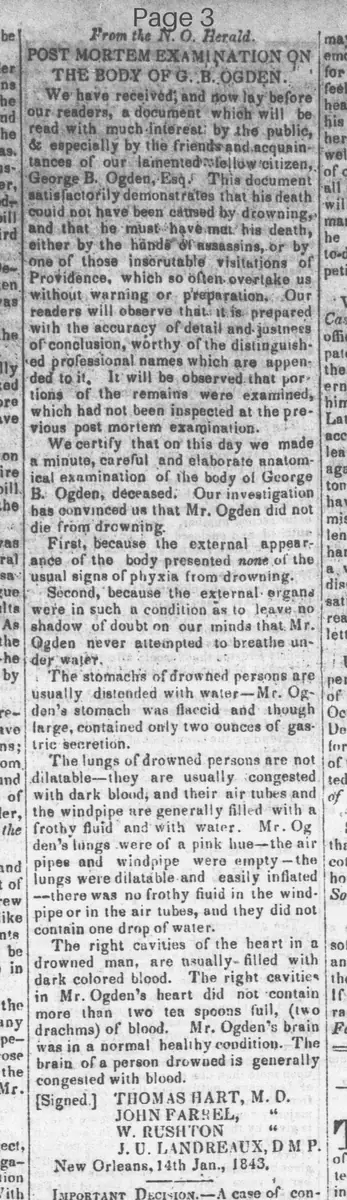
We have received, and now lay before our readers, a document which will be read with much interest by the public, & especially by the friends and acquaintances of our lamented fellow citizen, George B. Ogden, Esq. This document satisfactorily demonstrates that his death could not have been caused by drowning, and that he must have met his death, either by the hands of assassins, or by one of those inscrutable visitations of Providence, which so often overtake us without warning or preparation. Our readers will observe that it is prepared with the accuracy of detail and justice of conclusion, worthy of the distinguished professional names which are appended to it. It will be observed that portions of the remains were examined, which had not been inspected at the previous post mortem examination.
We certify that on this day we made a minute, careful and elaborate anatomical examination of the body of George B. Ogden, deceased. Our investigation has convinced us that Mr. Ogden did not die from drowning.
First, because the external appearance of the body presented none of the usual signs of asphyxia from drowning.
Second, because the external organs were in such a condition as to leave no shadow of doubt on our minds that Mr. Ogden never attempted to breathe under water.
The stomachs of drowned persons are usually distended with water—Mr. Ogden's stomach was flaccid and though large, contained only two ounces of gastric secretion.
The lungs of drowned persons are not dilatable—they are usually congested with dark blood, and their air tubes and the windpipe are generally filled with a frothy fluid and with water. Mr. Ogden's lungs were of a pink hue—the air pipes and windpipe were empty—the lungs were dilatable and easily inflated—there was no frothy fluid in the windpipe or in the air tubes, and they did not contain one drop of water.
The right cavities of the heart in a drowned man, are usually filled with dark colored blood. The right cavities in Mr. Ogden's heart did not contain more than two tea spoons full, (two drachms) of blood. Mr. Ogden's brain was in a normal healthy condition. The brain of a person drowned is generally congested with blood.
[Signed.]
THOMAS HART, M. D.
JOHN FARREL,
W. RUSHTON,
J. U. LANDREAUX. D M P.
New Orleans, 14th Jan., 1843.
POST MORTEM EXAMINATION ON THE BODY OF G. B. OGDEN.
We have received, and now lay before our readers, a document which will be read with much interest by the public, & especially by the friends and acquaintances of our lamented fellow citizen, George B. Ogden, Esq. This document satisfactorily demonstrates that his death could not have been caused by drowning, and that he must have met his death, either by the hands of assassins, or by one of those inscrutable visitations of Providence, which so often overtake us without warning or preparation. Our readers will observe that it is prepared with the accuracy of detail and justice of conclusion, worthy of the distinguished professional names which are appended to it. It will be observed that portions of the remains were examined, which had not been inspected at the previous post mortem examination.
We certify that on this day we made a minute, careful and elaborate anatomical examination of the body of George B. Ogden, deceased. Our investigation has convinced us that Mr. Ogden did not die from drowning.
First, because the external appearance of the body presented none of the usual signs of asphyxia from drowning.
Second, because the external organs were in such a condition as to leave no shadow of doubt on our minds that Mr. Ogden never attempted to breathe under water.
The stomachs of drowned persons are usually distended with water—Mr. Ogden's stomach was flaccid and though large, contained only two ounces of gastric secretion.
The lungs of drowned persons are not dilatable—they are usually congested with dark blood, and their air tubes and the windpipe are generally filled with a frothy fluid and with water. Mr. Ogden's lungs were of a pink hue—the air pipes and windpipe were empty—the lungs were dilatable and easily inflated—there was no frothy fluid in the windpipe or in the air tubes, and they did not contain one drop of water.
The right cavities of the heart in a drowned man, are usually filled with dark colored blood. The right cavities in Mr. Ogden's heart did not contain more than two tea spoons full, (two drachms) of blood. Mr. Ogden's brain was in a normal healthy condition. The brain of a person drowned is generally congested with blood.
[Signed.]
THOMAS HART, M. D.
JOHN FARREL,
W. RUSHTON,
J. U. LANDREAUX. D M P.
New Orleans, 14th Jan., 1843.
What sub-type of article is it?
Medical Curiosity
Mystery
Historical Event
What themes does it cover?
Misfortune
Justice
Providence Divine
What keywords are associated?
Post Mortem Examination
Drowning Ruled Out
George Ogden Death
Medical Report
New Orleans 1843
What entities or persons were involved?
George B. Ogden
Thomas Hart
John Farrel
W. Rushton
J. U. Landreaux
Where did it happen?
New Orleans
Story Details
Key Persons
George B. Ogden
Thomas Hart
John Farrel
W. Rushton
J. U. Landreaux
Location
New Orleans
Event Date
1843 01 14
Story Details
Post-mortem examination reveals George B. Ogden did not die from drowning, as the body shows none of the usual signs of asphyxia, water in lungs, or congested organs; stomach contained only gastric secretion, lungs were pink and empty, heart had minimal blood; brain healthy. Suggests death by assassins or inscrutable Providence.