Thank you for visiting SNEWPapers!
Sign up free
Story
March 15, 1879
Public Ledger
Memphis, Shelby County, Tennessee
What is this article about?
R. R. Whitehead, a Virginia native who ran a grocery in Bowling Green, KY, inherited a Louisiana sugar plantation and $30,000 from his father. Overwhelmed by sudden fortune and excessive drinking, he committed suicide by morphine on March 12, leaving his wife and children.
Clipping
OCR Quality
95%
Excellent
Full Text
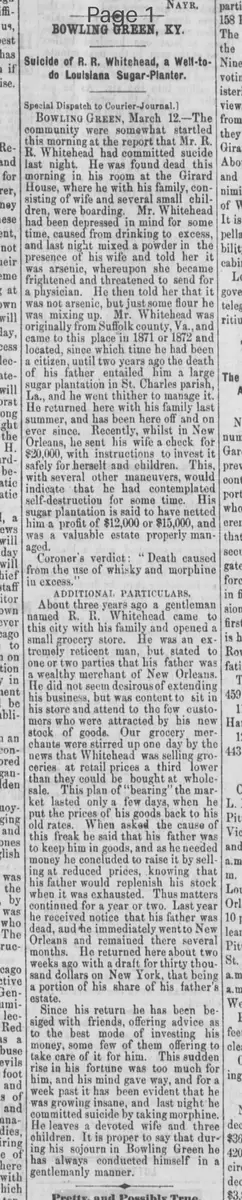
BOWLING GREEN, KY.
Suicide of R. R. Whitehead, a Well-to-do Louisiana Sugar-Planter.
Special Dispatch to Courier-Journal.
Bowling Green, March 12.—The community were somewhat startled this morning at the report that Mr. R. R. Whitehead had committed suicide last night. He was found dead this morning in his room at the Girard House, where he with his family, consisting of wife and several small children, were boarding. Mr. Whitehead had been depressed in mind for some time, caused from drinking to excess, and last night mixed a powder in the presence of his wife and told her it was arsenic, whereupon she became frightened and threatened to send for a physician. He then told her that it was not arsenic, but just some flour he was mixing up. Mr. Whitehead was originally from Suffolk county, Va., and came to this place in 1871 or 1872 and located, since which time he had been a citizen, until two years ago the death of his father entailed him a large sugar plantation in St. Charles parish, La., and he went thither to manage it. He returned here with his family last summer, and has been here off and on ever since. Recently, whilst in New Orleans, he sent his wife a check for $20,000, with instructions to invest it safely for herself and children. This, with several other maneuvers, would indicate that he had contemplated self-destruction for some time. His sugar plantation is said to have netted him a profit of $12,000 or $15,000, and was a valuable estate properly managed.
Coroner's verdict: "Death caused from the use of whisky and morphine in excess."
ADDITIONAL PARTICULARS.
About three years ago a gentleman named R. R. Whitehead came to this city with his family and opened a small grocery store. He was an extremely reticent man, but stated to one or two parties that his father was a wealthy merchant of New Orleans. He did not seem desirous of extending his business, but was content to sit in his store and attend to the few customers who were attracted by his new stock of goods. Our grocery merchants were stirred up one day by the news that Whitehead was selling groceries at retail prices a third lower than they could be bought at wholesale. This plan of "bearing" the market lasted only a few days, when he put the prices of his goods back to his old rates. When asked the cause of this freak he said that his father was to keep him in goods, and as he needed money he concluded to raise it by selling at reduced prices, knowing that his father would replenish his stock when it was exhausted. Thus matters continued for a year or two. Last year he received notice that his father was dead, and he immediately went to New Orleans and remained there several months. He returned here about two weeks ago with a draft for thirty thousand dollars on New York, that being a portion of his share of his father's estate. Since his return he has been besieged with friends, offering advice as to the best mode of investing his money, some few of them offering to take care of it for him. This sudden rise in his fortune was too much for him, and his mind gave way, and for a week past it has been evident that he was growing insane, and last night he committed suicide by taking morphine. He leaves a devoted wife and three children. It is proper to say that during his sojourn in Bowling Green he has always conducted himself in a gentlemanly manner.
Suicide of R. R. Whitehead, a Well-to-do Louisiana Sugar-Planter.
Special Dispatch to Courier-Journal.
Bowling Green, March 12.—The community were somewhat startled this morning at the report that Mr. R. R. Whitehead had committed suicide last night. He was found dead this morning in his room at the Girard House, where he with his family, consisting of wife and several small children, were boarding. Mr. Whitehead had been depressed in mind for some time, caused from drinking to excess, and last night mixed a powder in the presence of his wife and told her it was arsenic, whereupon she became frightened and threatened to send for a physician. He then told her that it was not arsenic, but just some flour he was mixing up. Mr. Whitehead was originally from Suffolk county, Va., and came to this place in 1871 or 1872 and located, since which time he had been a citizen, until two years ago the death of his father entailed him a large sugar plantation in St. Charles parish, La., and he went thither to manage it. He returned here with his family last summer, and has been here off and on ever since. Recently, whilst in New Orleans, he sent his wife a check for $20,000, with instructions to invest it safely for herself and children. This, with several other maneuvers, would indicate that he had contemplated self-destruction for some time. His sugar plantation is said to have netted him a profit of $12,000 or $15,000, and was a valuable estate properly managed.
Coroner's verdict: "Death caused from the use of whisky and morphine in excess."
ADDITIONAL PARTICULARS.
About three years ago a gentleman named R. R. Whitehead came to this city with his family and opened a small grocery store. He was an extremely reticent man, but stated to one or two parties that his father was a wealthy merchant of New Orleans. He did not seem desirous of extending his business, but was content to sit in his store and attend to the few customers who were attracted by his new stock of goods. Our grocery merchants were stirred up one day by the news that Whitehead was selling groceries at retail prices a third lower than they could be bought at wholesale. This plan of "bearing" the market lasted only a few days, when he put the prices of his goods back to his old rates. When asked the cause of this freak he said that his father was to keep him in goods, and as he needed money he concluded to raise it by selling at reduced prices, knowing that his father would replenish his stock when it was exhausted. Thus matters continued for a year or two. Last year he received notice that his father was dead, and he immediately went to New Orleans and remained there several months. He returned here about two weeks ago with a draft for thirty thousand dollars on New York, that being a portion of his share of his father's estate. Since his return he has been besieged with friends, offering advice as to the best mode of investing his money, some few of them offering to take care of it for him. This sudden rise in his fortune was too much for him, and his mind gave way, and for a week past it has been evident that he was growing insane, and last night he committed suicide by taking morphine. He leaves a devoted wife and three children. It is proper to say that during his sojourn in Bowling Green he has always conducted himself in a gentlemanly manner.
What sub-type of article is it?
Biography
Tragedy
Curiosity
What themes does it cover?
Fortune Reversal
Madness
Tragedy
What keywords are associated?
Suicide
Inheritance
Morphine Overdose
Sugar Plantation
Mental Depression
What entities or persons were involved?
R. R. Whitehead
Where did it happen?
Bowling Green, Ky
Story Details
Key Persons
R. R. Whitehead
Location
Bowling Green, Ky
Event Date
March 12
Story Details
R. R. Whitehead, a former grocery store owner in Bowling Green who inherited a sugar plantation in Louisiana after his father's death, committed suicide by taking morphine due to mental depression from excessive drinking and the strain of sudden wealth. He left his wife and children with financial provisions.