Thank you for visiting SNEWPapers!
Sign up free
Editorial
November 16, 1864
The Cadiz Sentinel
Cadiz, Harrison County, Ohio
What is this article about?
Editorial vehemently defends General McClellan against accusations of treason and partisan motives from the Cadiz Republican, highlighting his military achievements, unsolicited appointments, and loyalty to the Union during the Civil War.
Clipping
OCR Quality
98%
Excellent
Full Text
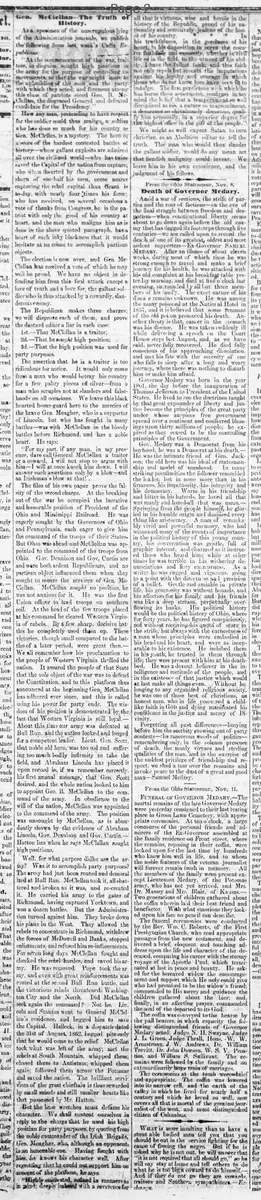
Gen. McClellan—The Truth of History.
As a specimen of the unscrupulous lying of the Administration journals, we publish the following from last week's Cadiz Republican:
"At the commencement of the war, traitors, in disguise, sought high positions in the army for the purpose of controlling its movements, so that the war might inure to the upbuilding of the men and the party with which they acted; and foremost among this class of patriots stood Geo. B. McClellan, the disgraced General and defeated candidate for the Presidency."
How any man, pretending to have respect for the soldier could thus malign a soldier who has done so much for his country as Gen. McClellan, is a mystery. The hero of a score of the hardest contested battles of history—whose gallant exploits are admired all over the civilized world—who has twice saved the Capital of the nation from capture; who when deserted by the government and shorn of one-half his men, come nearer capturing the rebel capital than Grant is to-day, with nearly four times his force; who has received, on several occasions a vote of thanks from Congress, he is the patriot with only the good of his country at heart, and the man who maligns him as is done in the above quoted paragraph, has a heart of such inky blackness that it would hesitate at no crime to accomplish partisan objects.
The election is now over, and Gen. McClellan has received a vote of which he may well be proud. We have no object in defending him from this foul attack except a love of truth and a love for the gallant soldier who is thus attacked by a cowardly, slanderous enemy.
The Republican makes three charges; we will disprove each of them, and prove the dastard editor a liar in each case:
1st.—That McClellan is a traitor;
2d—That he sought high position;
3d.—That the high position was used for party purposes.
The assertion that he is a traitor is too ridiculous for notice. It would only come from a man who would betray his country for a few paltry pieces of silver—from a man who scruples not at slanders and falsehoods on all occasions. We leave this black-hearted home-guard hero to the mercies of the brave Gen. Meagher, who is a supporter of Lincoln, but who has fought in many battles—was with McClellan in the bloody battles before Richmond, and has a noble heart. He says:
"For my part, if any man, in my presence, dare call General McClellan a traitor or a coward, I will not stop to argue with him—I will at once knock him down. I will answer such assertions only by a blow—and an Irishman's blow at that!"
The files of his own paper prove the falsity of the second charge. At the breaking out of the war he occupied the lucrative and honorable position of President of the Ohio and Mississippi Railroad. He was eagerly sought by the Governors of Ohio and Pennsylvania, each eager to give him the command of the troops of their States. But Ohio was ahead—and McClellan was appointed to the command of the troops from Ohio. Gov. Dennison and Gov. Curtin are and were both ardent Republicans, and no partisan object influenced them when they sought to secure the services of Gen. McClellan. McClellan sought no position, he was not anxious for it. He was the first Union officer to lead troops on southern soil. At the head of the few troops placed at his command he cleared Western Virginia of rebels. By a few sharp, decisive battles he completely used them up. These victories, though small compared to the battles of a later period, were great then. We all remember how his proclamation to the people of Western Virginia thrilled the nation. It assured the people of that State that the sole object of the war was to defend the Constitution, and to this platform thus announced at the beginning Gen. McClellan has adhered ever since, and this is called using his power for party ends. The wisdom of his position is demonstrated by the fact that Western Virginia is still loyal.
About this time our army was defeated at Bull Run, and the nation looked and longed for a competent leader. Lieut. Gen. Scott that noble old hero, was too old and suffering too much bodily infirmity to take the field, and Abraham Lincoln has placed it upon record in, if we remember correctly, his first annual message, that Gen. Scott desired, and the whole nation looked to him to appoint Geo. B. McClellan to the command of the army. In obedience to the will of the nation, McClellan was appointed to the command of the army. The position was unsought by McClellan, as is abundantly shown by the evidence of Abraham Lincoln, Gov. Dennison and Gov. Curtin. Hatton lies when he says McClellan sought high positions.
Well, for what purpose did he use the army? Was it to accomplish party purposes? The army had just been routed and demoralized at Bull Run. McClellan took it, all shattered and broken as it was, and re-created it. He carried his army to the gates of Richmond, having captured Yorktown, and won a dozen battles. But the Administration turned against him. They broke down his plans in the West. They allowed the rebels to concentrate in Richmond, withdrew the forces of McDowell and Banks, stopped enlistments, and refused him re-inforcements. For seven long days McClellan fought and checked the rebel hordes, and saved his army. He was removed. Pope took the army, and even with great reinforcements was routed at the second Bull Run battle, and the victorious rebels threatened Washington City and the North. Did McClellan seek again the command? Not he. Lincoln and Stanton went to General McClellan's residence, and begged him to save the Capital. Halleck, in a dispatch dated the 31st of August, 1862, begged piteously that he would come to the relief. McClellan took what was left of the army; met the rebels at South Mountain, whipped them; chased them to Antietam; whipped them again; followed them across the Potomac and saved the nation. The brilliant services of the great chieftain is thus rewarded by small minds and still smaller hearts like that possessed by Mr. Hatton.
But the base wretches must defame his character. We shall content ourselves in reply to the charge that he used his high position for party purposes, by quoting from the noble commander of the Irish Brigade, Gen. Meagher, who, although an opponent is an honorable one. Having fought with him, he knows his character well. After regretting that he could not support him on account of the platform, he says:
"Highly cultivated, refined in manners as he is modest—unequalled in bravery with a magnanimity which embraces all that is virtuous, wise and heroic in the history of the Republic, proud of his nationality and sensitively jealous of the honor of his country. In his truthfulness, in the goodness of his heart, in his disposition to serve the country faithfully and earnestly, whether in civil life or in the field, to the utmost of his ability, I have the fullest faith; and this faith not only repels but resents the imputations against his loyalty and courage in which those who do not know him have seen fit to indulge. The firm gentleness with which he has borne these aspersions, confirms in my mind the belief that a temperament so well disciplined as his, a nature so magnanimous a demeanor—so chivalrously decorous, qualify him personally, in a superior degree for the highest office in the gift of the people."
We might as well expect Satan to turn christian, as an Abolition editor to tell the truth. The man who would thus slander the gallant soldier, would do any mean act that fiendish malignity could invent. We leave him to his own conscience, and the judgment of his fellows.
As a specimen of the unscrupulous lying of the Administration journals, we publish the following from last week's Cadiz Republican:
"At the commencement of the war, traitors, in disguise, sought high positions in the army for the purpose of controlling its movements, so that the war might inure to the upbuilding of the men and the party with which they acted; and foremost among this class of patriots stood Geo. B. McClellan, the disgraced General and defeated candidate for the Presidency."
How any man, pretending to have respect for the soldier could thus malign a soldier who has done so much for his country as Gen. McClellan, is a mystery. The hero of a score of the hardest contested battles of history—whose gallant exploits are admired all over the civilized world—who has twice saved the Capital of the nation from capture; who when deserted by the government and shorn of one-half his men, come nearer capturing the rebel capital than Grant is to-day, with nearly four times his force; who has received, on several occasions a vote of thanks from Congress, he is the patriot with only the good of his country at heart, and the man who maligns him as is done in the above quoted paragraph, has a heart of such inky blackness that it would hesitate at no crime to accomplish partisan objects.
The election is now over, and Gen. McClellan has received a vote of which he may well be proud. We have no object in defending him from this foul attack except a love of truth and a love for the gallant soldier who is thus attacked by a cowardly, slanderous enemy.
The Republican makes three charges; we will disprove each of them, and prove the dastard editor a liar in each case:
1st.—That McClellan is a traitor;
2d—That he sought high position;
3d.—That the high position was used for party purposes.
The assertion that he is a traitor is too ridiculous for notice. It would only come from a man who would betray his country for a few paltry pieces of silver—from a man who scruples not at slanders and falsehoods on all occasions. We leave this black-hearted home-guard hero to the mercies of the brave Gen. Meagher, who is a supporter of Lincoln, but who has fought in many battles—was with McClellan in the bloody battles before Richmond, and has a noble heart. He says:
"For my part, if any man, in my presence, dare call General McClellan a traitor or a coward, I will not stop to argue with him—I will at once knock him down. I will answer such assertions only by a blow—and an Irishman's blow at that!"
The files of his own paper prove the falsity of the second charge. At the breaking out of the war he occupied the lucrative and honorable position of President of the Ohio and Mississippi Railroad. He was eagerly sought by the Governors of Ohio and Pennsylvania, each eager to give him the command of the troops of their States. But Ohio was ahead—and McClellan was appointed to the command of the troops from Ohio. Gov. Dennison and Gov. Curtin are and were both ardent Republicans, and no partisan object influenced them when they sought to secure the services of Gen. McClellan. McClellan sought no position, he was not anxious for it. He was the first Union officer to lead troops on southern soil. At the head of the few troops placed at his command he cleared Western Virginia of rebels. By a few sharp, decisive battles he completely used them up. These victories, though small compared to the battles of a later period, were great then. We all remember how his proclamation to the people of Western Virginia thrilled the nation. It assured the people of that State that the sole object of the war was to defend the Constitution, and to this platform thus announced at the beginning Gen. McClellan has adhered ever since, and this is called using his power for party ends. The wisdom of his position is demonstrated by the fact that Western Virginia is still loyal.
About this time our army was defeated at Bull Run, and the nation looked and longed for a competent leader. Lieut. Gen. Scott that noble old hero, was too old and suffering too much bodily infirmity to take the field, and Abraham Lincoln has placed it upon record in, if we remember correctly, his first annual message, that Gen. Scott desired, and the whole nation looked to him to appoint Geo. B. McClellan to the command of the army. In obedience to the will of the nation, McClellan was appointed to the command of the army. The position was unsought by McClellan, as is abundantly shown by the evidence of Abraham Lincoln, Gov. Dennison and Gov. Curtin. Hatton lies when he says McClellan sought high positions.
Well, for what purpose did he use the army? Was it to accomplish party purposes? The army had just been routed and demoralized at Bull Run. McClellan took it, all shattered and broken as it was, and re-created it. He carried his army to the gates of Richmond, having captured Yorktown, and won a dozen battles. But the Administration turned against him. They broke down his plans in the West. They allowed the rebels to concentrate in Richmond, withdrew the forces of McDowell and Banks, stopped enlistments, and refused him re-inforcements. For seven long days McClellan fought and checked the rebel hordes, and saved his army. He was removed. Pope took the army, and even with great reinforcements was routed at the second Bull Run battle, and the victorious rebels threatened Washington City and the North. Did McClellan seek again the command? Not he. Lincoln and Stanton went to General McClellan's residence, and begged him to save the Capital. Halleck, in a dispatch dated the 31st of August, 1862, begged piteously that he would come to the relief. McClellan took what was left of the army; met the rebels at South Mountain, whipped them; chased them to Antietam; whipped them again; followed them across the Potomac and saved the nation. The brilliant services of the great chieftain is thus rewarded by small minds and still smaller hearts like that possessed by Mr. Hatton.
But the base wretches must defame his character. We shall content ourselves in reply to the charge that he used his high position for party purposes, by quoting from the noble commander of the Irish Brigade, Gen. Meagher, who, although an opponent is an honorable one. Having fought with him, he knows his character well. After regretting that he could not support him on account of the platform, he says:
"Highly cultivated, refined in manners as he is modest—unequalled in bravery with a magnanimity which embraces all that is virtuous, wise and heroic in the history of the Republic, proud of his nationality and sensitively jealous of the honor of his country. In his truthfulness, in the goodness of his heart, in his disposition to serve the country faithfully and earnestly, whether in civil life or in the field, to the utmost of his ability, I have the fullest faith; and this faith not only repels but resents the imputations against his loyalty and courage in which those who do not know him have seen fit to indulge. The firm gentleness with which he has borne these aspersions, confirms in my mind the belief that a temperament so well disciplined as his, a nature so magnanimous a demeanor—so chivalrously decorous, qualify him personally, in a superior degree for the highest office in the gift of the people."
We might as well expect Satan to turn christian, as an Abolition editor to tell the truth. The man who would thus slander the gallant soldier, would do any mean act that fiendish malignity could invent. We leave him to his own conscience, and the judgment of his fellows.
What sub-type of article is it?
Partisan Politics
Military Affairs
What keywords are associated?
Mcclellan Defense
Traitor Accusation
Civil War Command
Partisan Slander
Union Loyalty
What entities or persons were involved?
Gen. Mcclellan
Cadiz Republican
Gen. Meagher
Abraham Lincoln
Gov. Dennison
Gov. Curtin
Hatton
Gen. Scott
Gen. Grant
Gen. Pope
Gen. Halleck
Gen. Stanton
Editorial Details
Primary Topic
Defense Of General Mcclellan Against Accusations Of Treason And Partisan Ambition
Stance / Tone
Strongly Pro Mcclellan And Anti Administration Slander
Key Figures
Gen. Mcclellan
Cadiz Republican
Gen. Meagher
Abraham Lincoln
Gov. Dennison
Gov. Curtin
Hatton
Gen. Scott
Gen. Grant
Gen. Pope
Gen. Halleck
Gen. Stanton
Key Arguments
Mcclellan Is Not A Traitor, As Affirmed By Gen. Meagher Who Would Physically Confront Such Accusers
Mcclellan Did Not Seek High Positions But Was Eagerly Appointed By Republican Governors And Lincoln
Mcclellan Used His Command To Reorganize And Lead The Union Army To Victories, Saving The Capital Multiple Times Despite Administration Interference
Accusations Of Using Position For Party Purposes Are False; His Actions Preserved The Constitution And Union Loyalty In Western Virginia