Thank you for visiting SNEWPapers!
Sign up free
The Hillsborough Recorder
Hillsboro, Orange County, North Carolina
What is this article about?
New Orleans newspapers defend General Lovell's actions during the city's surrender to Union forces, describing his refusal to surrender, evacuation of troops to avoid shelling civilians, and speeches encouraging resistance, met with public cheers and support.
Merged-components note: Seamless continuation reporting on Gen. Lovell's actions in New Orleans; relabeled from 'story' to 'domestic_news' as it is a factual report on national military events from American papers.
Clipping
OCR Quality
Full Text
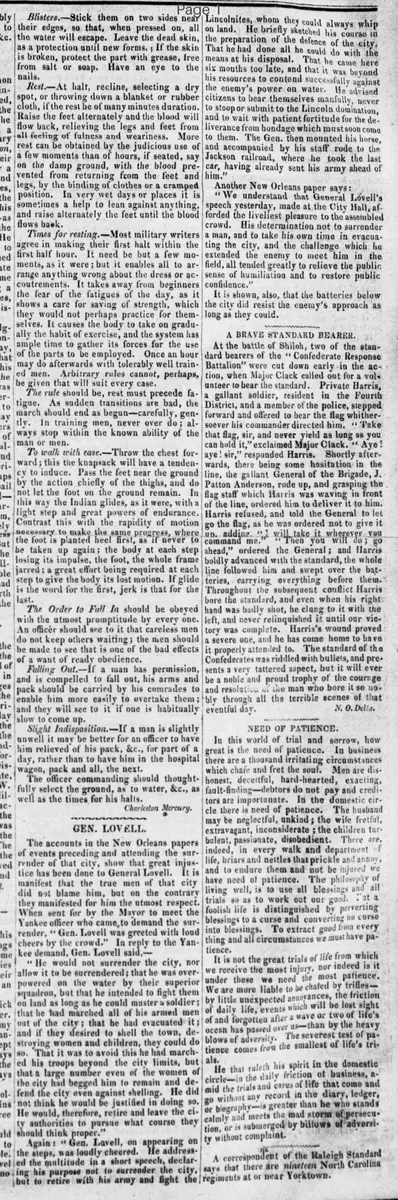
The accounts in the New Orleans papers of events preceding and attending the surrender of that city, show that great injustice has been done to General Lovell. It is manifest that the true men of that city did not blame him, but on the contrary they manifested for him the utmost respect.
When sent for by the Mayor to meet the Yankee officer who came to demand the surrender, "Gen. Lovell was greeted with loud cheers by the crowd." In reply to the Yankee demand. Gen. Lovell said.
"He would not surrender the city, nor allow it to be surrendered: that he was overpowered on the water by their superior squadron, but that he intended to fight them on land as long as he could muster a soldier; that he had marched all of his armed men out of the city ; that he had evacuated it; and if they desired to shell the town, destroying women and children, they could do so. That it was to avoid this he had marched his troops beyond the city limits, but that a large number even of the women of the city had begged him to remain and defend the city even against shelling. He did not think he would be justified in doing so. He would, therefore, retire and leave the city authorities to pursue what course they should think proper."
Again: "Gen. Lovell, on appearing on the steps, was loudly cheered. He addressed the multitude in a short speech, declaring his purpose not to surrender the city, but to retire with his army and fight the Lincolnites, whom they could always whip on land. He briefly sketched his course in the preparation of the defence of the city. That he had done all he could do with the means at his disposal. That he came here six months too late, and that it was beyond his resources to contend successfully against the enemy's power on water. He advised citizens to bear themselves manfully, never to stoop or submit to the Lincoln domination, and to wait with patient fortitude for the deliverance from bondage which must soon come to them. The Gen. then mounted his horse, and accompanied by his staff rode to the Jackson railroad, where he took the last car, having already sent his army ahead of him."
Another New Orleans paper says:
"We understand that General Lovell's speech yesterday, made at the City Hall, afforded the liveliest pleasure to the assembled crowd. His determination not to surrender a man, and to take his own time in evacuating the city, and the challenge which he extended the enemy to meet him in the field, all tended greatly to relieve the public sense of humiliation and to restore public confidence."
It is shown, also, that the batteries below the city did resist the enemy's approach as long as they could.
What sub-type of article is it?
What keywords are associated?
What entities or persons were involved?
Where did it happen?
Domestic News Details
Primary Location
New Orleans
Key Persons
Outcome
city evacuated by confederate troops to avoid shelling civilians; batteries resisted enemy approach; city authorities handled surrender; public confidence restored.
Event Details
General Lovell refused to surrender New Orleans to Union forces, evacuated his troops, addressed crowds with speeches defending his actions and encouraging resistance, and departed by rail after preparations for defense proved insufficient against naval superiority.