Thank you for visiting SNEWPapers!
Sign up free
The Enquirer
Richmond, Henrico County, Virginia
What is this article about?
On March 8, 1814, Secretary of the Navy William Jones reports to the House Naval Affairs Committee on progress building six 74-gun ships, six sloops of war, and numerous barges across U.S. ports; timber procurement under 1812 act; challenges with live oak; and selection of Hudson River site above Highlands for new dock yard.
Clipping
OCR Quality
Full Text
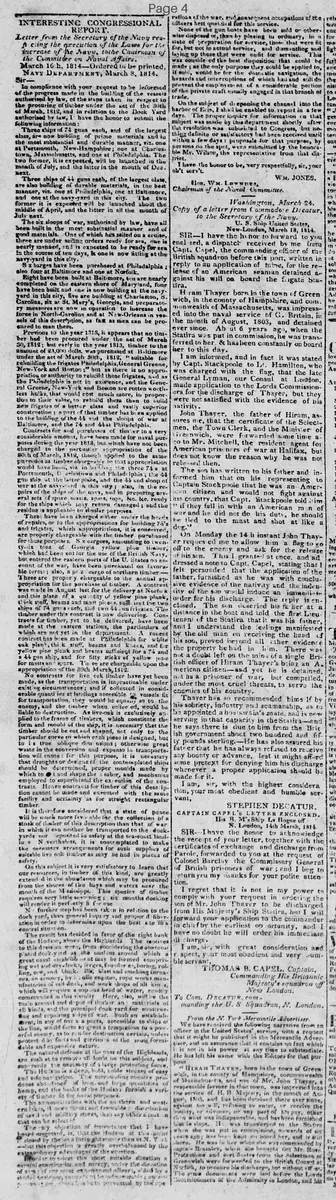
Letter from the Secretary of the Navy respecting the execution of the Laws for the increase of the Navy, to the Chairman of the Committee on Naval Affairs.
March 16th, 1814--Ordered to be printed.
Navy Department, March 8, 1814.
Sir,
In compliance with your request to be informed of the progress made in the building of the vessels authorised by law, of the steps taken in respect to the procuring of timber under the act of the 30th of March, 1812, and in relation to the Dock Yard authorised by law, I have the honor to submit the following information:
Three ships of 74 guns each, and of the largest class, are now building of prime materials and in the most substantial and durable manner, viz. one at Portsmouth, New-Hampshire; one at Charlestown, Massachusetts, and one at Philadelphia. The two former, it is expected, will be launched in the month of July, and the latter in the month of December next.
Three ships of 74 guns each, of the largest class, are also building of durable materials, in the best manner, viz. one at Philadelphia, one at Baltimore, and one at the navy-yard in this city. The two former it is expected will be launched about the middle of April, and the latter in the fall of the month of July next.
The six sloops of war, authorised by law, have all been built in the most substantial manner and of good materials. One of which has sailed on a cruise, three are under sailing orders ready for sea, one is nearly manned, and is expected to be ready for sea in the course of ten days, & one is now fitting at the navy-yard in this city.
Six barges have been purchased at Philadelphia; also four at Baltimore and one at Norfolk. Eight have been built at Baltimore, ten are nearly completed on the eastern shore of Maryland, four have been built and one is now building at the navy yard in this city, five are building at Charleston, S. Carolina, six at St. Mary's, Georgia, and preparatory measures are now in operation to increase the force in North-Carolina and at New-Orleans in vessels of this description, as far as men can be procured to man them.
Previous to the year 1813, it appears that no timber had been procured under the act of March 30, 1812; but early in the year 1813, timber to the amount of 23,000 dolls. was purchased at Baltimore under the act of March 30th, 1812, "suitable for rebuilding the frigates Philadelphia, General Greene, New-York and Boston:" but as there is no appropriation or authority to rebuild those frigates, and as the Philadelphia is not in existence, and the General Greene, New-York and Boston are rotten worthless hulks, that would cost much more, in proportion to their value, to rebuild them than to build new frigates of a better class and vastly superior construction; a part of that timber has been applied to the building of the 74s and the sloops of war at Baltimore, and the 74 at Philadelphia.
Contracts for and purchases of timber to a very considerable amount, have been made for naval purposes during the year 1813, but which have not been charged to the particular appropriation of the 30th of March, 1812, though applied to the same purposes as timber chargeable to that appropriation would have been, viz in building the three 74s at Portsmouth, Charlestown and Philadelphia; the 44 gun ship at the latter place, and the 74 and sloop of war at the navy-yard in this city; also, in the repairs of the ships of the navy, and in preparing several sets of spare masts, spars, tops, &c. &c. ready for the ships which may return damaged; and the residue is applicable to similar purposes.
These have been charged either under the heads of repairs, or to the appropriations for building 74's and frigates, which appropriations, it is conceived are properly chargeable with the timber purchased for those purposes. Six cargoes, amounting to twenty-six tons of Georgia yellow pine timber, which had been cut for the use of the British Navy, but entered the eastern ports of the U. States on account of the war, have been purchased on favorable terms; also, a prize cargo of northern timber. These are properly chargeable to the annual appropriation for the purchase of timber. A contract was made in August last for the delivery at Norfolk and this place of a quantity of yellow pine plank, thick stuff, beams and mast pieces, sufficient for two ships of 74 guns each, and two 44 gun frigates. The timber under this contract is now delivering. Contracts for timber, yet to be delivered, have been made at the eastern stations, the particulars of which are not yet in the department. A recent contract has been made at Philadelphia for white oak plank, thick stuff, beams and knees, and for yellow pine plank and beams sufficient for a 74 and 44 gun ship, and for fifty sticks of yellow pine for masts and spars. These are chargeable upon the appropriation of the 30th March, 1812.
No contracts for live oak timber have yet been made, as the transportation is impracticable under existing circumstances; and if collected in considerable quantities at landings accessible vessels fit for transportation, they would be exposed so to the enemy, and the timber when collected, would be liable to destruction. As live-oak is exclusively applied to the frame of timbers, which constitute the form and mould of the ship, it is necessary that the timber should be cut and shaped, not only to the particular curve to which each piece is designed, but to its true oblique dimensions; otherwise great waste in the conversion and expense in transportation will ensue: for this purpose, it is necessary that draughts or designs of the contemplated ships should be determined, proper moulds made by which to cut and shape the timber, and mechanics employed to superintend the execution of the contracts. Hence contracts for timber of this description cannot be made and executed with the same facility and certainty as for straight rectangular timber.
It is therefore considered that a state of peace will be much more favorable for the collection of a stock of timber of this description than that of war in which it can neither be transported to the dock yards nor deposited in safety at the sea-coast landings. Nevertheless, it is contemplated to make the necessary arrangements for such supplies of suitable live oak timber as may be had in places of safety.
On this subject it is very satisfactory to learn that our resources, in timber of this kind, are greatly extended in the abundance which may be procured from the shores of the bays and waters near the mouth of the Mississippi. This species of timber requires very little seasoning: six months docking will render it perfectly fit for use.
No further step has been taken in relation to the dock yard, than general inquiry and proper deliberation in order to determine upon the best site in a central situation.
The result has decided in favor of the right bank of the Hudson, above the Highlands. The motives to this decision were, from considering the contemplated dock yard as the nucleus around which a great naval establishment may be formed comprising wet and dry-docks, forges, founderies, boring, rolling, saw, and block-mill, blast and smelting furnaces, an armory, hydraulic engines, rope works manufactories of sail duck, and work shops of all kinds, which will require a copious head of water, readily commanded in this vicinity remain arsenal and depot of timber and materials of all kinds, and the principal dock yard for constructing and repairing ships of war. Such an establishment, in any of our sea ports, accessible to ships of the line, would form so great a temptation to a powerful enemy as to render it protected by fortifications and garrisons of the most formidable and expensive nature.
The natural defence at the pass of the Highlands, are such as to remove all doubt on this subject, and supersede the necessity of a large protecting force.
The Hudson is a deep, bold, noble stream of easy and safe navigation. The surrounding country produces abundance of iron and large quantities of hemp, and the banks of the Hudson furnish a variety of timber fit for naval purposes.
The communication with the northern and western states, is more direct and favorable : distribution of naval and military stores, than any other situation that can be selected.
The only objection of transportation that I have heard suggested, is that the Hudson at this point closes by the ice a fortnight sooner than at N. York --but this objection is greatly overbalanced by the extraordinary advantages of the situation.
In order to select the most suitable situation a careful examination and survey, under the direction of one of our best experienced officers, aided by a skillful engineer, will be indispensable ; which, however, has been prevented by the expense of the war, and consequent occupations of the officers best qualified for this service.
None of the gun boats have been sold or otherwise disposed of, than by placing in ordinary, in a state of preparation for service, those that were fit for, but not in actual service, and dismantling and laying up those that were unfit for service. This was considered the best disposition that could be made ; as the only purpose they could be applied to, if sold, would be for the domestic navigation, the hazards and interruptions of which had and still do prevent the employment of a considerable portion of the private craft usually engaged in that branch of trade.
On the subject of deepening the channel into the harbor of Erie, I shall be enabled to report in a few days. The proper inquiry for information on that subject was made by this department shortly after the resolution was submitted to Congress, but nothing definite or satisfactory had been received until within a few days: proposals for that purpose, by persons on the spot, were submitted by the honorable Mr. Wilson, the representative from that district.
I have the honor to be, very respectfully, sir, your ob't serv't
WM. JONES.
Hon. WM. Lowndes,
Chairman of the Naval Committee.
Washington, March 24.
What sub-type of article is it?
What keywords are associated?
What entities or persons were involved?
Where did it happen?
Domestic News Details
Primary Location
Washington
Event Date
March 8, 1814
Key Persons
Outcome
progress includes three 74-gun ships launching july/december 1814, three more in april/july; all six sloops built with one cruising, others ready; barges procured/built at various ports; timber purchased and contracted for naval use; hudson river site selected for dock yard; gun boats preserved; erie harbor report pending.
Event Details
Secretary Jones details construction of six 74-gun ships at Portsmouth NH, Charlestown MA, Philadelphia, Baltimore, and Washington; six sloops completed and deploying; barges acquired/built in multiple locations; timber procurement since 1813 for ships and repairs, including seized British and prize cargoes, contracts for pine and oak; challenges with live oak transport during war; proposed dock yard on Hudson above Highlands for comprehensive naval facilities; gun boats maintained; upcoming report on Erie harbor.