Thank you for visiting SNEWPapers!
Sign up free
Shepherdstown Register
Shepherdstown, Jefferson County, West Virginia
What is this article about?
Citizens of Jefferson County, Virginia, hold a public meeting in Charlestown to oppose annexation to West Virginia post-Civil War. They review legal history, pass resolutions affirming allegiance to Virginia, rejecting negro suffrage, and appointing committees for memorials to Congress and elections under Virginia law.
Merged-components note: This is a continuation of the public meeting report from page 1 to page 4, forming a single coherent narrative article. Label changed from 'notice' for the second part to 'story' as it is a full narrative report.
Clippings
1 of 2
OCR Quality
Full Text
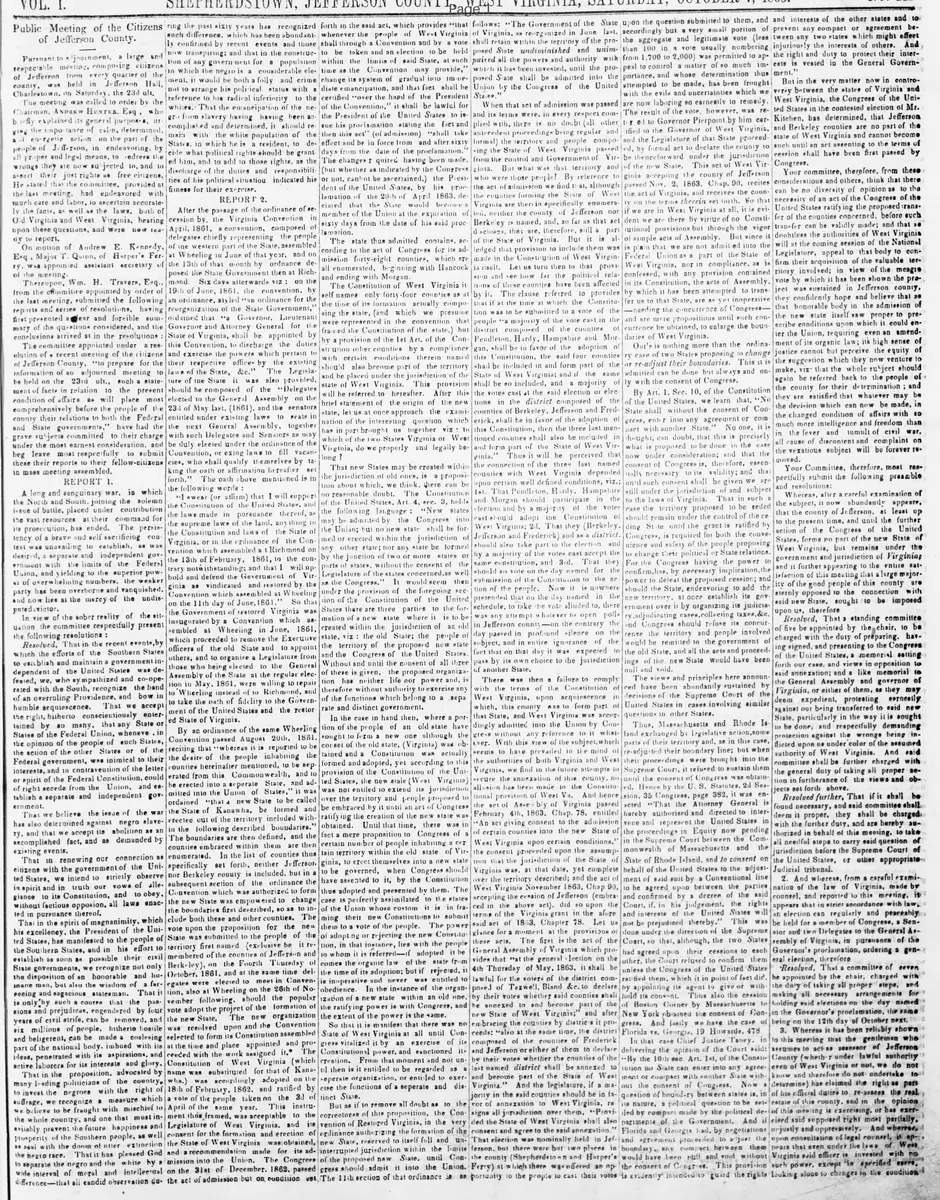
Pursuant to an adjournment, a large and respectable meeting, composing citizens of Jefferson from every quarter of the county, was held in Jefferson Hall, Charlestown, on Saturday, the 23d ult. The meeting was called to order by the Chairman, Andrew Hunter, Esq., who briefly explained its general purposes, urging the importance of calm, determined, and energetic action on the part of the people of Jefferson, in endeavoring, by all proper and legal means, to redress the wrongs they are now subjected to, and to assert their just rights as free citizens. He stated that the committee, provided at the last meeting, had endeavored with much care and labor, to ascertain accurately the facts, as well as the laws, both of Old Virginia and West Virginia, bearing upon these questions, and were now ready to report.
On motion of Andrew E. Kennedy, Esq., Major T. Quinn, of Harper's Ferry, was appointed assistant secretary of the meeting. Thereupon, Wm. H. Travers, Esq., from the committee appointed by order of the last meeting, submitted the following reports and series of resolutions, having first presented a clear and forcible summary of the questions considered, and the conclusions arrived at in the resolutions:
The committee appointed under a resolution of a recent meeting of the citizens of Jefferson County, "to prepare for the information of an adjourned meeting to be held on the 23rd ult., such a statement of facts in relation to the present condition of affairs as will place most comprehensively before the people of the county their relations to both the Federal and State governments," have had the grave subjects committed to their charge under the most earnest consideration, and beg leave most respectfully to submit these their reports to their fellow-citizens in mass meeting assembled.
REPORT 1.
A long and sanguinary war, in which the North and South, joining the solemn issue of battle, placed under contribution the vast resources at their command for its prosecution, has ended. The persistency of a brave and self-sacrificing contest was unavailing to establish, as was desired, a separate and independent government within the limits of the Federal Union, and yielding to the superior power of overwhelming numbers, the weaker party has been overborne and vanquished, and now lies at the mercy of the undisputed victor.
In view of the sober reality of the situation the committee respectfully present the following resolutions:
Resolved, That in the recent events, by which the efforts of the Southern States to establish and maintain a government independent of the United States was defeated, we, who sympathized and co-operated with the South, recognize the hand of an overruling Providence, and bow in humble acquiescence. That we accept the right, hitherto conscientiously entertained by so many, that any State or States of the Federal Union, whenever, in the opinion of the people of such States, the action of the other States or of the Federal government, was inimical to their interests, and in contravention of the letter or spirit of the Federal Constitution, could of right secede from the Union, and establish a separate and independent government.
That we believe the issue of the war has also determined against negro slavery, and that we accept its abolition as an accomplished fact, and as demanded by existing events.
That in renewing our connection as citizens with the government of the United States, we intend to strictly observe in spirit and in truth our vows of allegiance to its Constitution, and to obey, without factious opposition, all laws enacted in pursuance thereof.
That in the spirit of magnanimity, which his excellency, the President of the United States, has manifested to the people of the Southern States, and in his effort to establish as soon as possible their civil State governments, we recognize not only the disposition of an honorable and humane man, but also the wisdom of a far-seeing and sagacious statesman. That it is only by such a course that the passions and prejudices, engendered by four years of civil strife, can be removed, and six millions of people, hitherto hostile and belligerent, can be made a coalescing part of the national body, imbued with its ideas, penetrated with its aspirations, and actively laboring for its interests and glory.
That in the proposition, advocated by many leading politicians of the country, to invest the negroes with the right of suffrage, we recognize a measure which we believe to be fraught with mischief to the whole country, and one that must inevitably prevent the future happiness and prosperity of the Southern people, as well as seal with the doom of utter extinction the negro race. That it has pleased God to separate the negro and the white by a wide interval of moral and intellectual difference—that all candid observation during the past sixty years has recognized such difference, which has been abundantly confirmed by recent events and those now transpiring; and that in the construction of any government for a population in which the negro is a considerable element, it would be both a folly and crime not to arrange his political status with a reference to his radical inferiority to the whites. That the emancipation of the negro from slavery having been accomplished and determined, it should remain with the white population of the States, in which he is a resident, to decide what political rights should be granted him, and to add to those rights, as the discharge of the duties and responsibilities of his political situation indicated his fitness for their exercise.
REPORT 2.
After the passage of the ordinance of secession by the Virginia Convention in April, 1861, a convention, composed of delegates chiefly representing the people of the western part of the State, assembled at Wheeling in June of that year, and on the 13th of that month by ordinance deposed the State Government then at Richmond. Six days afterwards, viz: on the 19th of June, 1861, the convention, by an ordinance, styled "an ordinance for the reorganization of the State Government," ordained that "a Governor, Lieutenant Governor and Attorney General for the State of Virginia, shall be appointed by this Convention, to discharge the duties and exercise the powers which pertain to their respective offices by the existing laws of the State, &c." The Legislature of the State it was also provided, should be composed of the "Delegates elected to the General Assembly on the 23d of May last, (1861), and the senators entitled under existing laws to seats in the next General Assembly, together with such Delegates and Senators as may be duly elected under the ordinance of the Convention, or existing laws to fill vacancies, who shall qualify themselves by taking the oath or affirmation hereafter set forth." The oath above mentioned is in the following words:
"I swear (or affirm) that I will support the Constitution of the United States, and the laws made in pursuance thereof, as the supreme law of the land, anything in the Constitution and laws of the State of Virginia, or in the ordinance of the Convention which assembled at Richmond on the 13th of February, 1861, to the contrary notwithstanding: and that I will uphold and defend the Government of Virginia as vindicated and restored by the Convention which assembled at Wheeling on the 11th day of June, 1861." So that the Government of restored Virginia was inaugurated by a Convention which assembled at Wheeling in June, 1861, which proceeded to remove the Executive officers of the old State and to appoint others, and to organize a Legislature from those who being elected to the General Assembly of the State at the regular election in May, 1861, were willing to repair to Wheeling instead of to Richmond, and to take the oath of fidelity to the Government of the United States and the restored State of Virginia.
By an ordinance of the same Wheeling Convention passed August 20th, 1861, reciting that "whereas it is reported to be the desire of the people inhabiting the counties hereinafter mentioned, to be separated from this Commonwealth, and to be erected into a separate State, and admitted into the Union of States," it was ordained "that a new State to be called the State of Kanawha, be formed and erected out of the territory included within the following described boundaries." The boundaries are then defined, and the counties embraced within them are then enumerated. In the list of counties thus specifically set forth, neither Jefferson nor Berkeley county is included, but in a subsequent section of the ordinance the Convention which was authorized to form the new State was empowered to change the boundaries first described, so as to include both these and other counties. The vote upon the proposition of the new State was submitted to the people of the territory first named (exclusive be it remembered of the counties of Jefferson and Berkeley), on the Fourth Thursday of October, 1861, and at the same time delegates were elected to meet in Convention, also at Wheeling on the 26th of November following, should the popular vote adopt the project of the formation of the new State. The new organization was resolved upon and the Convention selected to form its Constitution assembled at the time and place appointed and proceeded with the work assigned it. The Constitution of West Virginia (which name was substituted for that of Kanawha) was accordingly adopted on the 18th of February, 1862, and ratified by a vote of the people taken on the 3d of April of the same year. This instrument thus framed, was acceptable to the Legislature of West Virginia, and its consent for the formation and erection of the State of West Virginia was obtained, and a recommendation made for its admission into the Union. The Congress on the 31st of December, 1862, passed the act of admission but on condition yet forth in the said act, which provides "that whenever the people of West Virginia shall through a Convention and by a vote to be taken and an election to be held within the limits of said State, at such time as the Convention may provide," change its system of gradual into immediate emancipation, and that fact shall be certified "over the hand of the President of the Convention," it shall be lawful for the President of the United States to issue his proclamation stating the fact and then this act (of admission) "shall take effect and be in force from and after sixty days from the date of the proclamation." The changes required having been made, (but whether as indicated by the Congress or not, cannot be ascertained.) the President of the United States, by his proclamation of the 20th of April, 1863, declared that the State would become a member of the Union at the expiration of sixty days from the date of his said proclamation.
The state thus admitted contains, according to the act of Congress for its admission forty-eight counties, which are all enumerated, beginning with Hancock and ending with Morgan. The Constitution of West Virginia itself names only forty-four counties as at the time of its formation actually composing the state, (and which we presume were represented in the convention that framed the Constitution of the state) but by a provision of the 1st Art. of the Constitution other counties by a compliance with certain conditions therein named should also become part of the territory and be placed under the jurisdiction of the state of West Virginia. This provision will be referred to hereafter. After this brief statement of the origin of the new state, let us at once approach the examination of the interesting question which has in part brought us together viz: to which of the two States Virginia or West Virginia, do we properly and legally belong.
That new States may be created within the jurisdiction of old ones, is a proposition about which, we think, there can be no reasonable doubt. The Constitution of the United States, Art. 4, sec. 3, holds the following language: "New states may be admitted by the Congress into the Union; but no new state shall be formed or erected within the jurisdiction of any other state; nor any state be formed by the junction of two or more states or parts of states, without the consent of the Legislatures of the states concerned, as well as the Congress." It would seem then under the provision of the foregoing section of the Constitution of the United States there are three parties to the formation of a new state where it is to be created within the jurisdiction of an old state, viz: the old State; the people of the territory of the proposed new state and the Congress of the United States. Without and until the consent of all three of these is given, the proposed organization has neither life nor power and is therefore without authority to exercise any of the functions which belong to a separate and distinct government.
In the case in hand then, where a portion of the people of an old state have sought to form a new one although the consent of the old state, (Virginia) was obtained and a Constitution was actually formed and adopted, yet according to this provision of the Constitution of the United States, the new state (West Virginia) was not entitled to extend its jurisdiction over the territory and people proposed to be embraced by it until an act of Congress ratifying the creation of the new state was obtained. Until that time, there was in fact a mere proposition to Congress of a certain number of people inhabiting a certain territory within the old state of Virginia, to erect themselves into a new state to be governed, when Congress should have assented to it, by the Constitution thus adopted and presented by them. The case is perfectly assimilated to the states of the Union whose custom it is in framing their new Constitutions to submit them to a vote of the people. The power of adopting or rejecting the new Constitution, in that instance, lies with the people to whom it is referred—if adopted it becomes the organic law of the state from the time of its adoption; but if rejected, it is inoperative and never was entitled to obedience. In the instance of the organization of a new state within an old one, the ratifying power is with Congress, and the extent of the power is the same.
So that it is manifest that there was no State of West Virginia at all until Congress vitalized it by an exercise of its Constitutional power, and sanctioned its creation. From that moment and not until then is it entitled to be regarded as a separate organization, or entitled to exercise the functions of a separate and distinct State.
But as if to remove all doubt as to the correctness of this proposition, the Convention of Restored Virginia, in the very ordinance authorizing the formation of the new State, reserved to itself full and uninterrupted jurisdiction within the limits of the proposed new State, until Congress should admit it into the Union. The 11th section of that ordinance is as follows: "The Government of the State of Virginia, as reorganized in June last, shall retain within the territory of the proposed State undiminished and unimpaired all the powers and authority with which it has been invested, until the proposed State shall be admitted into the Union by the Congress of the United States."
When that act of admission was passed and its terms were, in every respect complied with, there is no doubt (all other antecedent proceedings being regular and formal) the territory and people composing the State of West Virginia passed from the control and Government of Virginia. But what was that territory and who were those people? By reference to the act of admission we find that, although the counties forming the State of West Virginia are therein specifically enumerated, neither the county of Jefferson nor Berkeley is named, and, so far as that act discloses, they are, therefore, still a part of the State of Virginia. But it is alleged that provision to include them was made in the Constitution of West Virginia itself. Let us turn then to that provision and see how far the political relations of these counties have been affected by it. The clause referred to provides that if at the time at which the Constitution was to be submitted to a vote of the people "a majority of the vote cast in the district composed of the counties of Pendleton, Hardy, Hampshire and Morgan, shall be in favor of the adoption of this Constitution, the said four counties shall be included in and form part of the State of West Virginia; and if the same shall be so included, and a majority of the votes cast at the said election or elections in the district composed of the counties of Berkeley, Jefferson and Frederick, shall be in favor of the adoption of this Constitution, then the three last mentioned counties shall also be included in and form part of the State of West Virginia." Thus it will be perceived that the connection of the three last named counties with West Virginia depended upon certain well defined conditions, viz. 1st. That Pendleton, Hardy, Hampshire and Morgan should participate in the election and by a majority of the votes cast should adopt the Constitution of West Virginia; 2d. That they (Berkeley, Jefferson and Frederick) and as a district, should also take part in the election and by a majority of the votes cast accept the same constitution, and 3rd. That they should so vote on the day named for the submission of the Constitution to the action of the people. Now it is nowhere pretended that on the day named in the schedule, to take the vote alluded to, there was any attempt whatever to open polls in Jefferson county—on the contrary the day passed in profound silence on the subject, and in entire ignorance of the fact that on that day it was expected to pass by its own choice to the jurisdiction of another State.
There was then a failure to comply with the terms of the Constitution of West Virginia, upon acquiescence in which, this county was to form part of that State, and West Virginia was accordingly admitted into the Union by Congress without any reference to it whatever. With this view of the subject, which seems to have prevailed in the mind of the authorities of both Virginia and West Virginia, we find in the future attempts to secure the annexation of this county, no allusion has been made to the Constitutional provision of West Va. And hence the act of Assembly of Virginia passed February 4th, 1863, Chap. 78, entitled "An act giving consent to the admission of certain counties into the new State of West Virginia upon certain conditions," the consent proceeded upon the assumption that the jurisdiction of the State of Virginia was, at that date, yet complete over the territory described; and the act of West Virginia November 1863, Chap 90, accepting the cession of Jefferson (embraced in the above act), did so upon the terms of the Virginia grant in the aforesaid act of 1863, Chapter 78. Let us glance for a moment at the provisions of these acts. The first is the act of the General Assembly of Virginia which provides that "at the general election on the 4th Thursday of May, 1863, it shall be lawful for the voters of the district composed of Tazewell, Bland &c. to declare by their votes whether said counties shall be annexed to and become part of the new State of West Virginia;" and after embracing the counties by districts it proceeds: "also at the same time, the district composed of the counties of Frederick and Jefferson or either of them to declare by their votes whether the counties of the last named district shall be annexed to and become part of the State of West Virginia." And the legislature, if a majority in the said counties should be in favor of annexation to West Virginia, resigns all jurisdiction over them. "Provided the State of West Virginia shall also consent and agree to the said annexation."
That election was nominally held in Jefferson, but there were but two places in the county (Shepherdstown and Harper's Ferry) at which there was offered an opportunity to the people to cast their votes upon the question submitted to them, and accordingly but a very small portion of the aggregate and legitimate vote (less than 100 in a vote usually numbering from 1,700 to 2,000) was permitted to appeal to control a matter of so much importance, and whose determination thus attempted to be made, has been fraught with the evils and uncertainties which we are now laboring so earnestly to remedy.
The result of the vote, however, was returned to Governor Pierpoint by him certified to the Governor of West Virginia, and the Legislature of that State proceeded, by formal act to declare the county to be thenceforward under the jurisdiction of the new State. This act of West Virginia accepting the county of Jefferson passed Nov. 2, 1863, Chap. 90, recites the act of Virginia, and receives the county on the terms therein set forth. So that if we are in West Virginia at all, it is evident we are there by virtue of no Constitutional provisions but through the vigor of simple acts of Assembly. But since it is plain that we are not admitted into the Federal Union as a part of the State of West Virginia, nor in compliance, as is confessed, with any provision contained in its Constitution, the acts of Assembly, by which it has been attempted to transfer us to that State, are as yet inoperative—needing the concurrence of Congress—and are mere propositions until such concurrence be obtained, to enlarge the boundaries of West Virginia.
Ours is nothing more than the ordinary case of two States proposing to change or re-adjust their boundaries. This it is admitted can be done but always and only with the consent of Congress. By Art. 1, Sec. 10, of the Constitution of the United States, we learn that, "No State shall without the consent of Congress, enter into any agreement or compact with another State." No one, it is thought, can doubt, that this is precisely what is proposed to be done in the case now under consideration; and that the consent of Congress is, therefore, essentially necessary to its validity; and that until such consent shall be given we are still under the jurisdiction of and subject to the laws of Virginia. That in such a case the territory proposed to be ceded should remain under the control of the ceding State until the grant is ratified by Congress, is required for both the convenience and safety of the people proposing to change their political or State relations. For the Congress having the power to confirm, has, by necessary implication, the power to defeat the proposed cession; and should the State, endeavoring to add the new territory, at once establish its government over it by organizing its judiciary, adjudicating cases, collecting taxes, &c, and Congress should refuse its concurrence the territory and people involved would be remitted to the government of the old State, and all the acts and proceedings of the new State would have been null and void.
The views and principles here announced have been abundantly sustained by decisions of the Supreme Court of the United States in cases involving similar questions in other States. Thus, Massachusetts and Rhode Island exchanged by legislative action, some parts of their territory and, as in this case, re-adjusted their boundary line; but when their proceedings were brought into the Supreme Court, it refused to sustain them until the consent of Congress was obtained. Hence by the U. S. Statutes, 2d Session, 35th Congress, page 382, it was enacted "That the Attorney General is hereby authorised and directed to intervene and represent the United States in the proceedings in Equity now pending in the Supreme Court between the Commonwealth of Massachusetts and the State of Rhode Island, and to consent on behalf of the United States to the adjustment of said suit by a conventional line to be agreed upon between the parties and confirmed by a decree of the said Court, if, in his judgement, the rights and interests of the United States will not be prejudiced thereby." This was done under the direction of the Supreme Court, so that, although, the two States had agreed upon their cessions to each other, the Court refused to confirm them unless the Congress of the United States ratified them, which it in point of fact did, by appointing its agent to give or withhold its consent. Thus also the cession of Boston Corner by Massachusetts to New York obtained the consent of Congress. And lastly we have the case of Florida vs. Georgia, 19 Howards, 478. In that case Chief Justice Taney, in delivering the opinion of the Court said: "By the 10th sec. Art. 1, of the Constitution no State can enter into any agreement or compact with another State without the consent of Congress. Now a question of boundary between states is, in its nature, a political question to be settled by compact made by the political departments of the Government. And if Florida and Georgia had, by negotiations and agreement proceeded to adjust the boundary, any compact between them would have been null and void without the consent of Congress. This provision is evidently intended to guard the rights and interests of the other states and to prevent any compact or agreement between any two states which might affect injuriously the interests of others. And the right and duty to protect their interests is vested in the General Government."
But in the very matter now in controversy between the states of Virginia and West Virginia, the Congress of the United States in the contested election of Mr. Kitchen, has determined, that Jefferson and Berkeley counties are no part of the state of West Virginia and cannot become such until an act assenting to the terms of cession shall have been first passed by Congress.
Your committee, therefore, from these considerations and others, think that there can be no diversity of opinion as to the necessity of an act of the Congress of the United States ratifying the proposed transfer of the counties concerned, before such transfer can be validly made; and that doubtless the authorities of West Virginia will at the coming session of the National Legislature, appeal to that body to confirm their acquisition of the valuable territory involved; in view of the meagre vote by which it has been shown the project was sustained in Jefferson county, they confidently hope and believe that as that honorable body in the admission of the new state itself saw proper to prescribe conditions upon which it could enter the Union, requiring even an amendment of its organic law; its high sense of justice cannot but perceive the equity of the suggestion which they now venture to make, viz: that the whole subject should again be referred back to the people of the county for their determination: and they are satisfied that whatever may be the decision which can now be made, in the changed condition of affairs with so much more intelligence and freedom than in the fever and tumult of civil war, all cause of discontent and complaint on the vexatious subject will be forever removed.
Your Committee, therefore, most respectfully submit the following preamble and resolutions:
Whereas, after a careful examination of the subject, it now abundantly appears that the county of Jefferson, at least up to the present time, and until the further action of the Congress of the United States, forms no part of the new State of West Virginia, but remains under the government and jurisdiction of Virginia; and it further appearing to the entire satisfaction of this meeting that a large majority of the good people of this county are sternly opposed to the connection with said new State, sought to be imposed upon us, therefore
Resolved, That a standing committee of five be appointed by the chair, to be charged with the duty of preparing, having signed, and presenting to the Congress of the United States, a memorial setting forth our case, and views in opposition to said annexation; and a like memorial to the General Assembly and governor of Virginia, or either of them, as they may deem expedient, protesting earnestly against our being transferred to said new State, particularly in the way it is sought to be done, and respectfully demanding protection against the wrongs being inflicted upon us under color of the assumed authority of West Virginia. And said committee shall be further charged with the general duty of taking all proper action in furtherance of the views and objects set forth above.
Resolved further, That if it shall be found necessary, and said committee shall deem it proper, they shall be charged with the further duty, and are hereby authorized in behalf of this meeting, to take all needful steps to carry said question of jurisdiction before the Supreme Court of the United States, or other appropriate Judicial tribunal.
2. And whereas, from a careful examination of the law of Virginia, made by counsel, and reported to this meeting, it appears that in strict accordance with law, an election can regularly and peaceably be held for a member of Congress, a Senator and two Delegates to the General Assembly of Virginia, in pursuance of the Governor's proclamation, ordering a general election, therefore
Resolved, That a committee of seven be appointed by the chair, charged with the duty of taking all proper steps, and making all necessary arrangements for holding said elections on the day named in the Governor's proclamation, the same being on the 12th day of October next.
3. Whereas it has been reliably shown to this meeting that the gentleman who assumes to act as assessor of Jefferson County (whether under lawful authority even of West Virginia or not, we do not know and therefore do not undertake to determine) has claimed the right as part of his official duties to re-assess the real estate of this county, and in the opinion of this meeting is exercising, or has exercised said supposed right most partially, unjustly and oppressively. And whereas, upon consultation of legal counsel, it appears that even under the laws of West Virginia said officer is invested with no such power, except in specified cases, looking alone to changes in the condition
and ownership of the property since the last general assessment, therefore
Resolved, That this subject be referred to a committee of three, to be appointed by the chairman of this meeting, to be charged with the duty of further investigating the subject of State and County taxation as sought to be enforced against us; and to employ counsel, if deemed necessary, to appear before the Board of Supervisors, explain the injustice and illegality of these proceedings, and to take such other measures as may be necessary and proper to protect the citizens of this county against the grievances complained of.
The act of the Legislature of West Virginia, authorizing the location of the County Seat of Jefferson at Shepherdstown, having also provided for the removal of the same from said point by a vote of the people of said county, and that venerable and respectable town being so situated on the extreme border of the county, as to render it for said purpose the most inaccessible of any of the towns of the county, therefore
Resolved, That in the opinion of this meeting, whether we be in West Virginia or not, the County Seat ought to be restored to its ancient, central place of Charlestown, without delay, and that the Board of Supervisors are hereby respectfully requested to take the necessary measures for holding an election to determine said question, in pursuance of said act, at the earliest day practicable.
Resolved, That a committee of five, one of whom shall be designated as Treasurer, be appointed by the chair, to solicit and collect funds for the purpose of carrying out each of the foregoing resolutions; and that the said funds be applied accordingly by the treasurer under the direction of said committee.
Resolved, That the Chairman be authorized to appoint the foregoing several committees, at his convenience, after the adjournment of this meeting, and that he be further authorized to call a general meeting at any time hereafter, when he may deem it expedient.
The reports and each of the foregoing resolutions, were unanimously approved and concurred in, by a separate vote on each, except that on motion of E. I. Lee, Esq., so much of the report as concedes the right, under any circumstances, to divide a State of the Union, by erecting a new State within its boundaries, was negatived by a majority vote of the meeting.
On motion of R. W. Baylor, Esq., the thanks of the meeting were voted to the committee for the able and faithful manner in which they have performed their duties.
And on motion of the same the papers of this and Berkeley counties, and of the city of Richmond, were requested to publish the proceedings of this meeting. The meeting then adjourned.
ANDREW HUNTER, Cha'n.
B. F. BEALL,
T. QUINN,
Secretaries.
What sub-type of article is it?
What themes does it cover?
What keywords are associated?
What entities or persons were involved?
Where did it happen?
Story Details
Key Persons
Location
Jefferson Hall, Charlestown, Jefferson County, Virginia
Event Date
Saturday, The 23d Ult.
Story Details
Citizens of Jefferson County meet to discuss their legal status post-Civil War, arguing through reports that they remain part of Virginia due to lack of Congressional consent for annexation to West Virginia. They pass resolutions accepting the war's outcome, opposing negro suffrage, appointing committees for memorials to Congress and Virginia, planning elections under Virginia law, addressing taxation issues, and restoring the county seat to Charlestown.