Thank you for visiting SNEWPapers!
Sign up free
Story
October 9, 1875
Public Ledger
Memphis, Shelby County, Tennessee
What is this article about?
Jennie June defends the tied-back skirt against critics accusing it of indecency, arguing it outlines the female form no more than men's clothing and is an improvement over past bulky hoopskirts that concealed shape, promoting graceful modern dress within social norms.
Clipping
OCR Quality
85%
Good
Full Text
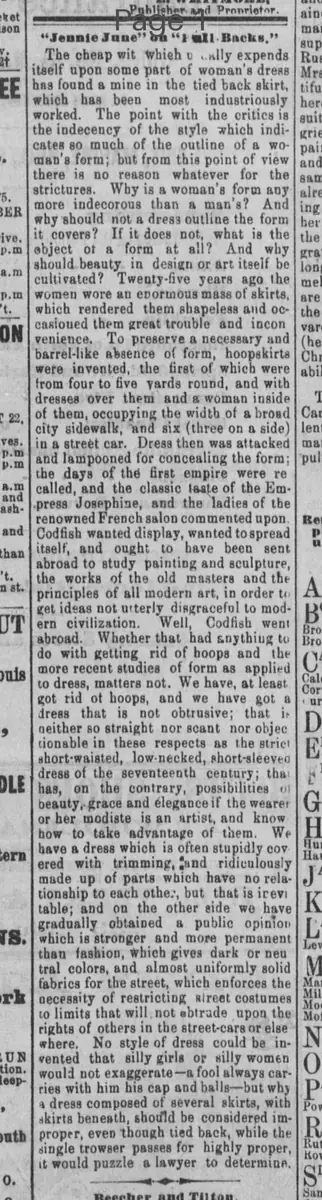
"Jennie June" on "Fill-Backs."
The cheap wit which usually expends itself upon some part of woman's dress has found a mine in the tied back skirt, which has been most industriously worked. The point with the critics is the indecency of the style which indicates so much of the outline of a woman's form; but from this point of view there is no reason whatever for the strictures. Why is a woman's form any more indecorous than a man's? And why should not a dress outline the form it covers? If it does not, what is the object of a form at all? And why should beauty in design or art itself be cultivated? Twenty-five years ago the women wore an enormous mass of skirts, which rendered them shapeless and occasioned them great trouble and inconvenience. To preserve a necessary and barrel-like absence of form, hoopskirts were invented, the first of which were from four to five yards round, and with dresses over them and a woman inside of them, occupying the width of a broad city sidewalk, and six (three on a side) in a street car. Dress then was attacked and lampooned for concealing the form: the days of the first empire were recalled, and the classic taste of the Empress Josephine, and the ladies of the renowned French salon commented upon. Codfish wanted display, wanted to spread itself, and ought to have been sent abroad to study painting and sculpture the works of the old masters and the principles of all modern art, in order to get ideas not utterly disgraceful to modern civilization. Well. Codfish went abroad. Whether that had anything to do with getting rid of hoops and the more recent studies of form as applied to dress, matters not. We have, at least got rid of hoops, and we have got a dress that is not obtrusive; that is neither so straight nor scant nor objectionable in these respects as the strict short-waisted, low-necked, short-sleeved dress of the seventeenth century; that has, on the contrary, possibilities of beauty, grace and elegance if the wearer or her modiste is an artist, and knows how to take advantage of them. We have a dress which is often stupidly covered with trimming, and ridiculously made up of parts which have no relationship to each other, but that is inevitable: and on the other side we have gradually obtained a public opinion which is stronger and more permanent than fashion, which gives dark or neutral colors, and almost uniformly solid fabrics for the street, which enforces the necessity of restricting street costumes to limits that will not obtrude upon the rights of others in the street-cars or elsewhere. No style of dress could be invented that silly girls or silly women would not exaggerate—a fool always carries with him his cap and bells—but why a dress composed of several skirts, with skirts beneath, should be considered improper, even though tied back, while the single trouser passes for highly proper, it would puzzle a lawyer to determine.
The cheap wit which usually expends itself upon some part of woman's dress has found a mine in the tied back skirt, which has been most industriously worked. The point with the critics is the indecency of the style which indicates so much of the outline of a woman's form; but from this point of view there is no reason whatever for the strictures. Why is a woman's form any more indecorous than a man's? And why should not a dress outline the form it covers? If it does not, what is the object of a form at all? And why should beauty in design or art itself be cultivated? Twenty-five years ago the women wore an enormous mass of skirts, which rendered them shapeless and occasioned them great trouble and inconvenience. To preserve a necessary and barrel-like absence of form, hoopskirts were invented, the first of which were from four to five yards round, and with dresses over them and a woman inside of them, occupying the width of a broad city sidewalk, and six (three on a side) in a street car. Dress then was attacked and lampooned for concealing the form: the days of the first empire were recalled, and the classic taste of the Empress Josephine, and the ladies of the renowned French salon commented upon. Codfish wanted display, wanted to spread itself, and ought to have been sent abroad to study painting and sculpture the works of the old masters and the principles of all modern art, in order to get ideas not utterly disgraceful to modern civilization. Well. Codfish went abroad. Whether that had anything to do with getting rid of hoops and the more recent studies of form as applied to dress, matters not. We have, at least got rid of hoops, and we have got a dress that is not obtrusive; that is neither so straight nor scant nor objectionable in these respects as the strict short-waisted, low-necked, short-sleeved dress of the seventeenth century; that has, on the contrary, possibilities of beauty, grace and elegance if the wearer or her modiste is an artist, and knows how to take advantage of them. We have a dress which is often stupidly covered with trimming, and ridiculously made up of parts which have no relationship to each other, but that is inevitable: and on the other side we have gradually obtained a public opinion which is stronger and more permanent than fashion, which gives dark or neutral colors, and almost uniformly solid fabrics for the street, which enforces the necessity of restricting street costumes to limits that will not obtrude upon the rights of others in the street-cars or elsewhere. No style of dress could be invented that silly girls or silly women would not exaggerate—a fool always carries with him his cap and bells—but why a dress composed of several skirts, with skirts beneath, should be considered improper, even though tied back, while the single trouser passes for highly proper, it would puzzle a lawyer to determine.
What sub-type of article is it?
Curiosity
Historical Event
What themes does it cover?
Social Manners
What keywords are associated?
Tied Back Skirt
Hoopskirts
Women's Fashion
Dress Reform
Social Norms
What entities or persons were involved?
Jennie June
Empress Josephine
Story Details
Key Persons
Jennie June
Empress Josephine
Story Details
Defense of tied-back skirts as modest and practical compared to past hoopskirts, critiquing fashion evolution and societal double standards on indecency.