Thank you for visiting SNEWPapers!
Sign up free
Editorial
May 5, 1868
The Daily Gate City
Keokuk, Lee County, Iowa
What is this article about?
Editorial harshly criticizes Secretary of State William H. Seward and President Andrew Johnson for corruption in the Alta Vela guano island dispute, accusing Seward of aiding associates in robbing Baltimore firm Patterson & Murguendo, with Johnson refusing to intervene.
Clipping
OCR Quality
95%
Excellent
Full Text
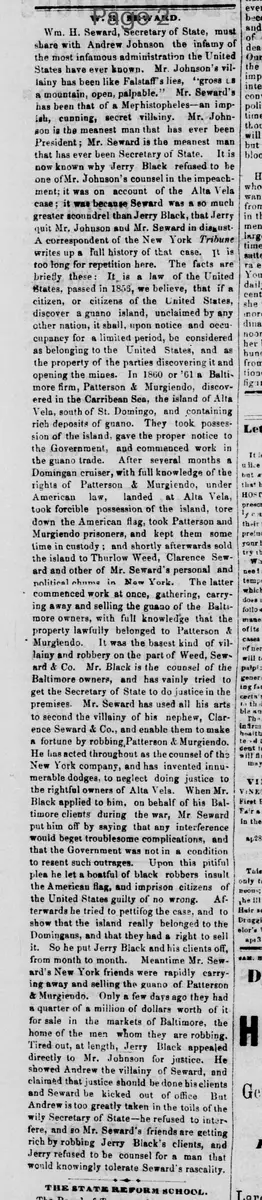
Wm. H. Seward, Secretary of State, must share with Andrew Johnson the infamy of the most infamous administration the United States have ever known. Mr. Johnson's villainy has been like Falstaff's lies, 'gross as a mountain, open, palpable.' Mr. Seward's has been that of a Mephistopheles—an impish, cunning, secret villainy. Mr. Johnson is the meanest man that has ever been President; Mr. Seward is the meanest man that has ever been Secretary of State. It is now known why Jerry Black refused to be one of Mr. Johnson's counsel in the impeachment; it was on account of the Alta Vela case; it was because Seward was a so much greater scoundrel than Jerry Black, that Jerry quit Mr. Johnson and Mr. Seward in disgust.
A correspondent of the New York Tribune writes up a full history of that case. It is too long for repetition here. The facts are briefly these: It is a law of the United States, passed in 1855, we believe, that if a citizen, or citizens of the United States, discover a guano island, unclaimed by any other nation, it shall, upon notice and occupancy for a limited period, be considered as belonging to the United States, and as the property of the parties discovering it and opening the mines. In 1860 or '61 a Baltimore firm, Patterson & Murguendo, discovered in the Caribbean Sea, the island of Alta Vela, south of St. Domingo, and containing rich deposits of guano. They took possession of the island, gave the proper notice to the Government, and commenced work in the guano trade. After several months a Dominican cruiser, with full knowledge of the rights of Patterson & Murguendo, under American law, landed at Alta Vela, took forcible possession of the island, tore down the American flag, took Patterson and Murguendo prisoners, and kept them some time in custody; and shortly afterwards sold the island to Thurlow Weed, Clarence Seward and other of Mr. Seward's personal and political chums in New York. The latter commenced work at once, gathering, carrying away and selling the guano of the Baltimore owners, with full knowledge that the property lawfully belonged to Patterson & Murguendo. It was the basest kind of villainy and robbery on the part of Weed, Seward & Co. Mr. Black is the counsel of the Baltimore owners, and has vainly tried to get the Secretary of State to do justice in the premises. Mr. Seward has used all his arts to second the villainy of his nephew, Clarence Seward & Co., and enable them to make a fortune by robbing Patterson & Murguendo. He has acted throughout as the counsel of the New York company, and has invented innumerable dodges, to neglect doing justice to the rightful owners of Alta Vela. When Mr. Black applied to him, on behalf of his Baltimore clients during the war, Mr. Seward put him off by saying that any interference would beget troublesome complications, and that the Government was not in a condition to resent such outrages. Upon this pitiful plea he let a boatful of black robbers insult the American flag, and imprison citizens of the United States guilty of no wrong. Afterwards he tried to pettifog the case, and to show that the island really belonged to the Dominicans, and that they had a right to sell it. So he put Jerry Black and his clients off from month to month. Meantime Mr. Seward's New York friends were rapidly carrying away and selling the guano of Patterson & Murguendo. Only a few days ago they had a quarter of a million of dollars worth of it for sale in the markets of Baltimore, the home of the men whom they are robbing. Tired out, at length, Jerry Black appealed directly to Mr. Johnson for justice. He showed Andrew the villainy of Seward, and claimed that justice should be done his clients and Seward be kicked out of office. But Andrew is too greatly taken in the toils of the wily Secretary of State—he refused to interfere, and so Mr. Seward's friends are getting rich by robbing Jerry Black's clients, and Jerry refused to be counsel for a man that would knowingly tolerate Seward's rascality.
A correspondent of the New York Tribune writes up a full history of that case. It is too long for repetition here. The facts are briefly these: It is a law of the United States, passed in 1855, we believe, that if a citizen, or citizens of the United States, discover a guano island, unclaimed by any other nation, it shall, upon notice and occupancy for a limited period, be considered as belonging to the United States, and as the property of the parties discovering it and opening the mines. In 1860 or '61 a Baltimore firm, Patterson & Murguendo, discovered in the Caribbean Sea, the island of Alta Vela, south of St. Domingo, and containing rich deposits of guano. They took possession of the island, gave the proper notice to the Government, and commenced work in the guano trade. After several months a Dominican cruiser, with full knowledge of the rights of Patterson & Murguendo, under American law, landed at Alta Vela, took forcible possession of the island, tore down the American flag, took Patterson and Murguendo prisoners, and kept them some time in custody; and shortly afterwards sold the island to Thurlow Weed, Clarence Seward and other of Mr. Seward's personal and political chums in New York. The latter commenced work at once, gathering, carrying away and selling the guano of the Baltimore owners, with full knowledge that the property lawfully belonged to Patterson & Murguendo. It was the basest kind of villainy and robbery on the part of Weed, Seward & Co. Mr. Black is the counsel of the Baltimore owners, and has vainly tried to get the Secretary of State to do justice in the premises. Mr. Seward has used all his arts to second the villainy of his nephew, Clarence Seward & Co., and enable them to make a fortune by robbing Patterson & Murguendo. He has acted throughout as the counsel of the New York company, and has invented innumerable dodges, to neglect doing justice to the rightful owners of Alta Vela. When Mr. Black applied to him, on behalf of his Baltimore clients during the war, Mr. Seward put him off by saying that any interference would beget troublesome complications, and that the Government was not in a condition to resent such outrages. Upon this pitiful plea he let a boatful of black robbers insult the American flag, and imprison citizens of the United States guilty of no wrong. Afterwards he tried to pettifog the case, and to show that the island really belonged to the Dominicans, and that they had a right to sell it. So he put Jerry Black and his clients off from month to month. Meantime Mr. Seward's New York friends were rapidly carrying away and selling the guano of Patterson & Murguendo. Only a few days ago they had a quarter of a million of dollars worth of it for sale in the markets of Baltimore, the home of the men whom they are robbing. Tired out, at length, Jerry Black appealed directly to Mr. Johnson for justice. He showed Andrew the villainy of Seward, and claimed that justice should be done his clients and Seward be kicked out of office. But Andrew is too greatly taken in the toils of the wily Secretary of State—he refused to interfere, and so Mr. Seward's friends are getting rich by robbing Jerry Black's clients, and Jerry refused to be counsel for a man that would knowingly tolerate Seward's rascality.
What sub-type of article is it?
Partisan Politics
Foreign Affairs
What keywords are associated?
Alta Vela
Guano Island
Seward Corruption
Johnson Administration
Patterson Murguendo
Jerry Black
Dominican Seizure
What entities or persons were involved?
Wm. H. Seward
Andrew Johnson
Jerry Black
Patterson & Murguendo
Thurlow Weed
Clarence Seward
Dominican Cruiser
Editorial Details
Primary Topic
Corruption In The Alta Vela Guano Island Case
Stance / Tone
Strongly Accusatory Of Villainy And Robbery By Seward And Johnson
Key Figures
Wm. H. Seward
Andrew Johnson
Jerry Black
Patterson & Murguendo
Thurlow Weed
Clarence Seward
Dominican Cruiser
Key Arguments
Seward And Johnson Share Infamy Of The Most Corrupt Us Administration
Seward's Cunning Villainy Aided Robbery Of Alta Vela Guano By His Associates
Black Refused To Counsel Johnson Due To Seward's Greater Scoundrelry In The Case
Us Law Of 1855 Grants Guano Islands To Discoverers Like Patterson & Murguendo
Dominicans Seized Island And Sold It To Seward's Friends Despite Us Rights
Seward Delayed Justice Citing War Complications And Invented Legal Dodges
Johnson Refused To Intervene, Allowing The Robbery To Continue