Thank you for visiting SNEWPapers!
Sign up free
Norfolk Gazette And Publick Ledger
Norfolk, Virginia
What is this article about?
Report on French fleets evading British blockades, escaping to the West Indies, and threatening English colonies, with speculation on potential invasions, naval confrontations involving Nelson, and impacts on English politics and American commerce.
Clipping
OCR Quality
Full Text
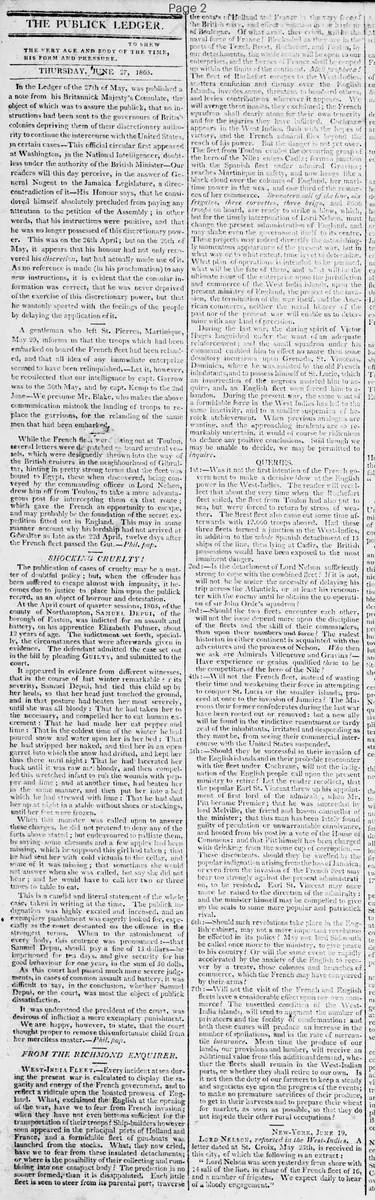
West-India Fleet. Every incident at sea during the present war is calculated to display the sagacity and energy of the French government, and to reflect a ridicule upon the boasted prowess of England. What, exclaimed the English at the opening of the war, have we to fear from French invasion; when they have not even bottoms sufficient for the transportation of their troops? Ship-builders however soon appeared in the principal ports of Holland and France, and a formidable fleet of gun-boats was launched from the stocks. What, they now cried, have we to fear from these insulated detachments; or where is the possibility of their collecting and combining into one compact body? The prediction is no sooner formed, than it is disappointed. Each little fleet is seen to steer from its parental port, traverse the coasts of Holland and France in the very face of the British navy, and effect a junction in the harbour of Boulogne. Of what avail, they cried, will be the naval force of France? Blockaded as they are in the ports of the Texel, Brest, Rochefort, and Toulon, by our detachments, the whole ocean will be open to our enterprises, and the heroes of France shall be cropped up within the limits of the continent. Mais non, pas si vite! The fleet of Rochefort escapes to the West-Indies, scatters confusion and dismay over the English Islands, invades some, threatens to bombard others, and levies contributions wherever it appears. We will avenge these insults, they exclaimed; the French squadron shall dearly atone for their own temerity and for the injuries they have inflicted. Cochrane appears in the West Indies, flush with the hopes of victory, and the French admiral flies beyond the reach of his power. But the danger is not yet over. The fleet from Toulon evades the devouring grasp of the hero of the Nile: enters Cadiz; forms a junction with the Spanish fleet under admiral Gravina: reaches Martinique in safety, and now hangs like a black cloud over the colonies of England, her maritime power in the west, and one third of the resources of her commerce. Seventeen sail of the line, six frigates, three corvettes, three brigs, and 8000 troops on board, are ready to strike a blow, which, but for the timely interposition of Lord Nelson, must change the present administration of England, and may shake even the government itself to its centre.
These projects may indeed diversify the astonishingly momentous appearance of the present war, but in what way or to what extent, time is yet to determine. What plan of operations is intended to be pursued, what will be the fate of them, and what will be the ultimate issue of the enterprize upon the jurisdiction and commerce of the West India islands, upon the present ministry of England, the project of the invasion, the termination of the war itself, and the American commerce, neither the naval history of the past nor of the present war will enable us to determine with any kind of precision.
During the last war, the daring spirit of Victor Hughes languished under the want of an adequate reinforcement; and the small squadron under his command enabled him to effect no more than some desultory incursions upon Grenada, St. Vincents, Dominica, where he was assisted by the old French inhabitants, and to possess himself of St. Lucie, which an insurrection of the negroes assisted him to acquire, and, an English fleet soon forced him to abandon. During the present war, the same want of a formidable force in the West Indies has led to the same inactivity, and to a similar suspension of heroic achievement. When previous analogies are wanting, and the approaching incidents are so remarkably uncertain, it would of course be ridiculous to deduce any positive conclusions. Still though we may be unable to decide, we may be permitted to inquire.
QUERIES
1st: Was it not the first intention of the French government to make a decisive blow at the English power in the West-Indies. The reader will recollect that about the very time when the Rochefort fleet sailed, the fleet from Toulon had also put to sea, but were forced to return by stress of weather. The Brest fleet also came out some time afterwards with 12,000 troops aboard. Had these three fleets formed a junction in the West-Indies, in addition to the whole Spanish detachment of 15 ships of the line, then lying at Cadiz, the British possessions would have been exposed to the most imminent danger.
2nd: Is the detachment of Lord Nelson sufficiently strong to cope with the combined fleet? If it is not, will not he be under the necessity of delaying his trip across the Atlantick, or at least his rencontre with the enemy until he obtains the co-operation of sir John Orde's squadron?
3rd: Should the two fleets encounter each other, will not the issue depend more upon the discipline of the fleets and the skill of their commanders, than upon their numbers and force? The rudest historian in either continent is acquainted with the adventures and the prowess of Nelson. Who then we ask are Admirals Villeneuve and Gravina? Have experience or genius qualified them to be the competitors of the hero of the Nile?
4th: Will not the French fleet, instead of wasting their time and weakening their force in attempting to conquer St. Lucia or the smaller islands, proceed at once to the invasion of Jamaica? The Maroons their former confederates during the last war have been rooted out or removed: but a new ally will be found in the vindictive resentment or tardy zeal of the inhabitants, irritated and desponding as they must be, from seeing their commercial intercourse with the United States suspended.
5th: Should they be successful in their invasion of the English islands and in their probable rencontre with the fleet under Cochrane, will not the indignation of the English people call upon the present ministry to retire? Let the reader recollect, that the popular Earl St. Vincent threw up his appointment of first lord of the admiralty, when Mr. Pitt became Premier; that he was succeeded by lord Melville, the friend and bosom counsellor of the minister: that this man has been lately found guilty of peculation or unwarrantable connivance, and hooted from his post by a vote of the House of Commons: and that Pitt himself has been charged with drinking from the same cup of corruption. These discontents, should they be swelled by the popular indignation arising from the loss of Jamaica, or even from the invasion of the French fleet may bear too strongly against the present administration, to be resisted. Earl St. Vincent may once more be raised to the direction of the admiralty: and the minister himself may be compelled to give up the seals to some more popular and patriotick rival.
6th: Should such revolutions take place in the English cabinet, may not a more important revolution be effected in its policy? May not lord Sidmouth be called once more to the ministry, to give peace to his country? Or will the same event be rapidly accelerated by the anxiety of the English to recover by a treaty, those colonies and branches of commerce, which the French may have conquered by their arms?
7th: Will not the visit of the French and English fleets have a considerable effect upon our own commerce? The unsettled condition of the West-India islands, will tend to augment the number of privateers and the facility of condemnation: and both these causes will produce an increase in the number of spoliations, and in the rate of mercantile insurance. Mean time the produce of our lands, our provisions and lumber, will receive an additional value from this additional demand, whether the fleets shall remain in the West-Indian ports, or whether they shall retire to our own. Is it not then the duty of our farmers to keep a steady and sagacious eye upon the progress of the events; to make no premature sacrifices of their produce, to get in their harvests and to prepare their wheat for market, as soon as possible, so that they do not impede their other rural occupations?
What sub-type of article is it?
What keywords are associated?
What entities or persons were involved?
Where did it happen?
Foreign News Details
Primary Location
West Indies
Key Persons
Outcome
french fleets evade british blockades, threaten english colonies in west indies; potential for invasion, naval confrontation, political changes in england, and impacts on american commerce
Event Details
French fleets from Rochefort and Toulon escape blockades, join Spanish forces, reach Martinique with 17 sail of the line, six frigates, three corvettes, three brigs, and 8000 troops, threatening English West India colonies; historical context from last war under Victor Hughes; queries on intentions, Nelson's strength, potential invasion of Jamaica, English political fallout, and effects on commerce.