Thank you for visiting SNEWPapers!
Sign up free
Literary
April 9, 1850
The New Hampshire Gazette And Republican Union
Portsmouth, Rockingham County, New Hampshire
What is this article about?
Short story by T. S. Arthur about Florine Malcolm, a beautiful but indolent city belle, who marries Henry Merwyn. After their families' financial ruin in a commercial crisis, they relocate to rural Ohio, where Florine sells her luxuries to start a small business, embracing a simpler, healthier, and happier life.
Merged-components note: Merged multi-part serialized literary story 'Two Scenes in the Life of a City Belle' across sequential components.
Clipping
OCR Quality
88%
Good
Full Text
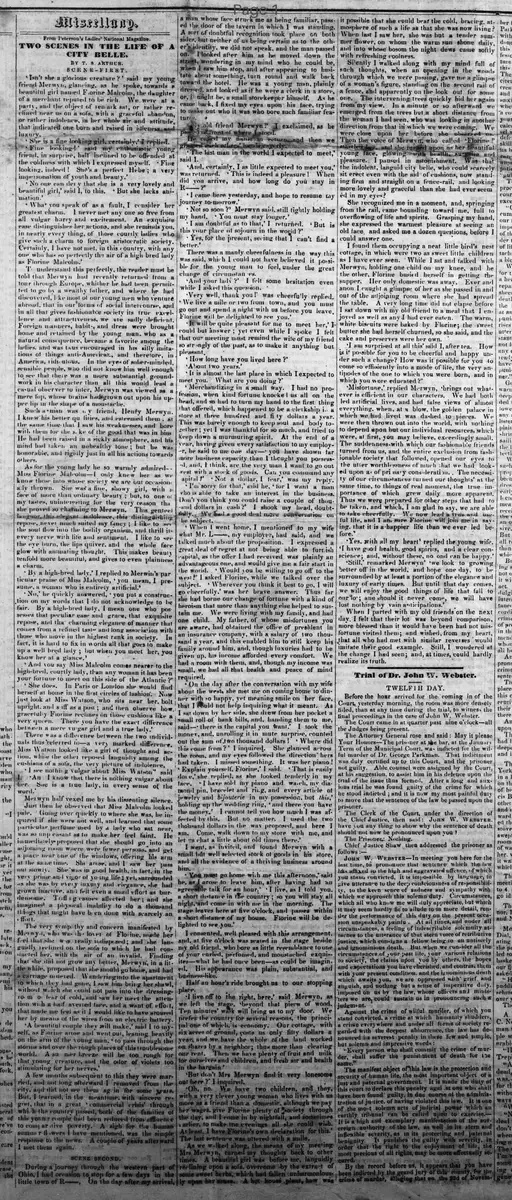
MISCELLANY.
From Peterson's Ladies' National Magazine
TWO SCENES IN THE LIFE OF A
CITY BELLE,
BY T. S. ARTHUR.
SCENE—FIRST.
“Isn't she a glorious creature?” said my young
friend Merwyn, glancing, as he spoke, towards
a beautiful girl named Florine Malcolm, the daughter
of a merchant reputed to be rich. We were at a
party, and the object of remark sat, or rather reclined near us on a sofa, with a graceful abandon,
or rather indolence, in her whole air and attitude.
that indicated one born and raised in idleness and
luxury.
“She is a fine looking girl, certainly,” replied.
“Fine looking!” said my enthusiastic young
friend, in surprise, half inclined to be offended at
the coldness with which I expressed myself. “Fine
looking, indeed! She's a perfect Hebe; a very
impersonation of youth and beauty.”
“No one can deny that she is a very lovely and
beautiful girl,” said I, to this. “But she lacks animation.”
“What you speak of as a fault, I consider her
greatest charm. I never met any one so free from
all vulgar hurry and excitement. An exquisite
ease distinguishes her actions, and she reminds you,
in nearly every thing, of those courtly ladies who
give such a charm to foreign aristocratic society.
“Certainly, I have not met, in this country, with any
one who has so perfectly the air of a high-bred lady
as Florine Malcolm.”
To understand this perfectly, the reader must be
told that Merwyn had recently returned from a
tour through Europe, whither he had been permitted
to go by a wealthy father, and where he had
discovered, like most of our young men who venture
abroad, that in our forms of social intercourse, and
in all that gives fashionable society its true excellence
and attractiveness, we are sadly deficient.
Foreign manners, habits, and dress were brought
home and retained by the young man, who as a
natural consequence, became a favorite among the
ladies, and was thus encouraged in his silly imitations
of things anti-American, and therefore, in
America, ridiculous. In the eyes of sober-minded,
sensible people, who did not know him well enough
to see that there was a more substantial groundwork
in his character than all this would lead a
casual observer to infer, Merwyn was viewed as a
mere fop, whose brains had grown out upon his upper
lip in the shape of a moustache.
Such a man was my friend, Henry Merwyn.
I knew his better qualities, and esteemed them at
the same time that I saw his weaknesses, and bore
with them for the sake of the good that was in him
He had been raised in a sickly atmosphere, and his
mind had taken an unhealthy tone; but he was
honorable, and rigidly just in all his actions towards
others.
As for the young lady he so warmly admired—
Miss Florine Malcolm—I only knew her as we
know those into whose society we are but occasionally
thrown. She was a fine, showy girl, with a
face of more than ordinary beauty; but, to one of
my tastes, uninteresting for the very reason that
she proved so charming to Merwyn. “This genteel
languor, this elegant indolence, this distinguishing
repose, never much suited my fancy; I like to see
the soul flow into the bodily organism, and thrill it
every nerve with life and sentiment. I like to see
the eye burn, the lips quiver, and the whole face
glow with animating thought. This makes beauty
tenfold more beautiful, and gives to even plainness
a charm.
“By a high-bred lady?” I replied to Merwin's particular praise of Miss Malcolm, “you mean, I presume,
a woman who is entirely artificial.”
“No,” he quickly answered, “you put a construction
on my words that I do not acknowledge to be
fair. By a high-bred lady, I mean one who possesses
that peculiar ease and grace, that exquisite
repose, and that charming elegance of manner that
comes from a refined taste and long association with
those who move in the highest rank in society. In
fact, it is hard to fix in words all that goes to make
up a well bred lady; but when you meet her, you
know her at a glance.”
“And you say Miss Malcolm comes nearer to the
high-bred, courtly lady, than any woman it has been
your fortune to meet on this side of the Atlantic?”
“She does. In Paris or London she would find
herself at home in the first circles of fashion. Now
just look at Miss Watson, who sits near her, bolt
upright and stiff as a post; and then observe how
gracefully Florine reclines on those cushions like a
very queen. There you have the exact difference
between a mere vulgar girl and a true lady.”
There was a difference between the two individuals
thus referred to—a very marked difference.
Miss Watson looked like a girl of thought and action,
while the other reposed languidly among the
cushions of a sofa, the very picture of indolence.
“I see nothing vulgar about Miss Watson” said
I. “And I know that there is nothing vulgar about
her. She is a true lady, in every sense of the
word.”
Merwyn half vexed me by his dissenting silence.
Just then he observed that Miss Malcolm looked
pale. Going over quickly to where she was, he inquired
if she were not well, and learned that some
particular perfume used by a lady who sat near,
was so unpleasant as to make her feel faint. He
immediately proposed that she should go into an
adjoining room where were fewer persons, and get
a place near one of the windows, offering his arm
at the same time. She arose, and I saw her pass
out slowly. She was in good health, in fact, in the
very prime and vigor of young life; yet, surrounded
as she was by every luxury and elegance, she had
grown inactive, and felt even a small effort as burdensome.
Trivial causes affected her; and she
imagined a physical inability to do a thousand
things that might have been done with scarcely an
effort.
The very sympathy and concern manifested by
Merwyn, who was the lover of Florine, made her
feel that she was really indisposed; and she languidly
reclined on the sofa to which he had conducted
her, with the air of an invalid. Finding
that she did not grow any better, Merwyn, in a little
while, proposed that she should go home, and had
a carriage ordered. Wandering into the apartment
to which they had gone; I saw him bring her shawl,
without which she could not pass into the dressing-room
for fear of cold, and saw her meet the attention
with a half averted face, and a want of effort,
that made me feel as if I would like to have aroused
her by means of the wires from an electric battery.
“A beautiful couple they will make,” said I to myself,
as Florine arose and went out, leaning heavily
on the arm of the young man, “to pass through the
storms and over the rough places of this troublesome
world. A summer breeze will be too rough for
that young creature, and the odor of violets too
stimulating for her nerves.”
A few months subsequent to this they were married,
and not long afterward I removed from the
city, and did not see them again for some years.
But, I learned, in the meantime, with sincere regret,
that in a great commercial crisis through
which the country passed, both of the families of
this young couple had been reduced from affluence
to comparative poverty. “A sigh for the human
heart!” was the simple
response to the news. A couple of years afterward
I met them again.
SCENE—SECOND.
During a journey through the western part of
Ohio, I had occasion to stop for a few days in the
little town of R—. On the day after my arrival,
a man whose face struck me as being familiar, passed
the door of the tavern in which I was standing.
A sort of doubtful recognition took place on both
sides, but neither of us being certain as to the other
identity, we did not speak, and the man passed
on. I looked after him as he moved down the
street, wondering in my mind who he could be,
when I saw him stop, and after appearing to hesitate
about something, turn round and walk back
toward the hotel. He was a young man, plainly
dressed, and looked as if he were a clerk in a store,
or, it might be, a small storekeeper himself. As he
came back, I fixed my eyes upon his face, trying
to make out who it was who bore such familiar features
“My old friend Merwyn!” I exclaimed, as he
came in front of where I stood.
He started at my name on return and then we
grasped each other's hands eagerly.
“The last man in the world I expected to meet,
said I.
“And, certainly, I as little expected to meet you.
This is indeed a pleasure! When
did you arrive, and how long do you stay in
R—?”
“I came here yesterday, and hope to resume my
journey to-morrow.”
“Not so soon?” Merwyn said, still tightly holding
my hand. “You must stay longer.”
“I am doubtful as to that,” I returned. “But is
this your place of sojourn in the world?”
“Yes, for the present, seeing that I can't find a
better.”
There was a manly cheerfulness in the way this
was said, which I could not have believed it possible
for the young man to feel, under the great
change of circumstances.
“And your lady?” I felt some hesitation even
while I asked this question.
“Very well, thank you!” was cheerfully replied.
We live a mile or two from town, and you must
go out and spend a night with us before you leave.
Florine will be delighted to see you.
“It will be quite pleasant for me to meet her,” I
could but answer; yet even while I spoke I felt
that our meeting must remind the wife of my friend
so strongly of the past, as to make it anything but
pleasant.
“How long have you lived here?”
“About two years.”
“It is almost the last place in which I expected to
meet you. “What are you doing?”"
“Merchandizing in a small way. I had no profession,
when kind fortune knocked us all on the
head, and so had to turn my hand to the first thing
that offered, which happened to be a clerkship in a
store at three hundred and fifty dollars a year.
This was barely enough to keep soul and body together;
yet I was thankful for so much, and tried to
keep down a murmuring spirit. At the end of a
year, having given every satisfaction to my employer,
he said to me one day— 'you have shown far
more business capacity than I thought you possessed,
and, I think, are the very man I want to go out
west with a stock of goods. Can you command any
capital?' Not a dollar, I fear,” was my reply.
“I'm sorry for that,” said he, “for I want a man
who is able to take an interest in the business.
Don't you think you could raise a couple of thousand
dollars in cash?” I shook my head, doubt-
fully. We had a good deal more conversation on
the subject.
“When I went home, I mentioned to my wife
what Mr. L— , my employer, had said, and we
talked much about the proposition. I expressed a
great deal of regret at not being able to furnish
capital, as the offer I had received was plainly an
advantageous one, and would give me a fair start in
the world. “Would you be willing to go off to the
west?” I asked Florine, while we talked over the
subject. “Wherever you think it best to go, I will
go cheerfully,” was her brave answer. Thus far
she had borne our change of fortune with a kind of
heroism that more than anything else helped to sustain
me. We were living with my family, and had
one child. My father, of whose misfortunes you
are aware, had obtained the office of president in
an insurance company, with a salary of two thousand
a year, and this enabled him to still keep his
family around him, and, though luxuries had to be
given up, his income afforded every comfort. We
had a room with them, and, though my income was
small, we had all that health and peace of mind
required.
“On the day after the conversation with my wife
about the west, she met me on coming home to dinner
with so happy, yet meaning smile on her face.
that I could not help inquiring what it meant. As
I sat down by her side, she drew from her pocket a
small roll of bank bills, and, handing them to me,
said— there is the capital you want.” I took the
money, and, unrolling it in mute surprise, counted
out the sum of two thousand dollars! “Where did
this come from?” I inquired. She glanced across
the room, and my eyes followed the direction hers
had taken. I missed something. It was her piano!
“Explain yourself, Florine,” I said. “That is easily
done,” she replied, as she looked tenderly in my
face. “I have sold my piano and watch, my diamond
pin, bracelet and ring, and every article of
jewelry and bijouterie in my possession, but this,”
holding up the wedding ring, “and there you have
the money.” I cannot tell you how much I was affected
by this. But no matter. I used the two
thousand dollars in the way proposed, and here I
am. Come, walk down to my store with me, and
let us chat a little about old times there.”
I went, as invited, and found Merwyn with a
small but well selected stock of goods in his store.
and all the evidence of a thriving business around
him.
“You must go home with me this afternoon,” said
he, as I rose to leave him, after having had an
agreeable talk for an hour, “I live, as I told you,
a short distance in the country; so you will stay all
night, and come in with me in the morning. The
stage leaves here at five o'clock, and passes within
a short distance of my house. Florine will be delighted
to see you.”
I consented, well pleased with this arrangement.
and, at five o'clock was seated in the stage beside
my old friend, who bore as little resemblance to one
of your curled, perfumed, and moustached exquisites—what
he had once been—as could be imagined.
His appearance was plain, substantial, and
business-like.
Half an hour's ride brought us to our stopping
place.
“I live off to the right, here,” said Merwyn, as
we left the stage, “beyond that piece of wood.
Ten minutes' walk will bring us to my door. We
prefer the country for several reasons, the principal
one of which, is economy. Our cottage, with
six acres of ground, costs us only fifty dollars a
year; and we have the whole of the land worked
on shares by a neighbor; thus more than clearing
our rent. Then we have plenty of fruit and milk
for ourselves and children, and fresh air and health
in the bargain.
“But don't Mrs. Merwyn find it very lonesome
out here?” I inquired.
“Oh, no. We have two children, and they
with a very clever young woman who lives with us
more as a friend than a domestic, although we pay
her wages, give Florine plenty of society through
the day, and I come in by nightfall, and sometimes
earlier, to make the evenings all she could wish.
At least, I have Florine's own declaration for this.”
The last sentence was uttered with a smile.
As we walked along, the means of my meeting
Mrs. Merwyn, turned my thoughts back to other
times. A beautiful girl was before me, languidly
reclining upon a sofa, overcome by the exhalations
of some sweet herbs, which had fallen unharmoniously
upon her sense. A hot-house plant! How was
it possible that she could bear the cold, bracing atmosphere
of such a life as that she was now living?
When last I saw her, she was but a tender summer
flower, on whom the warm sun shone daily,
and into whose bosom the night dews came softly
with refreshing coolness.
Silently I walked along with my mind full of
such thoughts, when an opening in the woods
through which we were passing, gave me a glimpse
of a woman's figure, standing on the second rail of
a fence, and apparently on the look out for some
one. The intervening trees quickly hid her again
from my view. In a minute or so afterward we
emerged from the trees but a short distance from
the woman I had seen, who was looking in another
direction from that in which we were coming. We
were close upon her before she observed us.
Then the voice of Merwyn, who called “Florine!”
startled her, and she turned upon us her beautiful
young face, glowing with health, surprise and
pleasure. I paused, in astonishment. Was that
the indolent, languid city belle, who could scarcely
sit erect even with the aid of cushions, now standing
firm and straight on a fence-rail, and looking
more lovely and graceful than she had ever seemed
in my eyes?
She recognized me in a moment, and, springing
from the rail, came bounding toward me, full to
overflowing of life and spirits. Grasping my hand,
she expressed the warmest pleasure at seeing an
old face, and asked me a dozen questions, before I
could answer one.
I found them occupying a neat little bird's nest
cottage, in which were two as sweet little children
as I have ever seen. While I sat and talked with
Merwyn, holding one child on my knee, and he
the other, Florine busied herself in getting the
supper. Her only domestic was away. Ever and
anon I caught a glimpse of her as she passed in and
out of the adjoining room where she had spread
the table. A very long time did not elapse before
I sat down with my old friend to a meal that I enjoyed
as well as any I had ever eaten. The warm,
white biscuits were baked by Florine; the sweet
butter she had herself churned, so she said, and the
cake and preserves were her own.
“I am surprised at all this” said I, after tea. “How
is it possible for you to be cheerful and happy under
such a change? How was it possible for you to
come so efficiently into a mode of life, the very antipodes
of the one to which you were born, and in
which you were educated?”.
“Misfortune,” replied Merwyn, “brings out whatever
is efficient in our characters. We had both
led artificial lives, and had false views of almost
everything, when, at one blow, the golden palace in
which we had lived was dashed to pieces. We
were then thrown out into the world, with nothing
to depend upon but our individual resources, which
were, at first, you may believe, exceedingly small.
The suddenness with which our fashionable friends
turned from us, and the entire exclusion from fashionable
society that followed, opened our eyes to
the utter worthlessness of much that we had looked
upon as of primary consideration. The necessity
of our circumstances turned our thoughts at the
same time, to things of real moment, the true importance
of which grew daily more apparent.
Thus we were prepared for other steps that had to
be taken, and which, I am glad to say, we are able
to take cheerfully. We now lead a true and useful
life, and I am sure Florine will join me in saying,
that it is a happier life than we ever led before.”
“Yes, with all my heart” replied the young wife.
“I have good health, good spirits, and a clear conscience;
and, without these, no one can be happy.
Still,” remarked Merwyn “we look to growing
better off in the world, and hope one day, to be
surrounded by at least a portion of the elegance and
luxury of early times. But until that day comes.
we will enjoy the good things of life that fall to
our lot; and should it never come, we will have
lost nothing by vain anticipations.”
When I parted with my old friends on the next
day, I felt that their lot was beyond comparison,
more blessed than it would have been had not misfortune
visited them; and wished, from my heart,
that all who had met with similar reverses would
imitate their good example. Still, I wondered at
the change I had seen; and, at times, could hardly
realize its truth.
From Peterson's Ladies' National Magazine
TWO SCENES IN THE LIFE OF A
CITY BELLE,
BY T. S. ARTHUR.
SCENE—FIRST.
“Isn't she a glorious creature?” said my young
friend Merwyn, glancing, as he spoke, towards
a beautiful girl named Florine Malcolm, the daughter
of a merchant reputed to be rich. We were at a
party, and the object of remark sat, or rather reclined near us on a sofa, with a graceful abandon,
or rather indolence, in her whole air and attitude.
that indicated one born and raised in idleness and
luxury.
“She is a fine looking girl, certainly,” replied.
“Fine looking!” said my enthusiastic young
friend, in surprise, half inclined to be offended at
the coldness with which I expressed myself. “Fine
looking, indeed! She's a perfect Hebe; a very
impersonation of youth and beauty.”
“No one can deny that she is a very lovely and
beautiful girl,” said I, to this. “But she lacks animation.”
“What you speak of as a fault, I consider her
greatest charm. I never met any one so free from
all vulgar hurry and excitement. An exquisite
ease distinguishes her actions, and she reminds you,
in nearly every thing, of those courtly ladies who
give such a charm to foreign aristocratic society.
“Certainly, I have not met, in this country, with any
one who has so perfectly the air of a high-bred lady
as Florine Malcolm.”
To understand this perfectly, the reader must be
told that Merwyn had recently returned from a
tour through Europe, whither he had been permitted
to go by a wealthy father, and where he had
discovered, like most of our young men who venture
abroad, that in our forms of social intercourse, and
in all that gives fashionable society its true excellence
and attractiveness, we are sadly deficient.
Foreign manners, habits, and dress were brought
home and retained by the young man, who as a
natural consequence, became a favorite among the
ladies, and was thus encouraged in his silly imitations
of things anti-American, and therefore, in
America, ridiculous. In the eyes of sober-minded,
sensible people, who did not know him well enough
to see that there was a more substantial groundwork
in his character than all this would lead a
casual observer to infer, Merwyn was viewed as a
mere fop, whose brains had grown out upon his upper
lip in the shape of a moustache.
Such a man was my friend, Henry Merwyn.
I knew his better qualities, and esteemed them at
the same time that I saw his weaknesses, and bore
with them for the sake of the good that was in him
He had been raised in a sickly atmosphere, and his
mind had taken an unhealthy tone; but he was
honorable, and rigidly just in all his actions towards
others.
As for the young lady he so warmly admired—
Miss Florine Malcolm—I only knew her as we
know those into whose society we are but occasionally
thrown. She was a fine, showy girl, with a
face of more than ordinary beauty; but, to one of
my tastes, uninteresting for the very reason that
she proved so charming to Merwyn. “This genteel
languor, this elegant indolence, this distinguishing
repose, never much suited my fancy; I like to see
the soul flow into the bodily organism, and thrill it
every nerve with life and sentiment. I like to see
the eye burn, the lips quiver, and the whole face
glow with animating thought. This makes beauty
tenfold more beautiful, and gives to even plainness
a charm.
“By a high-bred lady?” I replied to Merwin's particular praise of Miss Malcolm, “you mean, I presume,
a woman who is entirely artificial.”
“No,” he quickly answered, “you put a construction
on my words that I do not acknowledge to be
fair. By a high-bred lady, I mean one who possesses
that peculiar ease and grace, that exquisite
repose, and that charming elegance of manner that
comes from a refined taste and long association with
those who move in the highest rank in society. In
fact, it is hard to fix in words all that goes to make
up a well bred lady; but when you meet her, you
know her at a glance.”
“And you say Miss Malcolm comes nearer to the
high-bred, courtly lady, than any woman it has been
your fortune to meet on this side of the Atlantic?”
“She does. In Paris or London she would find
herself at home in the first circles of fashion. Now
just look at Miss Watson, who sits near her, bolt
upright and stiff as a post; and then observe how
gracefully Florine reclines on those cushions like a
very queen. There you have the exact difference
between a mere vulgar girl and a true lady.”
There was a difference between the two individuals
thus referred to—a very marked difference.
Miss Watson looked like a girl of thought and action,
while the other reposed languidly among the
cushions of a sofa, the very picture of indolence.
“I see nothing vulgar about Miss Watson” said
I. “And I know that there is nothing vulgar about
her. She is a true lady, in every sense of the
word.”
Merwyn half vexed me by his dissenting silence.
Just then he observed that Miss Malcolm looked
pale. Going over quickly to where she was, he inquired
if she were not well, and learned that some
particular perfume used by a lady who sat near,
was so unpleasant as to make her feel faint. He
immediately proposed that she should go into an
adjoining room where were fewer persons, and get
a place near one of the windows, offering his arm
at the same time. She arose, and I saw her pass
out slowly. She was in good health, in fact, in the
very prime and vigor of young life; yet, surrounded
as she was by every luxury and elegance, she had
grown inactive, and felt even a small effort as burdensome.
Trivial causes affected her; and she
imagined a physical inability to do a thousand
things that might have been done with scarcely an
effort.
The very sympathy and concern manifested by
Merwyn, who was the lover of Florine, made her
feel that she was really indisposed; and she languidly
reclined on the sofa to which he had conducted
her, with the air of an invalid. Finding
that she did not grow any better, Merwyn, in a little
while, proposed that she should go home, and had
a carriage ordered. Wandering into the apartment
to which they had gone; I saw him bring her shawl,
without which she could not pass into the dressing-room
for fear of cold, and saw her meet the attention
with a half averted face, and a want of effort,
that made me feel as if I would like to have aroused
her by means of the wires from an electric battery.
“A beautiful couple they will make,” said I to myself,
as Florine arose and went out, leaning heavily
on the arm of the young man, “to pass through the
storms and over the rough places of this troublesome
world. A summer breeze will be too rough for
that young creature, and the odor of violets too
stimulating for her nerves.”
A few months subsequent to this they were married,
and not long afterward I removed from the
city, and did not see them again for some years.
But, I learned, in the meantime, with sincere regret,
that in a great commercial crisis through
which the country passed, both of the families of
this young couple had been reduced from affluence
to comparative poverty. “A sigh for the human
heart!” was the simple
response to the news. A couple of years afterward
I met them again.
SCENE—SECOND.
During a journey through the western part of
Ohio, I had occasion to stop for a few days in the
little town of R—. On the day after my arrival,
a man whose face struck me as being familiar, passed
the door of the tavern in which I was standing.
A sort of doubtful recognition took place on both
sides, but neither of us being certain as to the other
identity, we did not speak, and the man passed
on. I looked after him as he moved down the
street, wondering in my mind who he could be,
when I saw him stop, and after appearing to hesitate
about something, turn round and walk back
toward the hotel. He was a young man, plainly
dressed, and looked as if he were a clerk in a store,
or, it might be, a small storekeeper himself. As he
came back, I fixed my eyes upon his face, trying
to make out who it was who bore such familiar features
“My old friend Merwyn!” I exclaimed, as he
came in front of where I stood.
He started at my name on return and then we
grasped each other's hands eagerly.
“The last man in the world I expected to meet,
said I.
“And, certainly, I as little expected to meet you.
This is indeed a pleasure! When
did you arrive, and how long do you stay in
R—?”
“I came here yesterday, and hope to resume my
journey to-morrow.”
“Not so soon?” Merwyn said, still tightly holding
my hand. “You must stay longer.”
“I am doubtful as to that,” I returned. “But is
this your place of sojourn in the world?”
“Yes, for the present, seeing that I can't find a
better.”
There was a manly cheerfulness in the way this
was said, which I could not have believed it possible
for the young man to feel, under the great
change of circumstances.
“And your lady?” I felt some hesitation even
while I asked this question.
“Very well, thank you!” was cheerfully replied.
We live a mile or two from town, and you must
go out and spend a night with us before you leave.
Florine will be delighted to see you.
“It will be quite pleasant for me to meet her,” I
could but answer; yet even while I spoke I felt
that our meeting must remind the wife of my friend
so strongly of the past, as to make it anything but
pleasant.
“How long have you lived here?”
“About two years.”
“It is almost the last place in which I expected to
meet you. “What are you doing?”"
“Merchandizing in a small way. I had no profession,
when kind fortune knocked us all on the
head, and so had to turn my hand to the first thing
that offered, which happened to be a clerkship in a
store at three hundred and fifty dollars a year.
This was barely enough to keep soul and body together;
yet I was thankful for so much, and tried to
keep down a murmuring spirit. At the end of a
year, having given every satisfaction to my employer,
he said to me one day— 'you have shown far
more business capacity than I thought you possessed,
and, I think, are the very man I want to go out
west with a stock of goods. Can you command any
capital?' Not a dollar, I fear,” was my reply.
“I'm sorry for that,” said he, “for I want a man
who is able to take an interest in the business.
Don't you think you could raise a couple of thousand
dollars in cash?” I shook my head, doubt-
fully. We had a good deal more conversation on
the subject.
“When I went home, I mentioned to my wife
what Mr. L— , my employer, had said, and we
talked much about the proposition. I expressed a
great deal of regret at not being able to furnish
capital, as the offer I had received was plainly an
advantageous one, and would give me a fair start in
the world. “Would you be willing to go off to the
west?” I asked Florine, while we talked over the
subject. “Wherever you think it best to go, I will
go cheerfully,” was her brave answer. Thus far
she had borne our change of fortune with a kind of
heroism that more than anything else helped to sustain
me. We were living with my family, and had
one child. My father, of whose misfortunes you
are aware, had obtained the office of president in
an insurance company, with a salary of two thousand
a year, and this enabled him to still keep his
family around him, and, though luxuries had to be
given up, his income afforded every comfort. We
had a room with them, and, though my income was
small, we had all that health and peace of mind
required.
“On the day after the conversation with my wife
about the west, she met me on coming home to dinner
with so happy, yet meaning smile on her face.
that I could not help inquiring what it meant. As
I sat down by her side, she drew from her pocket a
small roll of bank bills, and, handing them to me,
said— there is the capital you want.” I took the
money, and, unrolling it in mute surprise, counted
out the sum of two thousand dollars! “Where did
this come from?” I inquired. She glanced across
the room, and my eyes followed the direction hers
had taken. I missed something. It was her piano!
“Explain yourself, Florine,” I said. “That is easily
done,” she replied, as she looked tenderly in my
face. “I have sold my piano and watch, my diamond
pin, bracelet and ring, and every article of
jewelry and bijouterie in my possession, but this,”
holding up the wedding ring, “and there you have
the money.” I cannot tell you how much I was affected
by this. But no matter. I used the two
thousand dollars in the way proposed, and here I
am. Come, walk down to my store with me, and
let us chat a little about old times there.”
I went, as invited, and found Merwyn with a
small but well selected stock of goods in his store.
and all the evidence of a thriving business around
him.
“You must go home with me this afternoon,” said
he, as I rose to leave him, after having had an
agreeable talk for an hour, “I live, as I told you,
a short distance in the country; so you will stay all
night, and come in with me in the morning. The
stage leaves here at five o'clock, and passes within
a short distance of my house. Florine will be delighted
to see you.”
I consented, well pleased with this arrangement.
and, at five o'clock was seated in the stage beside
my old friend, who bore as little resemblance to one
of your curled, perfumed, and moustached exquisites—what
he had once been—as could be imagined.
His appearance was plain, substantial, and
business-like.
Half an hour's ride brought us to our stopping
place.
“I live off to the right, here,” said Merwyn, as
we left the stage, “beyond that piece of wood.
Ten minutes' walk will bring us to my door. We
prefer the country for several reasons, the principal
one of which, is economy. Our cottage, with
six acres of ground, costs us only fifty dollars a
year; and we have the whole of the land worked
on shares by a neighbor; thus more than clearing
our rent. Then we have plenty of fruit and milk
for ourselves and children, and fresh air and health
in the bargain.
“But don't Mrs. Merwyn find it very lonesome
out here?” I inquired.
“Oh, no. We have two children, and they
with a very clever young woman who lives with us
more as a friend than a domestic, although we pay
her wages, give Florine plenty of society through
the day, and I come in by nightfall, and sometimes
earlier, to make the evenings all she could wish.
At least, I have Florine's own declaration for this.”
The last sentence was uttered with a smile.
As we walked along, the means of my meeting
Mrs. Merwyn, turned my thoughts back to other
times. A beautiful girl was before me, languidly
reclining upon a sofa, overcome by the exhalations
of some sweet herbs, which had fallen unharmoniously
upon her sense. A hot-house plant! How was
it possible that she could bear the cold, bracing atmosphere
of such a life as that she was now living?
When last I saw her, she was but a tender summer
flower, on whom the warm sun shone daily,
and into whose bosom the night dews came softly
with refreshing coolness.
Silently I walked along with my mind full of
such thoughts, when an opening in the woods
through which we were passing, gave me a glimpse
of a woman's figure, standing on the second rail of
a fence, and apparently on the look out for some
one. The intervening trees quickly hid her again
from my view. In a minute or so afterward we
emerged from the trees but a short distance from
the woman I had seen, who was looking in another
direction from that in which we were coming. We
were close upon her before she observed us.
Then the voice of Merwyn, who called “Florine!”
startled her, and she turned upon us her beautiful
young face, glowing with health, surprise and
pleasure. I paused, in astonishment. Was that
the indolent, languid city belle, who could scarcely
sit erect even with the aid of cushions, now standing
firm and straight on a fence-rail, and looking
more lovely and graceful than she had ever seemed
in my eyes?
She recognized me in a moment, and, springing
from the rail, came bounding toward me, full to
overflowing of life and spirits. Grasping my hand,
she expressed the warmest pleasure at seeing an
old face, and asked me a dozen questions, before I
could answer one.
I found them occupying a neat little bird's nest
cottage, in which were two as sweet little children
as I have ever seen. While I sat and talked with
Merwyn, holding one child on my knee, and he
the other, Florine busied herself in getting the
supper. Her only domestic was away. Ever and
anon I caught a glimpse of her as she passed in and
out of the adjoining room where she had spread
the table. A very long time did not elapse before
I sat down with my old friend to a meal that I enjoyed
as well as any I had ever eaten. The warm,
white biscuits were baked by Florine; the sweet
butter she had herself churned, so she said, and the
cake and preserves were her own.
“I am surprised at all this” said I, after tea. “How
is it possible for you to be cheerful and happy under
such a change? How was it possible for you to
come so efficiently into a mode of life, the very antipodes
of the one to which you were born, and in
which you were educated?”.
“Misfortune,” replied Merwyn, “brings out whatever
is efficient in our characters. We had both
led artificial lives, and had false views of almost
everything, when, at one blow, the golden palace in
which we had lived was dashed to pieces. We
were then thrown out into the world, with nothing
to depend upon but our individual resources, which
were, at first, you may believe, exceedingly small.
The suddenness with which our fashionable friends
turned from us, and the entire exclusion from fashionable
society that followed, opened our eyes to
the utter worthlessness of much that we had looked
upon as of primary consideration. The necessity
of our circumstances turned our thoughts at the
same time, to things of real moment, the true importance
of which grew daily more apparent.
Thus we were prepared for other steps that had to
be taken, and which, I am glad to say, we are able
to take cheerfully. We now lead a true and useful
life, and I am sure Florine will join me in saying,
that it is a happier life than we ever led before.”
“Yes, with all my heart” replied the young wife.
“I have good health, good spirits, and a clear conscience;
and, without these, no one can be happy.
Still,” remarked Merwyn “we look to growing
better off in the world, and hope one day, to be
surrounded by at least a portion of the elegance and
luxury of early times. But until that day comes.
we will enjoy the good things of life that fall to
our lot; and should it never come, we will have
lost nothing by vain anticipations.”
When I parted with my old friends on the next
day, I felt that their lot was beyond comparison,
more blessed than it would have been had not misfortune
visited them; and wished, from my heart,
that all who had met with similar reverses would
imitate their good example. Still, I wondered at
the change I had seen; and, at times, could hardly
realize its truth.
What sub-type of article is it?
Prose Fiction
What themes does it cover?
Moral Virtue
Social Manners
What keywords are associated?
City Belle
Financial Ruin
Moral Transformation
Simpler Life
Marriage
Sacrifice
Rural Adaptation
What entities or persons were involved?
By T. S. Arthur
Literary Details
Title
Two Scenes In The Life Of A City Belle
Author
By T. S. Arthur
Key Lines
“I Have Sold My Piano And Watch, My Diamond Pin, Bracelet And Ring, And Every Article Of Jewelry And Bijouterie In My Possession, But This,” Holding Up The Wedding Ring, “And There You Have The Money.”
“Yes, With All My Heart” Replied The Young Wife. “I Have Good Health, Good Spirits, And A Clear Conscience; And, Without These, No One Can Be Happy.”
“Misfortune,” Replied Merwyn, “Brings Out Whatever Is Efficient In Our Characters.”