Thank you for visiting SNEWPapers!
Sign up free
True Democrat
Paulding, Jasper County, Mississippi
What is this article about?
A critical letter signed 'HUME' from the Vicksburg Sentinel details Gen. John A. Quitman's political history in Mississippi, highlighting his Federalist and Whig affiliations, bank involvements, and inconsistencies with Democratic principles to oppose his U.S. Senate candidacy against figures like McNutt.
Clipping
OCR Quality
Full Text
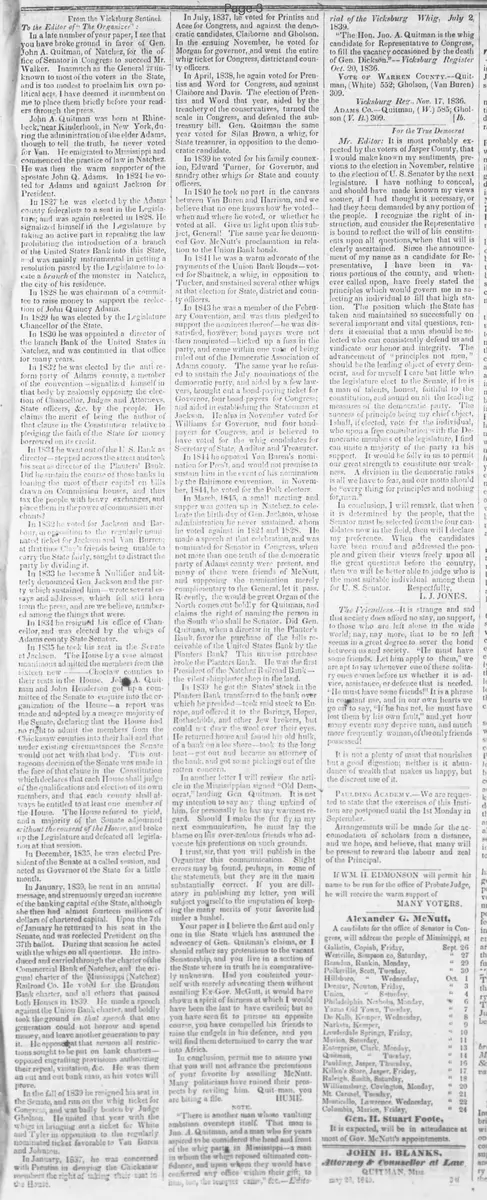
To the Editor of "The Organizer."
In a late number of your paper, I see that you have broke ground in favor of Gen. John A. Quitman, of Natchez, for the office of Senator in Congress to succeed Mr. Walker. Inasmuch as the General is known to most of the voters in the State, and is too modest to proclaim his own political acts, I have deemed it incumbent on me to place them briefly before your readers through the press.
John A. Quitman was born at Rhinebeck, near Kinderhook, in New York, during the administration of the elder Adams, though to tell the truth, he never voted for him. He emigrated to Mississippi and commenced the practice of law in Natchez. He was then the warm supporter of the apostate John Q. Adams. In 1824 he voted for Adams and against Jackson for President.
In 1827 he was elected by the Adams county federalists to a seat in the Legislature; and was again reelected in 1828. He signalized himself in the Legislature by taking an active part in repealing the law prohibiting the introduction of a branch of the United States Bank into this State, and was mainly instrumental in getting a resolution passed by the Legislature to locate a branch of the monster in Natchez, the city of his residence.
In 1828 he was chairman of a committee to raise money to support the reelection of John Quincy Adams.
In 1829 he was elected by the Legislature Chancellor of the State.
In 1830 he was appointed a director of the branch Bank of the United States in Natchez, and was continued in that office for many years.
In 1832 he was elected by the anti-reform party of Adams county, a member of the convention—signalized himself in that body by zealously opposing the election of Chancellor, Judges and Attorneys, State officers, &c. by the people. He claims the merit of being the author of that clause in the Constitution relative to pledging the faith of the State for money borrowed on its credit.
In 1834 he went out of the U. S. Bank as director—stepped across the street and took his seat as director of the Planters' Bank. Did he sustain the course of those banks in loaning the most of their capital on bills drawn on Commission houses, and thus tax the people with heavy exchanges, and place them in the power of commission merchants?
In 1832 he voted for Jackson and Barbour, in opposition to the regularly nominated ticket for Jackson and Van Buren; at that time Clay's friends being unable to carry the State fairly, sought to distract the party by dividing it.
In 1833 he became a Nullifier and bitterly denounced Gen. Jackson and the party which sustained him—wrote several essays and addresses, which fell still born from the press, and are we believe, numbered among the things that were.
In 1834 he resigned his office of Chancellor, and was elected by the whigs of Adams county State Senator.
In 1835 he took his seat in the Senate at Jackson. The House by a vote almost unanimous admitted the members from the sixteen new Choctaw counties to their seats in the House. John A. Quitman and John Henderson got up a committee of the Senate to enquire into the organization of the House—a report was made and adopted by a meagre majority of the Senate, declaring that the House had no right to admit the members from the Chickasaw counties into their hall and that under existing circumstances the Senate would not act with that body. This outrageous decision of the Senate was made in the face of that clause in the Constitution which declares that each House shall judge of the qualifications and election of its own members, and that each county shall always be entitled to at least one member of the House. The House refused to yield, and a majority of the Senate adjourned without the consent of the House, and broke up the Legislature and defeated all legislation at that session.
In December, 1835, he was elected President of the Senate at a called session, and acted as Governor of the State for a little month.
In January, 1836, he sent in an annual message, and strenuously urged an increase of the banking capital of the State, although she then had almost fourteen millions of dollars of chartered capital. Upon the 7th of January he returned to his seat in the Senate, and was reelected President on the 37th ballot. During that session he acted with the whigs on all questions. He introduced and carried through the charter of the Commercial Bank of Natchez, and the original charter of the Mississippi (Natchez) Railroad Co. He voted for the Brandon Bank charter, and all others that passed both Houses in 1836. He made a speech against the Union Bank charter, and boldly took the ground in that speech that one generation could not borrow and spend money, and leave another generation to pay it. He opposed at that session all restrictions sought to be put on bank charters—opposed engrafting provisions authorizing their repeal, visitation, &c. He was then an out and out bank man, as his votes will prove.
In the fall of 1839 he resigned his seat in the Senate and run on the whig ticket for Congress, and was badly beaten by Judge Gholson. He united that year with the whigs in bringing out a ticket for White and Tyler in opposition to the regularly nominated ticket favorable to Van Buren and Johnson.
In January, 1837, he was concerned with Prentiss in denying the Chickasaw member the right of taking his seat in the House.
In July, 1837, he voted for Prentiss and Atee for Congress, and against the democratic candidates, Claiborne and Gholson.
In the ensuing November, he voted for Morgan for governor, and went the entire whig ticket for Congress, district and county officers.
In April, 1838, he again voted for Prentiss and Word for Congress, and against Claiborne and Davis. The election of Prentiss and Word that year, aided by the treachery of the conservatives, turned the scale in Congress, and defeated the sub-treasury bill. Gen. Quitman the same year voted for Silas Brown, a whig, for State treasurer, in opposition to the democratic candidate.
In 1839 he voted for his family connexion, Edward Turner, for Governor, and sundry other whigs for State and county officers.
In 1840 he took no part in the canvass between Van Buren and Harrison, and we believe that no one knows how he voted—when and where he voted, or whether he voted at all. Give us light upon this subject, General! The same year he denounced Gov. McNutt's proclamation in relation to the Union Bank bonds.
In 1841 he was a warm advocate of the payment of the Union Bank Bonds—voted for Shattuck, a whig, in opposition to Tucker, and sustained several other whigs at that election for State, district and county officers.
In 1843 he was a member of the February Convention, and was thus pledged to support the nominees thereof—he was dissatisfied, however; bond payers were not then nominated—kicked up a fuss in the party, and came within one vote of being ruled out of the Democratic Association of Adams county. The same year he refused to sustain the July nominations of the democratic party, and aided by a few lawyers, brought out a bond-paying ticket for Governor, four bond payers for Congress; and aided in establishing the Statesman at Jackson. He also in November voted for Williams for Governor, and four bond-payers for Congress, and is believed to have voted for the whig candidates for Secretary of State, Auditor and Treasurer.
In 1844 he opposed Van Buren's nomination for Pres't, and would not promise to sustain him in the event of his nomination by the Baltimore convention. In November, 1844, he voted for the Polk electors.
In March, 1845, a small meeting and supper was gotten up in Natchez, to celebrate the birth day of Gen. Jackson, whose administration he never sustained, whom he voted against in 1824 and 1828. He made a speech at that celebration, and was nominated for Senator in Congress, when not more than one-tenth of the democratic party of Adams county were present, and many of these were friends of McNutt, and supposing the nomination merely complimentary to the General, let it pass.
Recently, the would be great Organ of the North comes out boldly for Quitman, and claims the right of naming the person in the South who shall be Senator. Did Gen. Quitman, when a director in the Planters' Bank, favor the purchase of the bills receivable of the United States Bank by the Planters Bank? This unwise purchase broke the Planters Bank. He was the first President of the Natchez Railroad Bank—the vilest shinplaster shop in the land.
In 1836 he got the State's stock in the Planters Bank transferred to the bank over which he presided—took said stock to Europe, and offered it to the Barings, Hopes, Rothschilds, and other Jew brokers, but could not draw the wool over their eyes. He returned home and found his old hulk of a bank on a lee shore—took to the long boat—got out and became an attorney of the bank, and got some pickings out of the rotten concern.
In another letter I will review the article in the Mississippian signed "Old Democrat," lauding Gen. Quitman. It is not my intention to say anything unkind of him, for personally he has my warmest regard. Should I make the fur fly in my next communication, he must lay the blame on his over-zealous friends who advocate his pretensions on such grounds.
I trust, sir, that you will publish in the Organizer this communication. Slight errors may be found, perhaps, in some of the statements but they are in the main substantially correct. If you are dilatory in publishing my letter, you will subject yourself to the imputation of keeping the many merits of your favorite hid under a bushel.
Your paper is I believe the first and only one in the State which has assumed the advocacy of Gen. Quitman's claims, or I should rather say pretensions to the vacant Senatorship, and you live in a section of the State where in truth he is comparatively unknown. Had you contented yourself with merely advocating him without assailing Ex-Gov. McNutt, it would have shown a spirit of fairness at which I would have been the last to have caviled; but as you have seen fit to pursue an opposite course, you have compelled his friends to raise the cudgels in his defence, and you will find them determined to carry the war into Africa.
In conclusion, permit me to assure you that you will not advance the pretensions of your favorite by assailing McNutt. Many politicians have ruined their prospects by reviling him. Quitman, you are biting a file.
HUME.
NOTE.
"There is another man whose vaulting ambition overleaps itself. That man is Jno. A. Quitman, and a man who for years aspired to be considered the head and front of the whig party in Mississippi—a man in whom the whigs reposed unlimited confidence, and upon whom they would have conferred any office within their gift; to him, too, the cap fits," &c.—Editorial of the Vicksburg Whig: July 2, 1839.
"The Hon. Jno. A. Quitman is the whig candidate for Representative to Congress, to fill the vacancy occasioned by the death of Gen. Dickson."—Vicksburg Register, Oct. 20, 1836.
VOTE OF WARREN COUNTY.—Quitman, (White) 552; Gholson, (Van Buren) 309.
Vicksburg Reg., Nov. 17, 1836.
ADAMS Co.—Quitman, (W.) 585; Gholson (V. B.) 309.
[Ib.
What sub-type of article is it?
What themes does it cover?
What keywords are associated?
What entities or persons were involved?
Letter to Editor Details
Author
Hume
Recipient
To The Editor Of "The Organizer."
Main Argument
gen. john a. quitman is unfit for u.s. senator due to his long history of political inconsistency, including early federalist support, whig affiliations, advocacy for banks, opposition to democratic reforms, and involvement in bond-paying controversies that contradict party principles.
Notable Details