Thank you for visiting SNEWPapers!
Sign up free
Alexandria Daily Gazette, Commercial & Political
Alexandria, Virginia
What is this article about?
British Minister Augustus J. Foster's letter to U.S. Secretary of State James Monroe on July 24, 1811, acknowledges Monroe's denial of orders authorizing Commodore Rodgers to attack HMS Little Belt, demands an inquiry into Rodgers' conduct for the unprovoked attack, regrets linking it to impressment and Chesapeake issues, and notes suspension of further Chesapeake reparations.
Clipping
OCR Quality
Full Text
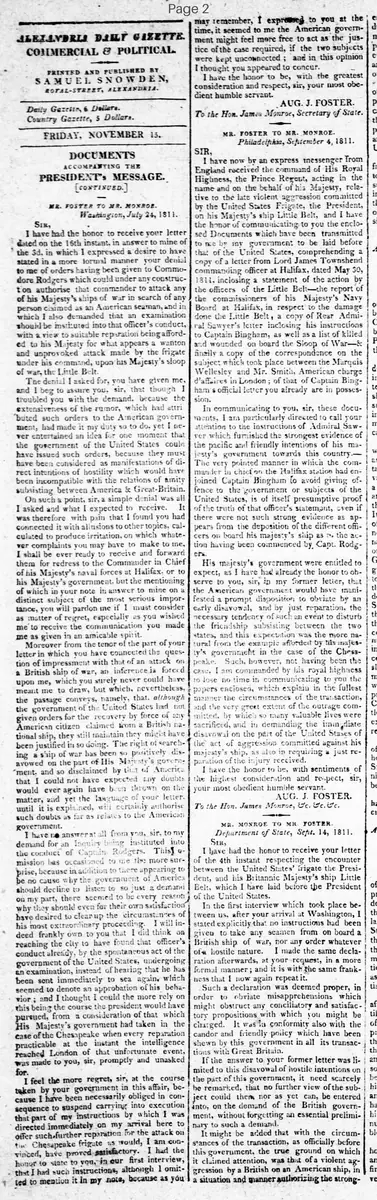
Washington, July 24, 1811.
SIR,
I have had the honor to receive your letter dated on the 16th instant, in answer to mine of the 3d. in which I expressed a desire to have stated in a more formal manner your denial to me of orders having been given to Commodore Rodgers which could under any construction authorize that commander to attack any of his Majesty's ships of war in search of any person claimed as an American seaman, and in which I also demanded that an examination should be instituted into that officer's conduct, with a view to suitable reparation being afforded to his Majesty for what appears a wanton and unprovoked attack made by the frigate under his command, upon his Majesty's sloop of war, the Little Belt.
The denial I asked for, you have given me, and I beg to assure you, sir, that though I troubled you with the demand, because the extensiveness of the rumor, which had attributed such orders to the American government, had made it my duty so to do, yet I never entertained an idea for one moment that the government of the United States could have issued such orders, because they must have been considered as manifestations of direct intentions of hostility which would have been incompatible with the relations of amity subsisting between America & Great-Britain.
On such a point, sir, a simple denial was all I asked and what I expected to receive. It was therefore with pain that I found you had connected it with allusions to other topics, calculated to produce irritation, on which whatever complaints you may have to make to me, I shall be ever ready to receive and forward them for redress to the Commander in Chief of his Majesty's naval forces at Halifax, or to his Majesty's government, but the mentioning of which in your note in answer to mine on a distinct subject of the most serious importance, you will pardon me if I must consider as matter of regret, especially as you wished me 'to receive the communication you made me as given in an amicable spirit.'
Moreover from the tenor of the part of your letter in which you have connected the question of impressment with that of an attack on a British ship of war, an inference is forced upon me, which you surely never could have meant me to draw, but which, nevertheless, the passage conveys, namely, that, although the government of the United States had not given orders for the recovery by force of any American citizen claimed from a British national ship, they still maintain they might have been justified in so doing. The right of searching a ship of war has been so positively disavowed on the part of His Majesty's government, and so disclaimed by that of America that I could not have expected any doubts would ever again have been thrown on the matter, and yet the language of your letter, until it is explained, will certainly authorize such doubts as far as relates to the American government.
I have no answer at all from you, sir, to my demand for an enquiry being instituted into the conduct of Captain Rodgers. This omission has occasioned to me the more surprise, because in addition to there appearing to be no cause why the government of America should decline to listen to so just a demand on my part, there seemed to be every reason why they should even for their own satisfaction have desired to clear up the circumstances of his most extraordinary proceeding. I will indeed frankly own to you that I did think on reaching the city to have found that officer's conduct already, by the spontaneous act of the government of the United States, undergoing an examination, instead of hearing that he has been sent immediately to sea again, which seemed to denote an approbation of his behavior; and I thought I could the more rely on this being the course the president would have pursued, from a consideration of that which His Majesty's government had taken in the case of the Chesapeake when every reparation practicable at the instant the intelligence reached London of that unfortunate event, was made to you, sir, promptly and unasked for.
I feel the more regret, sir, at the course taken by your government in this affair, because I have been necessarily obliged in consequence to suspend carrying into execution that part of my instructions by which I was directed immediately on my arrival here to offer such further reparation, for the attack on the Chesapeake frigate as would, I am convinced, have proved satisfactory. I had the honor to state to you, in our first interview, that I had such instructions, although I omitted to mention it in my note, because as you may remember, I expressed to you at the time, it seemed to me the American government might feel more free to act as the justice of the case required, if the two subjects were kept unconnected; and in this opinion I thought you appeared to concur.
I have the honor to be, with the greatest consideration and respect, sir, your most obedient humble servant.
AUG. J. FOSTER.
To the Hon. James Monroe, Secretary of State.
What sub-type of article is it?
What keywords are associated?
What entities or persons were involved?
Where did it happen?
Foreign News Details
Primary Location
Washington
Event Date
July 24, 1811
Key Persons
Outcome
denial of orders for attack on british ships; demand for investigation into commodore rodgers' conduct regarding the attack on hms little belt; suspension of further reparations for the chesapeake incident due to lack of response.
Event Details
British Minister Foster acknowledges U.S. denial of orders to Commodore Rodgers authorizing attacks on British warships for seamen recovery. He demands an inquiry into Rodgers' unprovoked attack on HMS Little Belt and expresses regret over Monroe linking the issue to impressment and Chesapeake, leading to suspension of additional Chesapeake reparations.