Thank you for visiting SNEWPapers!
Sign up free
Literary
February 27, 1822
The Hillsborough Recorder
Hillsboro, Orange County, North Carolina
What is this article about?
An essay advocating for nurturing children's natural curiosity as the foundation of intellectual growth, criticizing parents and teachers who suppress it, and warning of the risks of misinformation if inquiries are ignored.
Clipping
OCR Quality
95%
Excellent
Full Text
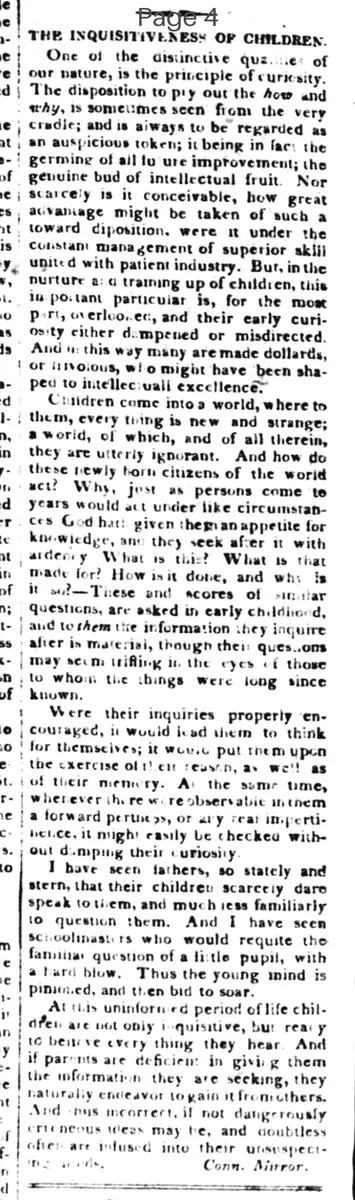
THE INQUISITIVENESS OF CHILDREN.
One of the distinctive qualities of our nature, is the principle of curiosity. The disposition to pry out the how and why, is sometimes seen from the very cradle; and is always to be regarded as an auspicious token; it being in fact the germ of all future improvement; the genuine bud of intellectual fruit. Nor scarcely is it conceivable, how great advantage might be taken of such a towardly disposition, were it under the constant management of superior skill united with patient industry. But, in the nurture and training up of children, this important particular is, for the most part, overlooked, and their early curiosity either dampened or misdirected. And in this way many are made dullards, or irrecoverable, who might have been shaped to intellectual excellence.
Children come into a world, where to them, every thing is new and strange; a world, of which, and of all therein, they are utterly ignorant. And how do these newly born citizens of the world act? Why, just as persons come to years would act under like circumstances. God has given them an appetite for knowledge, and they seek after it with ardency. What is this? What is that made for? How is it done, and why is it so?—These and scores of similar questions, are asked in early childhood, and to them the information they inquire after is material, though their questions may seem trifling in the eyes of those to whom the things were long since known.
Were their inquiries properly encouraged, it would lead them to think for themselves; it would put them upon the exercise of their reason, as well as of their memory. At the same time, wherever there were observable in them a forward pertness, or any real impertinence, it might easily be checked without dampening their curiosity.
I have seen fathers, so stately and stern, that their children scarcely dare speak to them, and much less familiarly to question them. And I have seen schoolmasters who would requite the natural, question of a little pupil, with a smart blow. Thus the young mind is pinioned, and then bid to soar.
At this uninformed period of life children are not only inquisitive, but ready to believe every thing they hear. And if parents are deficient in giving them the information they are seeking, they naturally endeavor to gain it from others. And thus incorrect, if not dangerously erroneous ideas may be, and doubtless often are, infused into their unsuspecting minds.
Conn. Mirror.
One of the distinctive qualities of our nature, is the principle of curiosity. The disposition to pry out the how and why, is sometimes seen from the very cradle; and is always to be regarded as an auspicious token; it being in fact the germ of all future improvement; the genuine bud of intellectual fruit. Nor scarcely is it conceivable, how great advantage might be taken of such a towardly disposition, were it under the constant management of superior skill united with patient industry. But, in the nurture and training up of children, this important particular is, for the most part, overlooked, and their early curiosity either dampened or misdirected. And in this way many are made dullards, or irrecoverable, who might have been shaped to intellectual excellence.
Children come into a world, where to them, every thing is new and strange; a world, of which, and of all therein, they are utterly ignorant. And how do these newly born citizens of the world act? Why, just as persons come to years would act under like circumstances. God has given them an appetite for knowledge, and they seek after it with ardency. What is this? What is that made for? How is it done, and why is it so?—These and scores of similar questions, are asked in early childhood, and to them the information they inquire after is material, though their questions may seem trifling in the eyes of those to whom the things were long since known.
Were their inquiries properly encouraged, it would lead them to think for themselves; it would put them upon the exercise of their reason, as well as of their memory. At the same time, wherever there were observable in them a forward pertness, or any real impertinence, it might easily be checked without dampening their curiosity.
I have seen fathers, so stately and stern, that their children scarcely dare speak to them, and much less familiarly to question them. And I have seen schoolmasters who would requite the natural, question of a little pupil, with a smart blow. Thus the young mind is pinioned, and then bid to soar.
At this uninformed period of life children are not only inquisitive, but ready to believe every thing they hear. And if parents are deficient in giving them the information they are seeking, they naturally endeavor to gain it from others. And thus incorrect, if not dangerously erroneous ideas may be, and doubtless often are, infused into their unsuspecting minds.
Conn. Mirror.
What sub-type of article is it?
Essay
What themes does it cover?
Moral Virtue
Social Manners
What keywords are associated?
Children
Curiosity
Inquisitiveness
Education
Nurture
Intellectual Growth
Parenting
Literary Details
Title
The Inquisitiveness Of Children.
Subject
On Nurturing Children's Curiosity
Key Lines
God Has Given Them An Appetite For Knowledge, And They Seek After It With Ardency. What Is This? What Is That Made For? How Is It Done, And Why Is It So?—These And Scores Of Similar Questions, Are Asked In Early Childhood...
Thus The Young Mind Is Pinioned, And Then Bid To Soar.
And Thus Incorrect, If Not Dangerously Erroneous Ideas May Be, And Doubtless Often Are, Infused Into Their Unsuspecting Minds.