Thank you for visiting SNEWPapers!
Sign up free
Smyrna Times
Smyrna, Kent County, Delaware
What is this article about?
University of Delaware agricultural engineer Ernest N. Scarborough advises farmers on protecting buildings from lightning via a free new USDA publication available from extension agents or USDA offices. Lightning causes over 400 deaths, 1,000 injuries annually in rural areas, plus livestock losses and fires.
Clipping
OCR Quality
Full Text
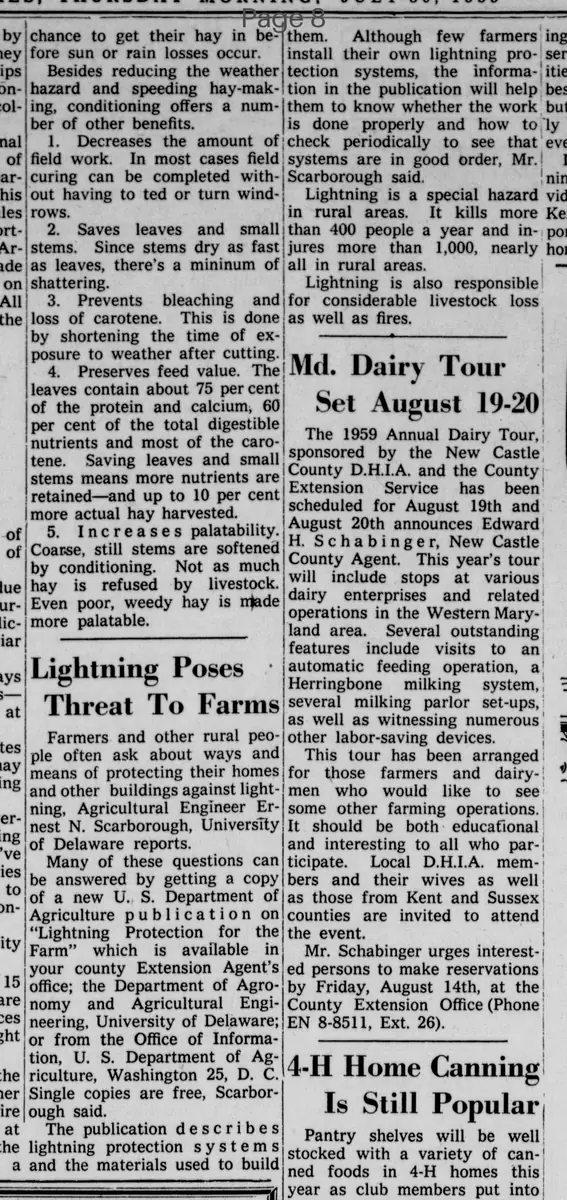
Farmers and other rural people often ask about ways and means of protecting their homes and other buildings against lightning, Agricultural Engineer Ernest N. Scarborough, University of Delaware reports.
Many of these questions can be answered by getting a copy of a new U. S. Department of Agriculture publication on "Lightning Protection for the Farm" which is available in your county Extension Agent's office; the Department of Agronomy and Agricultural Engineering, University of Delaware; or from the Office of Information, U. S. Department of Agriculture, Washington 25, D. C.
Single copies are free, Scarborough said.
The publication describes lightning protection systems and the materials used to build them.
Although few farmers install their own lightning protection systems, the information in the publication will help them to know whether the work is done properly and how to check periodically to see that systems are in good order, Mr. Scarborough said.
Lightning is a special hazard in rural areas. It kills more than 400 people a year and injures more than 1,000, nearly all in rural areas.
Lightning is also responsible for considerable livestock loss as well as fires.
What sub-type of article is it?
What keywords are associated?
What entities or persons were involved?
Domestic News Details
Key Persons
Outcome
lightning kills more than 400 people a year and injures more than 1,000, nearly all in rural areas. lightning is also responsible for considerable livestock loss as well as fires.
Event Details
Farmers and other rural people often ask about ways and means of protecting their homes and other buildings against lightning, Agricultural Engineer Ernest N. Scarborough, University of Delaware reports. Many of these questions can be answered by getting a copy of a new U. S. Department of Agriculture publication on "Lightning Protection for the Farm" which is available in your county Extension Agent's office; the Department of Agronomy and Agricultural Engineering, University of Delaware; or from the Office of Information, U. S. Department of Agriculture, Washington 25, D. C. Single copies are free, Scarborough said. The publication describes lightning protection systems and the materials used to build them. Although few farmers install their own lightning protection systems, the information in the publication will help them to know whether the work is done properly and how to check periodically to see that systems are in good order, Mr. Scarborough said. Lightning is a special hazard in rural areas.