Thank you for visiting SNEWPapers!
Sign up free
Daily National Intelligencer
Washington, District Of Columbia
What is this article about?
In Richmond on Oct. 31, Judge Brockenbrough overruled a motion in Alexander Lithgow's case to challenge Grand Jury members for favor, citing legal precedents. Two directors were set aside from the jury, which then found three felony bills against Lithgow and one murder bill against King. A venue change motion is expected.
Clipping
OCR Quality
Full Text
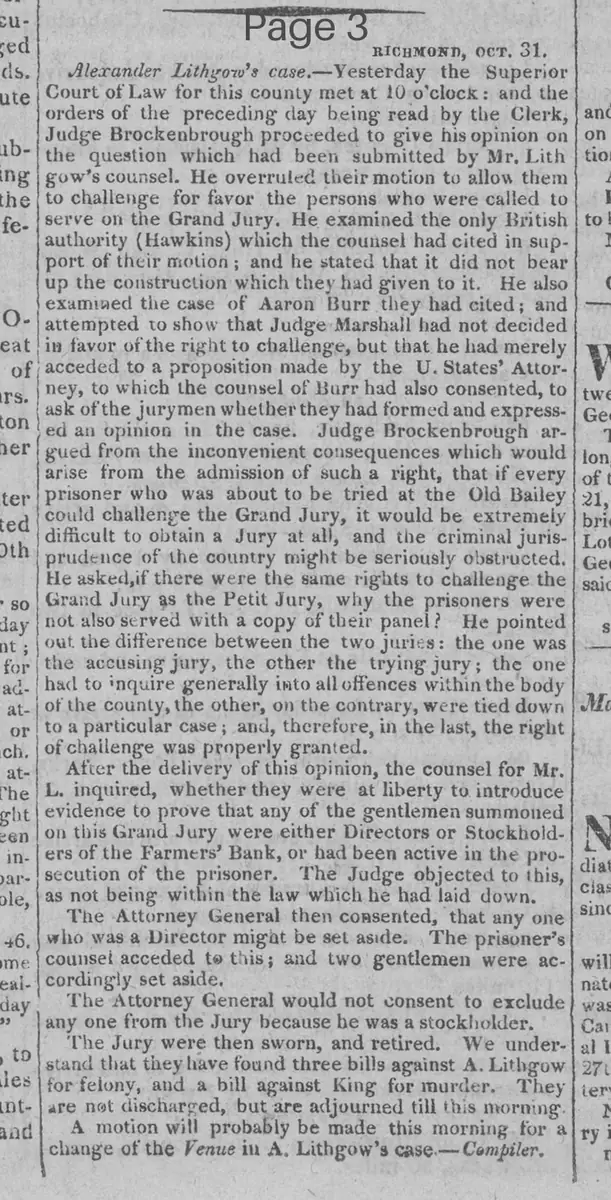
Alexander Lithgow's case.—Yesterday the Superior Court of Law for this county met at 10 o'clock: and the orders of the preceding day being read by the Clerk, Judge Brockenbrough proceeded to give his opinion on the question which had been submitted by Mr. Lithgow's counsel. He overruled their motion to allow them to challenge for favor the persons who were called to serve on the Grand Jury. He examined the only British authority (Hawkins) which the counsel had cited in support of their motion; and he stated that it did not bear up the construction which they had given to it. He also examined the case of Aaron Burr they had cited; and attempted to show that Judge Marshall had not decided in favor of the right to challenge, but that he had merely acceded to a proposition made by the U. States' Attorney, to which the counsel of Burr had also consented, to ask of the jurymen whether they had formed and expressed an opinion in the case. Judge Brockenbrough argued from the inconvenient consequences which would arise from the admission of such a right, that if every prisoner who was about to be tried at the Old Bailey could challenge the Grand Jury, it would be extremely difficult to obtain a Jury at all, and the criminal jurisprudence of the country might be seriously obstructed. He asked, if there were the same rights to challenge the Grand Jury as the Petit Jury, why the prisoners were not also served with a copy of their panel? He pointed out the difference between the two juries: the one was the accusing jury, the other the trying jury; the one had to inquire generally into all offences within the body of the county, the other, on the contrary, were tied down to a particular case; and, therefore, in the last, the right of challenge was properly granted.
After the delivery of this opinion, the counsel for Mr. L. inquired, whether they were at liberty to introduce evidence to prove that any of the gentlemen summoned on this Grand Jury were either Directors or Stockholders of the Farmers' Bank, or had been active in the prosecution of the prisoner. The Judge objected to this, as not being within the law which he had laid down. The Attorney General then consented, that any one who was a Director might be set aside. The prisoner's counsel acceded to this; and two gentlemen were accordingly set aside. The Attorney General would not consent to exclude any one from the Jury because he was a stockholder. The Jury were then sworn, and retired. We understand that they have found three bills against A. Lithgow for felony, and a bill against King for murder. They are not discharged, but are adjourned till this morning. A motion will probably be made this morning for a change of the Venue in A. Lithgow's case.—Compiler.
What sub-type of article is it?
What keywords are associated?
What entities or persons were involved?
Where did it happen?
Domestic News Details
Primary Location
Richmond
Event Date
Oct. 31.
Key Persons
Outcome
motion to challenge grand jury overruled; two directors set aside; jury found three felony bills against lithgow and one murder bill against king; jury adjourned; motion for change of venue expected.
Event Details
Superior Court met; Judge Brockenbrough overruled motion to challenge Grand Jury for favor, citing precedents from Hawkins and Aaron Burr case; argued differences between Grand and Petit Juries; counsel inquired about introducing evidence on jurors' connections to Farmers' Bank; Attorney General consented to set aside directors; two set aside; stockholders not excluded; jury sworn and found bills; adjourned till morning.